Question
The $Mn^{3+}$ ion is unstable in solution and undergoes disproportionation to give $Mn^{2+}, MnO_2,$ and $H^+$ ion. Write a balanced ionic equation for the reaction.

Answer

The given reaction can be represented as: $\text{Mn}_{(\text{aq})}^{3+}\rightarrow\text{Mn}_{(\text{aq})}^{2+}+\text{MnO}_{2(\text{s})}+\text{H}_{(\text{aq})}^+$ The oxidation half equation is: $\stackrel{{+3}}{\ \ \ \ \ \ \ \hbox{Mn}^{3+}}_{(\text{aq})}\rightarrow\stackrel{{+4}}{\ \ \ \ \ \ \ \hbox{MnO}}_{2(\text{s})}$ The oxidation number is balanced by adding one electron as: $\text{Mn}_{(\text{aq})}^{3+}\rightarrow\text{MnO}_{2(\text{s})}+\text{e}^{-}$ The charge is balanced by adding $4H^+$^ ions as: $\text{Mn}_{(\text{aq})}^{3+}\rightarrow\text{MnO}_{2(\text{s})}+4\text{H}_{(\text{aq})}^++\text{e}^{-}$ The O atoms and H^+ ions are balanced by adding $2H_2O$ molecules as: $\text{Mn}_{(\text{aq})}^{3+}+2\text{H}_2\text{O}_{(\text{l})}\rightarrow\text{MnO}_{2(\text{s})}+4\text{H}_{(\text{aq})}^++\text{e}^{-}\ .....(\text{i})$ The reduction half equation is: $\text{Mn}^{3+}_{(\text{aq})}\rightarrow\text{Mn}^{2+}_{(\text{aq})}$ The oxidation number is balanced by adding one electron as: $\text{Mn}^{3+}_{(\text{aq})}+\text{e}^-\rightarrow\text{Mn}^{2+}_{(\text{aq})}\ .....(\text{ii})$The balanced chemical equation can be obtained by adding equation (i) and (ii) as:
$2\text{Mn}_{(\text{aq})}^{3+}+2\text{H}_2\text{O}_{(\text{l})}\rightarrow\text{MnO}_{2(\text{s})}+2\text{Mn}^{2+}_{(\text{aq})}+4\text{H}^{+}_{(\text{aq})}$

Need a full question paper?

Generate a complete, print-ready paper with questions like this in minutes — across 16+ boards, with answer keys.
Start Generating Free

Similar questions

  1. Define standard enthalpy of formation. Explain why the enthalpy changes for the reaction given below are not enthalpies of formation of $CaCO_3$ and HBr:
  1. $\text{CaO(s)}+\text{CO}_2(\text{g})\overrightarrow{\ \ \ \ \ \ \ \ }\ \text{CaCO}_3(\text{s});$ $\Delta_\text{r}\text{H}^\circ=-178.3\text{kJ mol}^{-1}$
  2. $\text{H}_2(\text{g})+\text{Br}_2(\text{g})\overrightarrow{\ \ \ \ \ \ \ }\ 2\text{HBr(g)};$ $\Delta_\text{r}\text{H}^\circ=-72.8\text{kJ mol}^{-1}$
  1. Use the bond enthalpies listed below to determine the enthalpy of reaction:
$\ \ \ \ \ \ \ \ \text{H}\\ \ \ \ \ \ \ \ \ \ |\\\text{H}-\text{C}-\text{H(g)}+2\text{O}=\text{O(g)}\overrightarrow{\ \ \ \ \ }\ \text{O}=\text{C}=\text{O(g)}\\ \ \ \ \ \ \ \ \ \ |\\ \ \ \ \ \ \ \ \ \text{H}\\+2\text{H}-\text{O}-\text{H(g)}$

Bond enthalpy $(\Delta\text{H}^\circ)/\text{kJ mol}^{-1}$ of C=O = 741; C-H = 414; H-O = 464; O=O = 498.
What is called electrovalent bond? Describe the circumstances necessary for the formation of ionic bond.
Discuss the trend of the following:
Thermal stability of carbonates of Group 2 elements.
Attempt any five of the following:
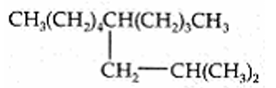
1. What is electrophile in sulphonation?
2. Write IUPAC name of following:
Image
3. Write IUPAC name: $CH _3 CH - C \left( CH _3\right)_2$
4. Methane does not react with chlorine in dark. Why?
5. How would you convert ethene to ethane molecule?
6. What is Huckel rule?
7. What is decarboxylation? Give an example.
Attempt any five of the following:
1. Why does the iodination of benzene is carried out in the presence of nitric acid or iodic acid?
2. Can a catalyst change the position of equilibrium in a reaction?
3. Why is benzene extraordinarily stable though it contains three double bonds?
4. Bring out the following conversion ethane to ethene.
5. Why are alkanes called paraffins?
6. Draw the New man's projection formula of the staggered form of 1,2-dichloroethane.
7. Give the IUPAC name of the lowest molecular weight alkane that contains a quaternary carbon.
The ionization constant of nitrous acid is $4.5 \times 10^{–4}$. Calculate the pH of $0.04M$ sodium nitrite solution and also its degree of hydrolysis.
Explain the effect of pressure, temperature, addition of catalyst and inert gas on the equilibrium of reversible reaction.
Explain the oxidation number method to balance the redox reaction with explain.
Write short note on ionisation constant and ionic product of water.
The ionization constant of dimethylamine is $5.4 \times 10^{–4}$​​​​​​​. Calculate its degree of ionization in its $0.02M$ solution. What percentage of dimethylamine is ionized if the solution is also $0.1M$ in NaOH?