Question
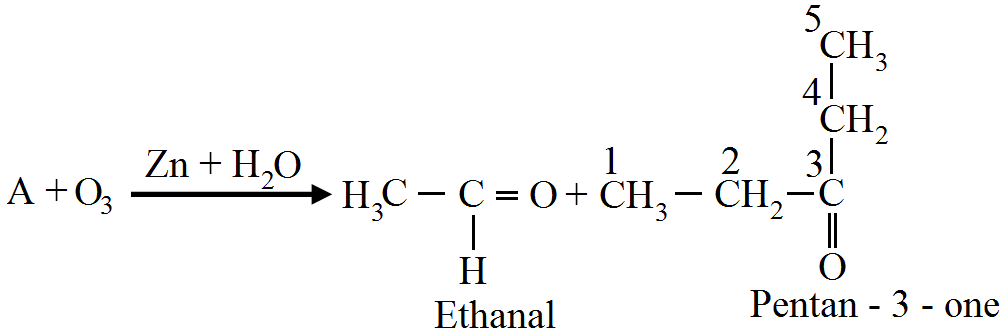
An alkene 'A' on ozonolysis gives a mixture of ethanal and pentan-3-one. Write structure and IUPAC name of 'A'.
Answer


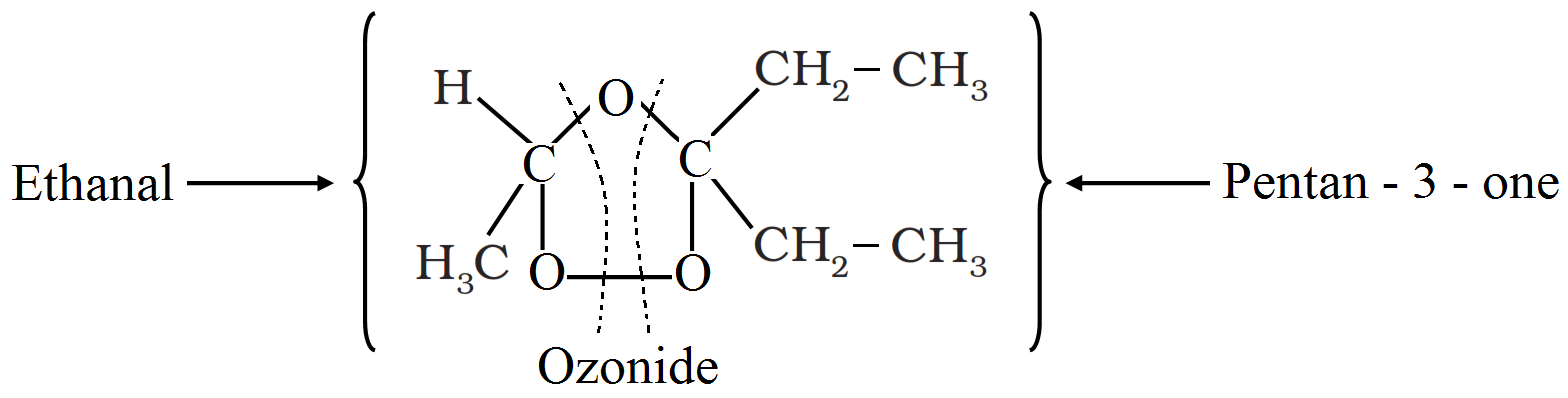
During ozonolysis, an ozonide having a cyclic structure is formed as an intermediate which undergoes cleavage to give the final products. Ethanal and pentan-3-one are obtained from the intermediate ozonide. Hence, the expected structure of the ozonide is:

This ozonide is formed as an addition of ozone to 'A'. The desired structure of ‘A’ can be obtained by the removal of ozone from the ozonide. Hence, the structural formula of 'A' is:
$\text{H}_3\stackrel{1}{\hbox{C}}-\stackrel{2}{\hbox{C}}\text{H}=\stackrel{3}{\hbox{C}}-\stackrel{4}{\hbox{C}}\text{H}_2-\stackrel{5}{\hbox{C}}\text{H}_3\\\ \ \ \ \ \ \ \ \ \ \ \ \ \ \ \ \ \ \ \ \ \ \ \ \ \ |\\\ \ \ \ \ \ \ \ \ \ \ \ \ \ \ \ \ \ \ \ \ \ \ \ \text{CH}_2-\text{CH}_3$
The IUPAC name of 'A' is 3-Ethylpent-2-ene.

Need a full question paper?

Generate a complete, print-ready paper with questions like this in minutes — across 16+ boards, with answer keys.
Start Generating Free

Similar questions

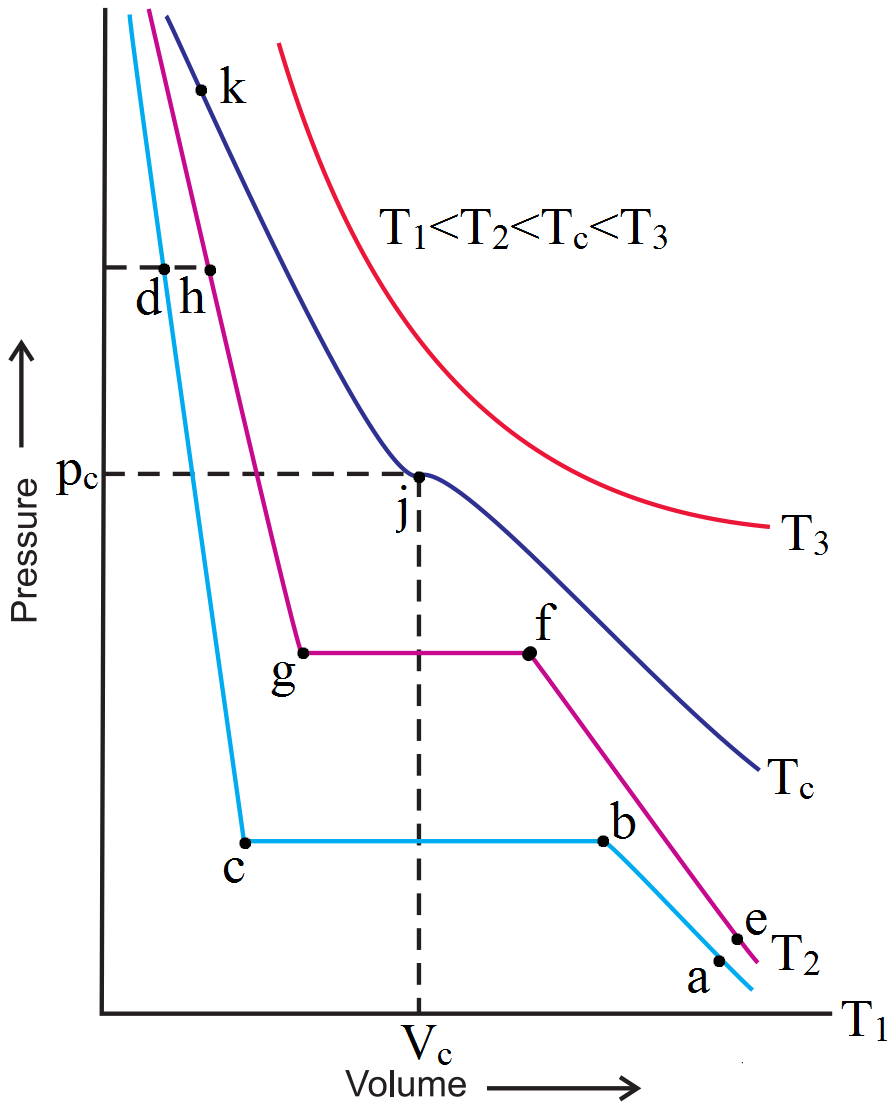
Isotherms of carbon dioxide at various temperatures are represented in the figure. Answer the following questions based on the figure.

i. In which state will $CO _2$ exist between the points a and b at temperature $T _1$ ?
ii. At what point will $CO _2$ start liquefying when temperature is $T _1$ ?
iii. At what point will $CO _2$ be completely liquefied when temperature is $T _2$ ?
iv. Will condensation take place when the temperature is $T_3$ ?
v. What portion of the isotherm at $T _1$ represent liquid and gaseous $CO _2$ at equilibrium?
  1. $\text{Cu}|\text{Cu}^{2+}(1\text{M})||\text{Ag}^+(1\text{M})|\text{Ag}$
$\text{E}^0_\frac{\text{Cu}^{2+}}{\text{Cu}}=0.34\text{V}$

$\text{E}^0_\frac{\text{Ag}^+}{\text{Ag}}=+0.80\text{V}$
  1. Write reaction at anode and cathode.
  2. Write net cell reaction.
  3. Calculate e.m.f. of the cell.
  1. What is meant by E.M.F of cell? How is it measured?
1. Write all structural isomers of molecular formula $C _3 H _6 O$
2. Write resonance structures of $CH _3 COO ^{-}$and show the movement of electrons by curved arrows.
  1. Write chemical equations when:
  1. Borax is heated strongly.
  2. Aluminium is treated with dilute NaOH.
  3. Dimethyldichlorosilane is hydrolysed followed by condensation polymeri-sation.
  1.  
  1. Explain that $CO_2$ is a gas while $SiO_2$ is solid at room temperature.
  2. $SnCl_2$​​​​​​​ acts as reducing agent. Explain.
Calculate the oxidation number of sulphur, chromium and nitrogen in $H_2SO_5$, $\text{Cr}_2\text{O}^{2-}_7$ and $\text{NO}^{-}_3.$ Suggest structure of these compounds. Count for the fallacy.
Derive the formula to find the ionization constant of weak acids and bases and how will you obtain the value of [H] to find their pH?
Calculate the degree of ionization of 0.05 M acetic acid if its $pK _{ a }$ value is 4.74 . How is the degree of dissociation affected when its solution also contains
a. 0.01 M
b. 0.1 M HCl ?
Dihydrogen gas used in Haber’s process is produced by reacting methane from natural gas with high temperature steam. The first stage of two stage reaction involves the formation of CO and $H_2$. In second stage, CO formed in first stage is reacted with more steam in water gas shift reaction,
$\text{CO (g) + H}_2\text{O (g)}\rightleftharpoons\text{CO}_2\text{ (g) + H}_2\text{ (g)}$
If a reaction vessel at 400°C is charged with an equimolar mixture of CO and steam such that $\text{p}_\text{co}=\text{p}_{\text{H}_2\text{O}}=4.0$bar, what will be the partial pressure of $H_2$ at equilibrium?$\text{K}_\text{p}=10.1\text{ at }400^\circ\text{C}$
The first ionization enthalpy values (in $\mathrm{kJ} \mathrm{~mol}^{-1}$ ) of group 13 elements are:
B Al Ga In Tl
801 577 579 558 589
How would you explain this deviation from the general trend?
Explain the nomenclature of organic compounds by common name system with examples.