Question
Why don't we have interference when two candles are placed close to each other and the intensity is seen at a distant screen? What happens if the candles are replaced by laser sources?

Answer

In order to get interference, the sources should be coherent, i.e. they should emit wave of the same frequency and a stable phase difference. Two candles that are placed close to each other are distinct and cannot be considered as coherent sources. Two independent sources cannot be coherent. So, two different laser sources will also not serve the purpose.

Need a full question paper?

Generate a complete, print-ready paper with questions like this in minutes — across 16+ boards, with answer keys.
Start Generating Free

Similar questions

A plumb bob is hung from the ceiling of a train compartment. If the train moves with an acceleration 'a' along a straight horizontal track, the string supporting the bob makes an angle $\tan^{-1}\Big(\frac{\text{a}}{\text{g}}\Big)$ with the normal to the ceiling. Suppose the train moves on an inclined straight track with uniform velocity. If the angle of incline is $\tan^{-1}\Big(\frac{\text{a}}{\text{g}}\Big),$ the string again makes the same angle with the normal to the ceiling. Can a person sitting inside the compartment tell by looking at the plumb line whether the train is accelerated on a horizontal straight track or it is going on an incline? If yes, how? If no, suggest a method to do so.
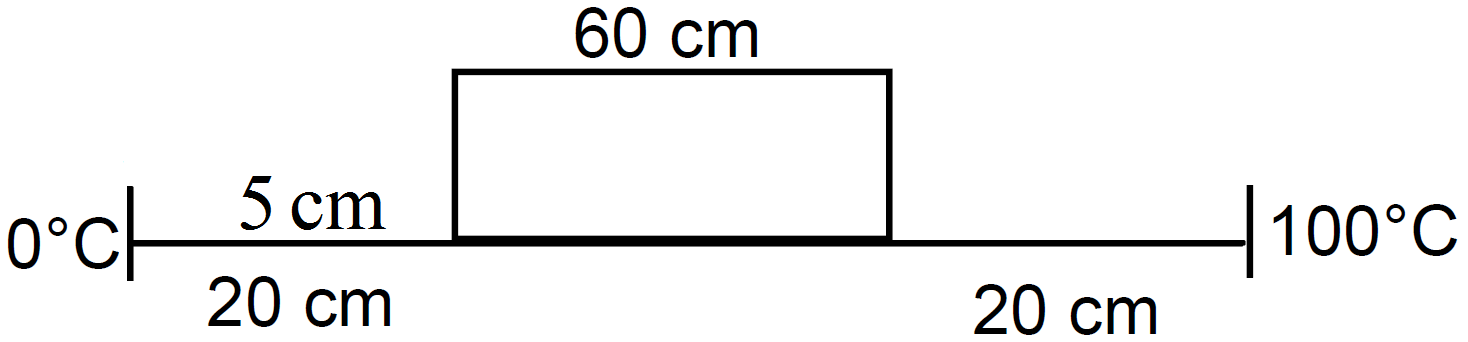
Consider the situation shown in figure. The frame is made of the same material and has a uniform cross$-$sectional area everywhere. Calculate the amount of heat flowing per second through a cross section of the bent part if the total heat taken out per second from the end at $100^\circ C$ is $130J.$​​​​​​​
Explain diffraction by a single slit and write down the conditions for central maximum, secondary maxima and minima.
Two point charges $5 \mu C$ and $-5 \mu C$ are kept at a distance of 1 cm from each other. Calculate the intensity of the electric field at a distance of 0.30 cm from mid-point (i) in the axial position, (ii) in neutral position.
When some wax is rubbed on a cloth, it becomes waterproof. Explain.
A bar magnet makes 40 oscillations per minute in an oscillation magnetometer. An identical magnet is demagnetized completely and is placed over the magnet in the magnetometer. Find the time taken for 40 oscillations by this combination. Neglect any induced magnetism.
If the earth's magnetic field has a magnitude $3.4 \times 10^{-5} T$ at the magnetic equator of the earth what would be its value at the earth's geomagnetic poles?
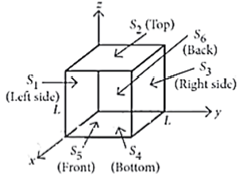
Net electric flux through a cube is the sum of fluxes through its six faces. Consider a cube as shown in figure, having sides of length $L =10.0 \ cm$. The electric field is uniform, has a magnitude $E =4.00 \times 10^3\ NC ^{-1}$ and is parallel to the $xy$ plane at an angle of $37^{\circ}$ measured from the $+ x -$axis towards the $+ y -$axis.
Image
$(i)$ Electric flux passing through surface $S_6$ is
$(a)\ -24 Nm ^2 C ^{-1}$
$(b)\ 32 Nm ^2 C ^{-1}$
$(c)\ -32 Nm ^2 C ^{-1}$
$(d)\ 24 Nm ^2 C ^{-1}$
$(ii)$ Electric flux passing through surface $S_1$ is
$(a)\ -32\  Nm ^2 C ^{-1}$
$(b)\ -24 \ Nm ^2 C ^{-1}$
$(c)\ 32 \ Nm ^2 C ^{-1}$
$(d)\ 24 \ Nm ^2 C ^{-1}$
$(iii)$ The surfaces that have zero flux are
$(a)\ S _2$ and $S _4$
$(b)\ S_3$ and $S_6$
$(c)\ S _1$ and $S _2$
$(d)\ S _1$ and $S _3$
$(iv)$ he total net electric flux through all faces of the cube is $(a)24\ Nm 2 C-1 (c)-8\ Nm2 C-1 b$
$(a)\ 24\ Nm ^2 C ^{-1}$
$(b)\ 8\ Nm ^2 C ^{-1}$
$(c)\ -8\ Nm ^2 C ^{-1}$
$(d)$ zero
$OR$
The dimensional formula of surface integral $\oint \vec{E} \cdot d \vec{S}$ of an electric field is
$(a)\ \left[ M ^{-1} L^3 T^{-3} A\right]$
$(b)\ \left[ M L ^2 T^{-2} A^{-1}\right]$
$(c) \ \left[ ML ^3 T^{-3} A^{-1}\right]$
$(d)\ \left[ M L ^{-3} T^{-3} A^{-1}\right]$
When subatomic particles undergo reactions, energy is conserved, but mass is not necessarily conserved. However, a particle's mass “contributes” to its total energy, in accordance with Einstein's famous equation $, E = mc^2$ In this equation $, E$ denotes the energy carried by a particle because of its mass. The particle can also have additional energy due to its motion and its interactions with other particles. Consider a neutron at rest and well separated from other particles. It decays into a proton, an electron and an undetected third particle as given here : Neutron $\rightarrow$ proton $+$ electron $+$ ??? The given table summarizes some data from a single neutron decay. Electron volt is a unit of energy. Column $2$ shows the rest mass of the particle times the speed of light squared.
Particle
Mass $\times c^2 (MeV)$
Kinetic energy $(MeV)$
Neutron
$940.97$ $0.00$
Proton
$939.67$ $0.01$
Electron
$0.51$ $0.39$
  1. From the given table, which properties of the undetected third particle can be calculate?
  1. Total energy, but not kinetic energy.
  2. Kinetic energy, but not total energy.
  3. Both total energy and kinetic energy.
  4. Neither total energy nor kinetic energy.
  1. Assuming the table contains no major errors, what can we conclude about the $($mass $\ \times c^2)$ of the undetected third particle?
  1. It is $0. 79 MeV$
  2. It is $0.39 MeV$
  3. It is less than or equal to $0.79 MeV$ ; but we cannot be more precise.
  4. It is less than or equal to $0.40 MeV$ ; but we cannot be more precise.
  1. Could this reaction occur?
Proton $\rightarrow$ neutron $+$ other particles
  1. Yes, if the other particles have much more kinetic energy than mass energy.
  2. Yes, but only if the proton has potential energy $($due to interactions with other particles$)$.
  3. No, because a neutron is more massive than a proton.
  4. No, because a proton is positively charged while a neutron is electrically neutral.
  1. How much mass has to be converted into energy to produce electric power of $500MW$ for one
  1. hour?
  1. $2 \times 10^{-5}kg$
  2. $1 \times 10^{-5}kg$
  3. $3 \times 10^{-5}kg$
  4. $4 \times 10^{-5}kg$
  1. The equivalent energy of $1g$ of substance is.
  1. $9 \times 10^{13}J$
  2. $6 \times 10^{12}J$
  3. $3 \times 10^{13}J$
  4. $6 \times 10^{13}J$
Write the equation of average power for $L - C - R$ series $AC$ circuit and discuss its special cases.