Question
Why is an amide more acidic than an amine?

Answer

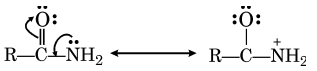
Amides are more acidic than amines because of the presence of lone pair of electron on N -atom of $- NH _2$ group. But this lone pair of electrons is involved in resonance as shown below :
Image
Due to $+R$ effect availability of lone pair of electrons of N of $- NH _2$ group decreases. As a result acid amide is much weaker base than amines. Because of the positive charge on N -atom as a result of resonance, N can lose easily a proton from N and behaves as a weak acid.

Need a full question paper?

Generate a complete, print-ready paper with questions like this in minutes — across 16+ boards, with answer keys.
Start Generating Free

Similar questions

The rate constant for a first order reaction is $60s^{-1}.$ How much time will it take to reduce the concentration of the reactant $\frac{1}{10}$th its initial value?
Explain magnetic properties of transition element.
Boiling point of water at $750\ mm$ Hg is $99.63^\circ C.$ How much sucrose is to be added to $500\ g$ of water such that it boils at $100^\circ C.$
Iron has a body centred unit cell with a cell edge of 286.6 pm. The density of iron is 7.87 g $ cm^{-3} $ Use these information to calculate Avogadro's number. (Atomic weight of Fe, 56 g $ mol^{-1} $)
Explain the following reaction of $C _2 H _5 OH$ :
(a) Schotten Baumann reaction
(b) Reaction with concen. $HNO _3$
(c) Reaction with excess of $NH _3$
(d) Reduction with Red P and HI
How would you account for the following:
  1. The transition elements have high enthalpies of atomisation.
  2. The transition metals and their compounds are found to be good catalysts in many processes.
(a) Out of t-butyl alcohol and n-butanol, which one will undergo acid catalysed dehydration faster and why?
(b) Carry out the following conversions :
(i) Phenol to Salicylaldehyde
(ii) t-butylchloride to t-butyl ethyl ether
(iii) Propene to Propanol
  1. Draw the pyranose structure of glucose.
  2. What type of linkage is present in proteins?
  3. Give one example each for water-soluble vitamins and fat-soluble vitamins.
Which one of the following has the highest dipole moment?
(i) $CH _2 Cl _2$, (ii) $CHCl _3$, (iii) $CCl _4$
(i) Out of $\left( CH _3\right)_3 C - Br$ and $\left( CH _3\right)_3 C - I$, which one is more reactive towards $S_N 1$ and why ?
(ii) Write the product formed when $p$-nitrochlorobenzene is heated with aqueous NaOH at 443 K followed by acidification.