Question
Why is it difficult for DNA to pass through cell membranes? How can E.coli cells be made competent and who developed this method?

Answer

DNA is a hydrophillic molecule so it is difficult to cross lipid molecules of membrane.
  • To make E. coli cells competent to take up DNA, they should be treated with divalent cations or calcium.
  • In 1970, Mandel and Higa found that E.coli cells become competent to take up DNA when they are suspended in cold calcium chloride.

Need a full question paper?

Generate a complete, print-ready paper with questions like this in minutes — across 16+ boards, with answer keys.

Start Generating Free

Similar questions

Explain co-evolution with reference to parasites and their hosts. Mention any four special adaptive features evolved in parasites for their parasitic mode of life.

OR

Explain parasitism and co-evolution with the help of one example of each.
Where is an operator' located in a prokaryotic DNA? How does an operator regulate gene expression at transcription level in a prokaryote? Explain.
What do you think is the significance of reproductive health in a society?
What way the advent of the birth-control pill have resulted in an increase in STDs?
Describe a biogas plant.
Which part of the blastula is destinated to form germ layers of the developing embryo in humans?
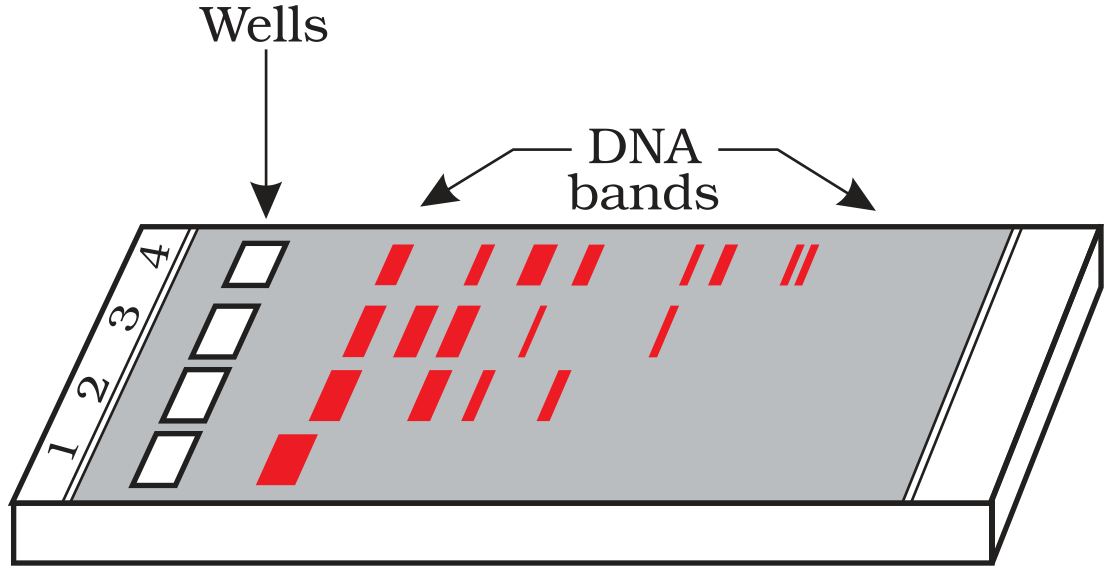
Rajesh was doing gel electrophoresis to purify DNA fragments. Given below is the sketch of the observations of the experiment performed by him.

  1. At which end he would have loaded the samples and where?
  2. Analyse the reason for different positions taken up by the DNA bands.
  3. Elaborate the step he would have followed to visualise DNA bands.
Name the pest that destroys the cotton bolls. Explain the role of Bacillus thuringiensis in protecting the cotton crop against the pest to increase the yield.
Water is very essential for life. Write any three features each for plants and animals, which enable them to survive in water scarce environment.
Identify 'a', 'b', 'c', 'd', 'e' and 'f' in the table given below:
No. Syndrome Cause Characteristics of affected individual Sex Male/Female/Both
1 Down’s Trisomy of 21
‘a’ (i)
(ii)
'b'
2 ‘c’ XXY Overall masculine development ‘d’
3 Turner’s 45 with OX
‘e’ (i)
(ii)
‘f’