Question
Why is it not possible to make permanent magnets from paramagnetic materials?

Answer

Permanent magnets are made from the material that are easily magnetized and retain the magnetization even reverse magnetizing field is applied (high coercivity). Paramagnetic materials get small magnetization, if they are placed in magnetic field, they lose their magnetization easily if the reverse field is applied. Hence, they are not used to make permanent magnet.

Need a full question paper?

Generate a complete, print-ready paper with questions like this in minutes — across 16+ boards, with answer keys.
Start Generating Free

Similar questions

A spherical shell made of plastic, contains a charge Q distributed uniformly over its surface. What is the electric field inside the shell? If the shell is hammered to deshape it without altering the charge, will the field inside be changed? What happens if the shell is made of a metal?
Calculate the number of states per cubic metre of sodium in $3s$ band. The density of sodium is $1013\ kg/ m^3$. How many of them are empty?
The horizontal component of earth’s magnetic field at a given place is $0.4 \times 10^{-4} Wb/m^2 $ and angle of dip is $30^\circ .$ Calculate the value of $(i)$ Vertical component $(ii)$ Total intensity of earth’s magnetic field.
The maximum speed and acceleration of a particle executing simple harmonic motion are $10\ cm/s$ and $50\ cm/s^2.$ Find the position$(s)$ of the particle when the speed is $8\ cm/s.$
A long straight wire of a circular cross-section of radius ‘a’ carries a steady current ‘I’. The current is uniformly distributed across the cross-section. Apply Ampere’s circuital law to calculate the magnetic field at a point ‘r’ in the region for (i) r < a and (ii) r > a.
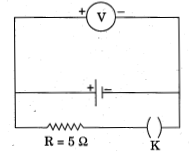
Write any two factors on which internal resistance of a cell depends. The reading on a high resistance voltmeter, when a cell is connected across it, is 2.2 V. When the terminals of the cell are also connected to a resistance of 5 Ω as shown in the circuit, the voltmeter reading drops to 1.8 V. Find the internal resistance of the cell.
A constant force of 2.50N accelerates a stationary particle of mass 15g through a displacement of 2.50m. Find the work done and the average power delivered.
The kinetic energy of a charged particle decreases by 10J as it moves from a point at potential 100V to a point at potential 200V. Find the charge on the particle.
Explain barrier potential of $p-n$ junction.
An electric bulb, when connected across a power supply of 220V, consumes a power of 60W. If the supply drops to 180V, what will be the power consumed? If the supply is suddenly increased to 240V, what will be the power consumed?