Question
Why is parallel arrangement used in domestic wiring?

Answer

Parallel arrangement is used in domestic wiring due to the following reasons:
  • Each device will have the same voltage which is equal to the voltage of the supply.
  • If two or more devices are used at the same time then, each appliance will be able to draw the required current.
  • If one of the devices fails then other keeps working.​​​​​​​

Need a full question paper?

Generate a complete, print-ready paper with questions like this in minutes — across 16+ boards, with answer keys.
Start Generating Free

Similar questions

A concave lens has a focal length of 20cm. At what distance from the lens a 5cm tall object be placed so that it forms an image at 15cm from the lens? Also calculate the size of the image formed.
List three ways in which the magnetic field strength of a current-carrying solenoid can be increased?
If the image formed by a lens for all positions of an object placed in front of it is always erect and diminished, what is the nature of this lens? Draw a ray diagram to justify your answer. If the numerical value of the power of this lens is 10 D, what is its focal length in the Cartesian system?
An object is 24cm away from a concave mirror and its image is 16cm from the mirror. Find the focal length and radius of curvature of the mirror, and the magnification of the image.
A large coal-fired power station produces 2000MW of electrical energy. A wind turbine with 33m blades can produce 300kW.
  1. How many turbines would be needed to replace the power station?
  2. Why, in actual practice, this number of turbines could not replace the coal-fired power station?
A concave lens of focal length 15 cm forms an image 10 cm from the lens. How far is the object placed from the lens? Draw the ray diagram.
An eye has a far point of 2m. What type of lens in spectacles would be needed to increase the far point to infinity? Also calculate the power of lens required. Is this eye long-sighted or short-sighted?
How does the resistance of a conductor depend on:
  1. Length of the conductor?
  2. Area of cross-section of the conductor?
  3. Temperature of the conductor?
Distinguish between a convex and a concave mirror.
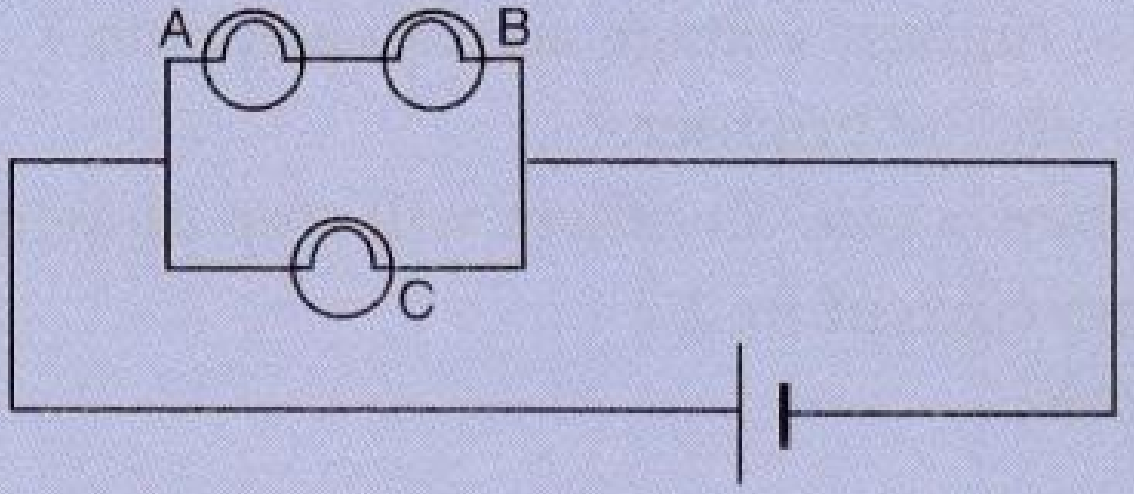
Consider the circuit given below where A, B and C are three identical light bulbs of constant resistance.

  1. List the bulbs in order of increasing brightness.
  2. If C burns out, what will be the brightness of A now compared with before?
  3. If B burns out instead, what will be the brightness of A and C compared with before?