Why it is more hotter for same distance over the top of a candle than it in the side of its flame?
Easy


Download our appand get started for free
Experience the future of education. Simply download our apps or reach out to us for more information. Let's shape the future of learning together!No signup needed.*
Similar Questions
- 1A body cools from ${60^o}C$ to ${50^o}C$ in $10$ minutes when kept in air at ${30^o}C$. In the next $10$ minutes its temperature will beView Solution
- 2A copper pipe of length $10 \,m$ carries steam at temperature $110^{\circ} C$. The outer surface of the pipe is maintained at a temperature $10^{\circ} C$. The inner and outer radii of the pipe are $2 \,cm$ and $4 \,cm$, respectively. The thermal conductivity of copper is $0.38 kW / m /{ }^{\circ} C$. In the steady state, the rate at which heat flows radially outward through the pipe is closest to ............. $\,kW$View Solution
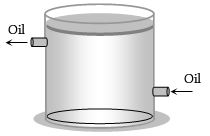
- 3The top of insulated cylindrical container is covered by a disc having emissivity $0.6$ and thickness $1\, cm$. The temperature is maintained by circulating oil as shown in figure. If temperature of upper surface of disc is $127^o C$ and temperature of surrounding is $27^o C$, then the radiation loss to the surroundings will be (Take $\sigma = \frac{{17}}{3} \times {10^{ - 8}}W/{m^2}{K^4})$View Solution
- 4View SolutionWhich of the following is best close to an ideal black body
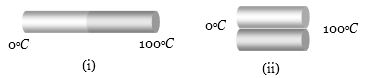
- 5Two identical square rods of metal are welded end to end as shown in figure $(i)$ , $20$ calories of heat flows through it in $4$ minutes. If the rods are welded as shown in figure $(ii)$, the same amount of heat will flow through the rods in ....... $\min.$View Solution
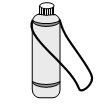
- 6The only possibility of heat flow in a thermos flask is through its cork which is $75 cm^2$ in area and $5 cm$ thick. Its thermal conductivity is $0.0075 cal/cmsec^oC$. The outside temperature is$ 40^oC$ and latent heat of ice is $80 cal g^{-1}$. Time taken by $500 g$ of ice at $0^oC$ in the flask to melt into water at $0^oC$ is ....... $hr$View Solution
- 7Two rods having thermal conductivity in the ratio of $5 : 3$ having equal lengths and equal cross-sectional area are joined by face to face. If the temperature of the free end of the first rod is $100°C$ and free end of the second rod is $20°C$ . Then temperature of the junction is...... $^oC$View Solution
- 8View SolutionThe cause of Fraunhoffer lines is
- 9Four rods of same material and having the same cross section and length have been joined, as shown. The temperature of the junction of four rods will be ............... $^{\circ} C$View Solution

- 10View SolutionWoollen clothes are used in winter season because woolen clothes