Which of the following is best close to an ideal black body
AIPMT 2002, Easy


Download our appand get started for free
Experience the future of education. Simply download our apps or reach out to us for more information. Let's shape the future of learning together!No signup needed.*
Similar Questions
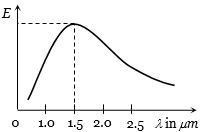
- 1In the figure, the distribution of energy density of the radiation emitted by a black body at a given temperature is shown. The possible temperature of the black body is ....... $K$View Solution
- 2The wavelength of maximum energy released during an atomic explosion was $2.93 \times {10^{ - 10}}m$. Given that Wein's constant is $2.93 \times {10^{ - 3}}m - K$, the maximum temperature attained must be of the order ofView Solution
- 3View SolutionWoollen clothes are used in winter season because woolen clothes
- 4The following three objects $(1)$ a metal tray, $(2)$ a block of wood and $(3)$ a woolen cap are left in a closed room overnight. Next day, the temperature of each is recorded as $T_1, T_2$ and $T_3$, respectively. The likely situation isView Solution
- 5There is formation of layer of snow $x\,cm$ thick on water, when the temperature of air is $ - {\theta ^o}C$ (less than freezing point). The thickness of layer increases from $x$ to $y$ in the time $t$, then the value of $t$is given byView Solution
- 6View SolutionHalf part of ice block is covered with black cloth and rest half is covered with white cloth and then it is kept in sunlight. After some time clothes are removed to see the melted ice. Which of the following statements is correct
- 7In a steady state of thermal conduction, temperature of the ends $A$ and $B$ of a $20\, cm$ long rod are ${100^o}C$ and ${0^o}C$ respectively. What will be the temperature of the rod at a point at a distance of $6$ cm from the end $A$ of the rod....... $^oC$View Solution
- 8$Assertion :$ It is hotter over the top of a fire than at the same distance of the sides.View Solution
$Reason :$ Air surrounding the fire conducts more heat upwards.
- 9The ends $\mathrm{Q}$ and $\mathrm{R}$ of two thin wires, $\mathrm{PQ}$ and $RS$, are soldered (joined) togetker. Initially each of the wires has a length of $1 \mathrm{~m}$ at $10^{\circ} \mathrm{C}$. Now the end $\mathrm{P}$ is maintained at $10^{\circ} \mathrm{C}$, while the end $\mathrm{S}$ is heated and maintained at $400^{\circ} \mathrm{C}$. The system is thermally insulated from its surroundings. If the thermal conductivity of wire $\mathrm{PQ}$ is twice that of the wire $RS$ and the coefficient of linear thermal expansion of $P Q$ is $1.2 \times 10^{-5} \mathrm{~K}^{-1}$, the change in length of the wire $\mathrm{PQ}$ isView Solution
- 10A hollow copper sphere $S$ and a hollow copper cube $ C$ , both of negligible thin walls of same area, are filled with water at $90°C$ and allowed to cool in the same environment. The graph that correctly represents their cooling isView Solution