Question
Why the molecular motion of the molecules ceases at zero kelvin?

Answer

We know, kinetic energy of a molecule is proportional to the absolute temperature.

i.e., $\frac{1}{2}\text{mv}^2_\text{rms}\propto\text{T}$

At $\text{T}=0$

$\frac{1}{2}\text{mv}^2_{\text{rms}}=0,$ Since $\frac{1}{2}\text{m}\neq0,\therefore\text{v}_{\text{rms}}=0$

Thus molecular motion ceases at zero kelvin.

Need a full question paper?

Generate a complete, print-ready paper with questions like this in minutes — across 16+ boards, with answer keys.

Start Generating Free

Similar questions

Show that the total linear momentum of an isolated system of interacting particles is conserved.
When the planet Jupiter is at a distance of 824.7 million kilometers from the Earth, its angular diameter is measured to be 35.72” of arc. Calculate the diameter of Jupiter.
Two charged particles, having equal charges of 2.0 × 10-5C each, are brought from infinity to within a separation of 10cm. Find the increase in the electric potential energy during the process.
Why length, mass and time are chosen as base quantities in mechanics?
A uniform rod of mass 300g and length 50cm rotates at a uniform angular speed of 2rad/s about an axis perpendicular to the rod through an end. Calculate:
  1. The angular momentum of the rod about the axis of rotation.
  2. The speed of the centre of the rod.
  3. Its kinetic energy.
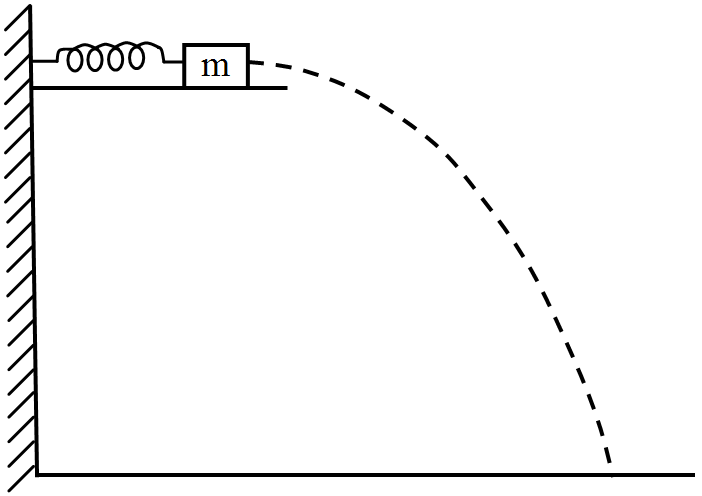
A small block of mass 'm' is pressed against a horizontal spring fixed at one end to compress the spring through 5.0cm. When released the block moves horizontally till it leaves the spring. Where will it hit the ground at a distance 2m below the slab?

$[\text{k}=100\frac{\text{N}}{\text{m}}=100\text{g}]$

When walking on ice, one should take short steps rather than long steps. Why?
Underline the correct alternative :
(a) When a conservative force does positive owrk on a body, the potential energy of the body increases/decreases/remains unaltered.
(b) Work done by a body against friction always results in a loss of its kinetic/potential energy.
(c) The rate of change of total momentum of a many-particle system is proportional to the external force/sum of the internal forces on the system.
(d) In an inelastic collision of two bodies, the quantities which do not change after the collision are the total kinetic energy/total linear momentum/total energy of the system of two bodies
Answer the following :
(a) You can shield a charge from electrical forces by putting it inside a hollow conductor. Can you shield a body from the gravitational influence of nearby matter by putting it inside a hollow sphere or by some other
means?
(b) An astronaut inside a small space ship orbiting around the earth cannot detect gravity. If the space station orbiting around the earth has a large size, can he hope to detect gravity?
(c) If you compare the gravitational force on the earth due to the sun to that due to the moon, you would find that the Sun’s pull is greater than the moon’s pull. (you can check this yourself using the data available in the succeeding exercises). However, the tidal effect of the moon’s pull is greater than the tidal effect of sun.Why?
If two resistances of values $\text{R}_1=(2.0\pm0. 1)12$ and $\text{R}_2=(12.3\pm0.2)\Omega$ are put (i) in parallel and (ii) in series, find the error in the equivalent resistance.