Question 13 Marks
Estimate the total number of air molecules (inclusive of oxygen, nitrogen, water vapour and other constituents) in a room of capacity 25.0m3 at a temperature of 27°C and 1 atm pressure.
Answer
View full question & answer→Volume of the room, V = 25.0m3
Temperature of the room, T = 27°C = 300K
Pressure in the room, P = 1 atm = 1 × 1.013 × 105Pa
The ideal gas equation relating pressure (P), Volume (V), and absolute temperature (T) can be written as,
PV = kBNT
Where,
KB is Boltzmann constant = 1.38 × 10⁻²³m2kg s-2k-1
N is the number of air molecules in the room
$\therefore\text{ N}=\frac{\text{PV}}{\text{K}_{\text{B}}\text{T}}$
$=\frac{1.013\times10^{5}\times25}{(1.38\times10^{23}\times300)}$
= 6.11 × 1026 molecules
Therefore, the total number of air molecules in the given room is 6.11 × 1026
Temperature of the room, T = 27°C = 300K
Pressure in the room, P = 1 atm = 1 × 1.013 × 105Pa
The ideal gas equation relating pressure (P), Volume (V), and absolute temperature (T) can be written as,
PV = kBNT
Where,
KB is Boltzmann constant = 1.38 × 10⁻²³m2kg s-2k-1
N is the number of air molecules in the room
$\therefore\text{ N}=\frac{\text{PV}}{\text{K}_{\text{B}}\text{T}}$
$=\frac{1.013\times10^{5}\times25}{(1.38\times10^{23}\times300)}$
= 6.11 × 1026 molecules
Therefore, the total number of air molecules in the given room is 6.11 × 1026

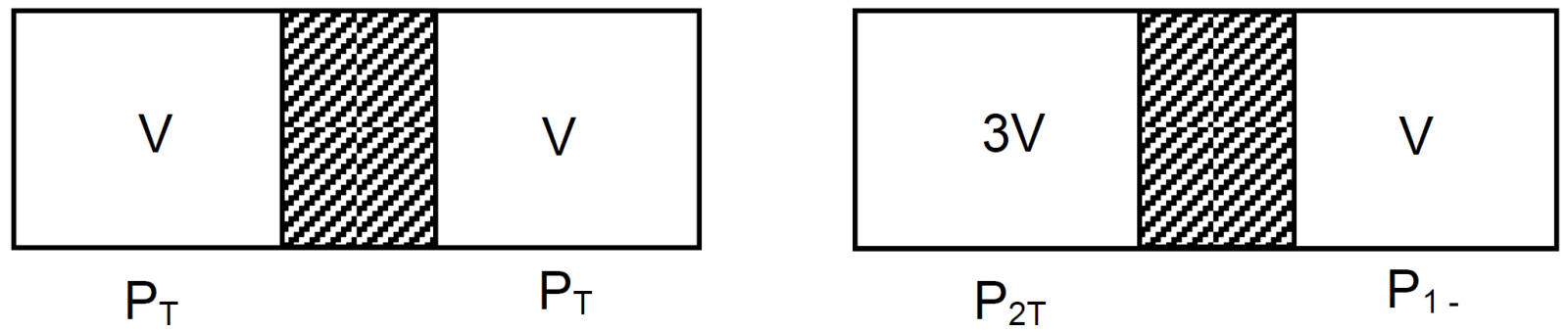

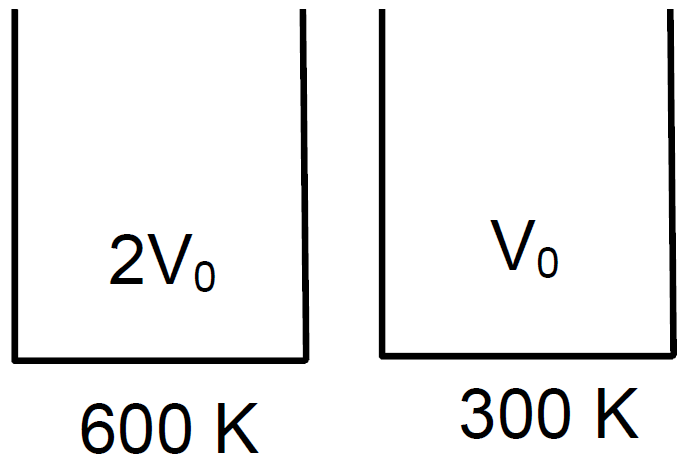 n1 = n2 = n