Question
A magnetic field

Answer

(c)$\overrightarrow F = q\overrightarrow {v\,} \times \overrightarrow B $

Need a full question paper?

Generate a complete, print-ready paper with questions like this in minutes — across 16+ boards, with answer keys.
Start Generating Free

Similar questions

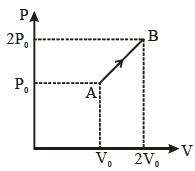
The $P-V$ diagram of $2\,g$ of helium gas for a certain process $A$ $\to$ $B$ is shown in the figure. What is the heat given to the gas during the process $A$ $\to$ $B$?
For extrinsic semiconductors; when doping level is increased;
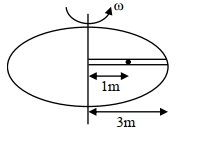
A circular table is rotating with an angular velocity of $\omega \mathrm{rad} / \mathrm{s}$ about its axis (see figure). There is a smooth groove along a radial direction on the table. A steel ball is gently placed at a distance of $1 \mathrm{~m}$ on the groove. All the surface are smooth. If the radius of the table is $3 \mathrm{~m}$, the radial velocity of the ball w.r.t. the table at the time ball leaves the table is $x \sqrt{2} \omega \mathrm{m} / \mathrm{s}$, where the value of $x$ is............
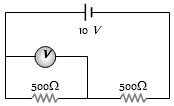
A voltmeter of resistance $1000\,\Omega$ is connected across a resistance of $500\, \Omega$ in the given circuit. What will be the reading of voltmeter .............. $V$
A mass $0.9\,kg$, attached to a horizontal spring, executes $SHM$ with an amplitude $A _{1}$. When this mass passes through its mean position, then a smaller mass of $124\,g$ is placed over it and both masses move together with amplitude $A _{2}$. If the ratio $\frac{ A _{1}}{ A _{2}}$ is $\frac{\alpha}{\alpha-1}$, then the value of $\alpha$ will be$......$
A long solenoid is fabricated to closely winding wire of radius $0.5\,mm$ over a cylindrical frame so that the successive turns nearly touch each other, the magnetic field at the centre of solenoid if it carries a current of $5\,A$
Which of the following physical quantities do not have same dimensions?
A sample of an ideal gas occupies a volume $V$ at a pressure $P$ and absolute temperature $T,$ the mass of each molecule is $m.$ The expression for the density of gas is ($k =$ Boltzmann’s constant)
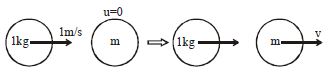
A particle of mass $1\, kg$ moving with velocity $1\, m/s$, collides elastically with another particle of mass $m$. In the collision particle of mass $1\, kg$ loses $\frac{3}{4}$of its $K.E.$ The value of $m$ is :
Initial pressure and volume of a gas are $P$ and $V$ respectively. First it is expanded isothermally to volume $4V$ and then compressed adiabatically to volume $V$ . The final pressure of gas will be (given $\gamma = 3/2$ )