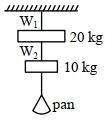
Wires ${W}_{1}$ and ${W}_{2}$ are made of same material having the breaking stress of $1.25 \times 10^{9} \,{N} / {m}^{2}$ ${W}_{1}$ and ${W}_{2}$ have cross-sectional area of $8 \times 10^{-7}\, {m}^{2}$ and $4 \times 10^{-7}\, {m}^{2}$, respectively. Masses of $20 \,{kg}$ and $10\, {kg}$ hang from them as shown in the figure. The maximum mass that can be placed in the pan without breaking the wires is $.....{kg}$ (Use $\left.{g}=10\, {m} / {s}^{2}\right)$
JEE MAIN 2021, Diffcult
Download our app for free and get started
${B} \cdot {S}_{1}=\frac{{T}_{\operatorname{lmax}}}{8 \times 10^{-7}} \Rightarrow {T}_{1 {max}}=8 \times 1.25 \times 100$
$=1000\, {N}$
${B} \cdot {S}_{2}=\frac{{T}_{2 \max }}{4 \times 10^{-7}} \Rightarrow {T}_{2 \max }=4 \times 1.25 \times 100$
$=500\, {N}$
${m}=\frac{500-100}{10}=40\, {kg}$

Download our appand get started for free
Experience the future of education. Simply download our apps or reach out to us for more information. Let's shape the future of learning together!No signup needed.*
Similar Questions
- 1A rod of length $l$ and area of cross-section $A$ is heated from $0°C$ to $100°C$. The rod is so placed that it is not allowed to increase in length, then the force developed is proportional toView Solution
- 2A thin $1 \,m$ long rod has a radius of $5\, mm$. A force of $50\,\pi kN$ is applied at one end to determine its Young's modulus. Assume that the force is exactly known. If the least count in the measurement of all lengths is $0.01\, mm$, which of the following statements is false ?View Solution
- 3The upper end of a wire of diameter $12\,mm$ and length $1\,m$ is clamped and its other end is twisted through an angle of $30^{\circ}$. The angle of shear is$........^{\circ}$View Solution
- 4A uniform cube is subjected to volume compression. If each side is decreased by $1\%,$ then bulk strain isView Solution
- 5Two wires are made of the same material and have the same volume. However wire $1$ has crosssectional area $A$ and wire $2$ has cross-section area $3A$. If the length of wire $1$ increases by $\Delta x$ on applying force $F$, how much force is needed to stretch wire $2$ by the same amount?View Solution
- 6A rubber cord catapult has cross-sectional area $25\,m{m^2}$ and initial length of rubber cord is $10\,cm.$ It is stretched to $5\,cm.$ and then released to project a missile of mass $5gm.$ Taking ${Y_{rubber}} = 5 \times {10^8}N/{m^2}$ velocity of projected missile is ......... $ms^{-1}$View Solution
- 7The temperature of a wire of length $1$ metre and area of cross-section $1\,c{m^2}$ is increased from $0°C$ to $100°C$. If the rod is not allowed to increase in length, the force required will be $(\alpha = {10^{ - 5}}/^\circ C$ and $Y = {10^{11}}\,N/{m^2})$View Solution
- 8The bulk modulus of a gas is defined as $B=-V d p / d V$. For an adiabatic process the variation of $B$ is proportional to $p^n$. For an ideal gas $n$ isView Solution
- 9View SolutionDue to addition of impurities, the modulus of elasticity
- 10View SolutionTo keep constant time, watches are fitted with balance wheel made of