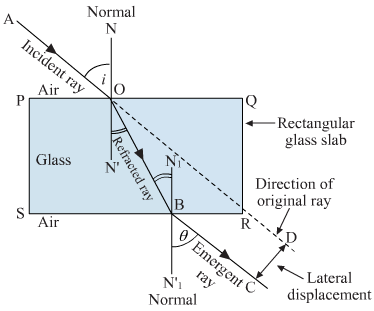
With the help of a diagram, show how when light falls obliquely on the side of a rectangular glass slab the emergent ray is parallel to the incident ray.
Download our app for free and get started

Download our appand get started for free
Experience the future of education. Simply download our apps or reach out to us for more information. Let's shape the future of learning together!No signup needed.*
Similar Questions
- 1View SolutionWhat is the difference between a real image and a virtual image? Give one example of each type of image.
- 2View SolutionAn object is placed just outside the principal focus of concave mirror. Draw a ray diagram to show how the image is formed, and describe its size, position and nature.
- 3View SolutionWhat are the important differences between looking at a photograph of your face and looking at yourself in a plane mirror?
- 4View SolutionDescribe the nature of image formed when the object is placed at a distance of 20cm from a concave mirror of focal length 10cm.
- 5View SolutionState the uses of plane mirrors.
- 6View SolutionWhy does a ray of light passing through the centre of curvature of a concave mirror gets reflected along same path after reflection?
- 7View SolutionA convex lens is immersed in a liquid of refractive index greater than that of glass. How will the nature of lens change?
- 8View SolutionAn object is placed at a distance of 30 cm from a concave lens of focal length 15 cm. List four characteristics (nature, position, etc.) of the image formed by the lens.
- 9View SolutionDraw ray diagrams showing the image formation by a concave mirror when an object is placed:A little beyond centre of curvature of the mirror.
- 10View SolutionDefine:
- Principal focus of a concave mirror.
- Focal length of a concave mirror.