Question
With the help of an activity, explain the method inducing electric current in a coil with a moving magnet. State the rule used to find the direction of electric current thus generated in the coil.

Answer

Take a coil of wire AB having a large number of turns .connecting the ends of the coil to a galvanometer as shown in below attached figure. Take a strong bar magnet and move its north towards the end B of the coil.Withdraw the north pole of the magnet away from the coil. Now the galvanometer is deflected toward the left, showing that the current is now set up in the direction opposite to the first.
Place the magnet stationary at a point near to the coil, keeping its rforth pole towards the end B of the coil. We see that the galvanometer needle deflects toward the right when the coil is moved towards the north pole of the magnet. Similarly, the needle moves toward left when the coil is moved away.
When the coil is kept stationary with respect to the magnet, the deflection of the galvanometer drops to zero.
To find the direction of electric current Fleming’s right hand rule is applied. According to it, if we stretch the forefinger, middle finger and thumb of our right hand mutually perpendicular in such a way that thumb points along the direction of motion of conductor, forefinger along the direction of magnetic field; then the middle finger points along the direction of induced current.
When current in P is changed, the field associated with Q will vary causing an induced current in Q.
If both the coils are moved in the same direction with same speed, there will not be any change in the field associated with Q.
Hence no current will be induced in Q.
Need a full question paper?

Generate a complete, print-ready paper with questions like this in minutes — across 16+ boards, with answer keys.

Start Generating Free

Similar questions

An electric heater is connected to the 230V mains supply. A current of 8A flows through the heater.
  1. How much charge flows around the circuit each second?
  2. How much energy is transferred to the heater each second?
The electronic configurations of three elements A, B and C are as follows:
A 2, 8, 1
B 2, 8, 7
C 2, 4
  1. Which of these elements is a metal?
  2. Which of these elements are non-metals?
  3. Which two elements will combine to form an ionic bond?
  4. Which two elements will combine to form a covalent bond?
  5. Which element will form an anion of valency 1?
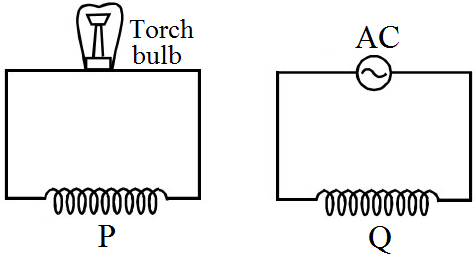
A coil P is connected to a torch bulb and placed to another coil Q as shown in figure below:

Explain the following observations:
  1. Bulb lights and.
  2. Bulb gets dimmer, if the coil P is moves upwards.
What is ‘dispersion of white light’? State its cause. Draw a ray diagram to show the dispersion of white light by a glass prism.
Define the term ‘structural isomerism’. Explain why propane cannot exhibit this property. Draw the structures of possible isomers of butane, $C _4 H _{10}$.
You must have seen tarnished copper vessels being cleaned with lemon or tamarind juice. Explain why these sour substances are effective in cleaning the vessels.
What are the qualities of an ideal source of energy?
What are the special features of commercial electric motors?
Determine how far an object must be placed in front of a converging lens of focal length 10cm in order to produce an erect (upright) image of linear magnification 4.
The near-point of a person suffering from hypermetropia is at 50cm from his eye. What is the nature and power of the lens needed to correct this defect ? (Assume that the near-point of the normal eye is 25cm).