Question
With the help of an example, explain how the neutron to proton ratio changes during $\alpha-$decay of a nucleus.

Answer

Let us like the example of $\alpha-$decay of $^{238}_{92}\text{U}.$ The decay scheme is
$^{238}_{92}\text{U}\rightarrow ^{234}_{90}\text{Th}+^4_2\alpha \text{ (or}^4_2\text{He})$
Neutron to proton ratio before $\alpha-$decay $=\frac{238-92}{92}=\frac{146}{92}=1.59$
Neutron to proton ratio after $\alpha-$decay $=\frac{238-90}{90}=\frac{144}{90}=1.60$
$\frac{146}{92}<\frac{144}{90}$
This shows that the neutron to proton ratio increases during $\alpha-$decay of a nucleus.

Need a full question paper?

Generate a complete, print-ready paper with questions like this in minutes — across 16+ boards, with answer keys.
Start Generating Free

Similar questions

How are electromagnetic waves produced? What is the source of energy carried by a propagating electromagnetic wave? Identify the electromagnetic radiations used:
  1. In remote switches of household electronic devices.
  2. As diagnostic tool in medicine.
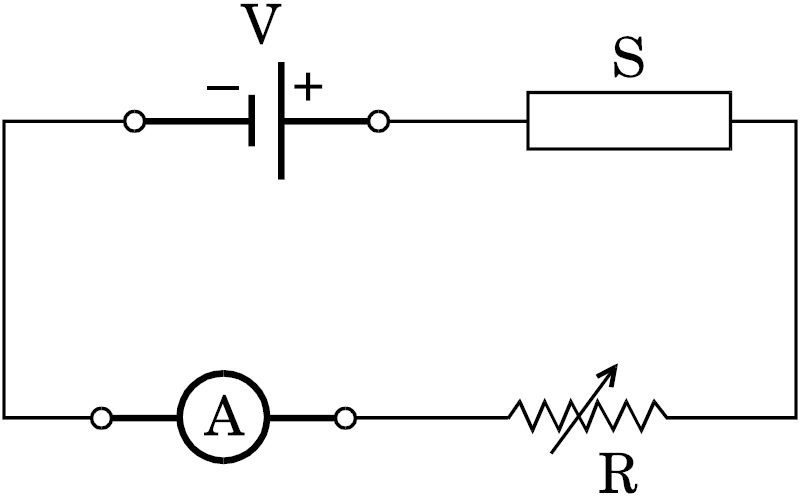
  1. In the following diagram ‘S’ is a semiconductor. Would you increase or decrease the value of R to keep the reading of the ammeter A constant when S is heated? Give reason for your answer.
  1. Draw the circuit diagram of a photodiode and explain its working. Draw its I - V characteristics.
An alpha particle is accelerated through a potential difference of $100 V.$ Calculate:
$i.$ The speed acquired by the alpha particle, and
$ii.$ The de-Broglie wavelength associated with it. 
$($Take mass of alpha particle $=6.4 \times 10^{-27} kg )$
The potential barrier existing across an unbiased p-n. junction is 0·2 volt. What minimum kinetic energy a hole should have to diffuse from the p-side to the n-side if,
  1. The junction is unbiased.
  2. The junction is forwardbiased at 0.1 volt.
  3. The junction is reverse-biased at 0.1 volt?
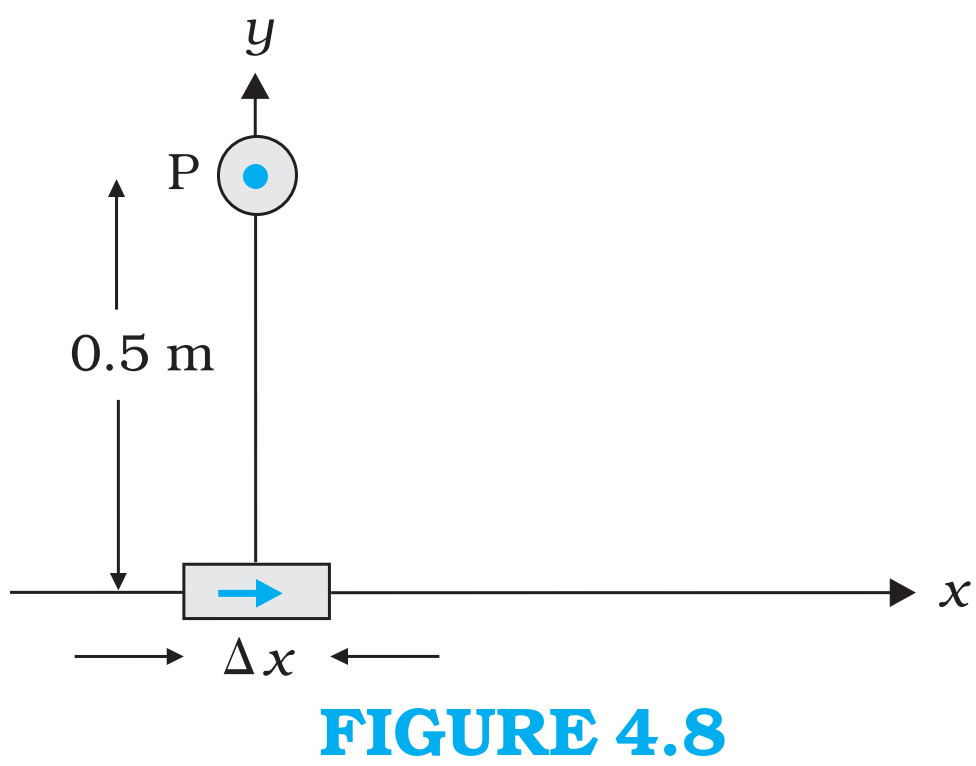
An element $\Delta l =\Delta x \hat{ i }$ is placed at the origin and carries a large current $I=10$ A $($Fig. $4.8)$. What is the magnetic field on the $y$ axis at a distance of $0.5 m . \Delta x=1 cm$.
Image
Explain electrical energy and power.
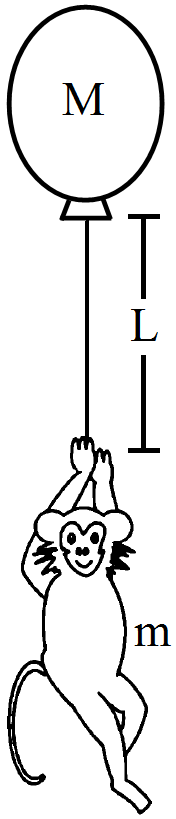
The balloon, the light rope and the monkey shown in figure are at rest in the air. If the monkey reaches the top of the rope, by what distance does the balloon descend ? Mass of the balloon = M, mass of the monkey = m and the length of the rope ascended by the monkey = L.
Write the two processes that take place in the formation of a p-n junction. Explain with the help of a diagram, the formation of depletion region and barrier potential in a p-n junction.
Write Einstein's photoelectric equation in terms of the stopping potential and the threshold frequency for a given photosensitive material. Draw a plot showing the variation of stopping potential vs. the frequency of incident radiation.
A wheel of moment of inertia $0.10kg-m^2$ is rotating about a shaft at an angular speed of 160rev/ minute. A second wheel is set into rotation at 300rev/ minute and is coupled to the same shaft so that both the wheels finally rotate with a common angular speed of 200rev/ minute. Find the moment of inertia of the second wheel.