Question
With the help of one example each, provide genetic explanation for the following observations:
F1-generation resembles both the parents.

Answer

F1 generation resembles both the parents: This happens in the case of co-dominance where both alleles express themselves fully in heterozygous condition. For example: Different types of red blood cells determine ABO blood grouping in human beings.

Co-dominance:

  • The alleles which are able to express themselves independently, even when present together are called co-dominant alleles and this biological phenomenon is called co–dominance. For example, ABO blood grouping in humans.
  • ABO blood groups are controlled by gene I. Gene I has three alleles IA, IB and IO/i.
  • IA and IB produce RBC surface antigens sugar polymer A and B, respectively, whereas i does not produce any antigen.
  • IA and IB are dominant over i hence IA and IB are dominant alleles and i is recessive allele as in IAi and IBi.
  • When IA and IB are present together, both express equally and produce the surface antigens A and B, hence show co-dominance.
  • Since humans are diploid, each person possesses any two of the three ‘I’ gene alleles, resulting into six different genotypic combinations and four phenotypic expressions.

Table showing the genetic basis of blood groups in human population:

Allele from Parent 1
Allele from Parent 2
Genotype of offspring
Blood groups of offspring
IA
IA
IAIA
A
IA
B
IAIB
AB
IA
i
IAi
A
IB
IB
IBIB
B
IB
i
IBi
B
i
i
ii
O

Need a full question paper?

Generate a complete, print-ready paper with questions like this in minutes — across 16+ boards, with answer keys.
Start Generating Free

Similar questions

Answer the following questions:
State and explain the law of segregation as proposed by Mendel in a monohybrid cross.
Diseases like dysentery, cholera, typhoid etc., are more common in over crowded human settlements. Why?
State the hypothesis proposed by Oparin and Haldane. Describe how S.L. Miller experiemen-tally supported it.###Describe the experiment of S.L. Miller. Comment upon his contribution in origin of life on earth, on the basis of experiments and observations.
Read the following and answer any four questions from (i) to (v) given below:

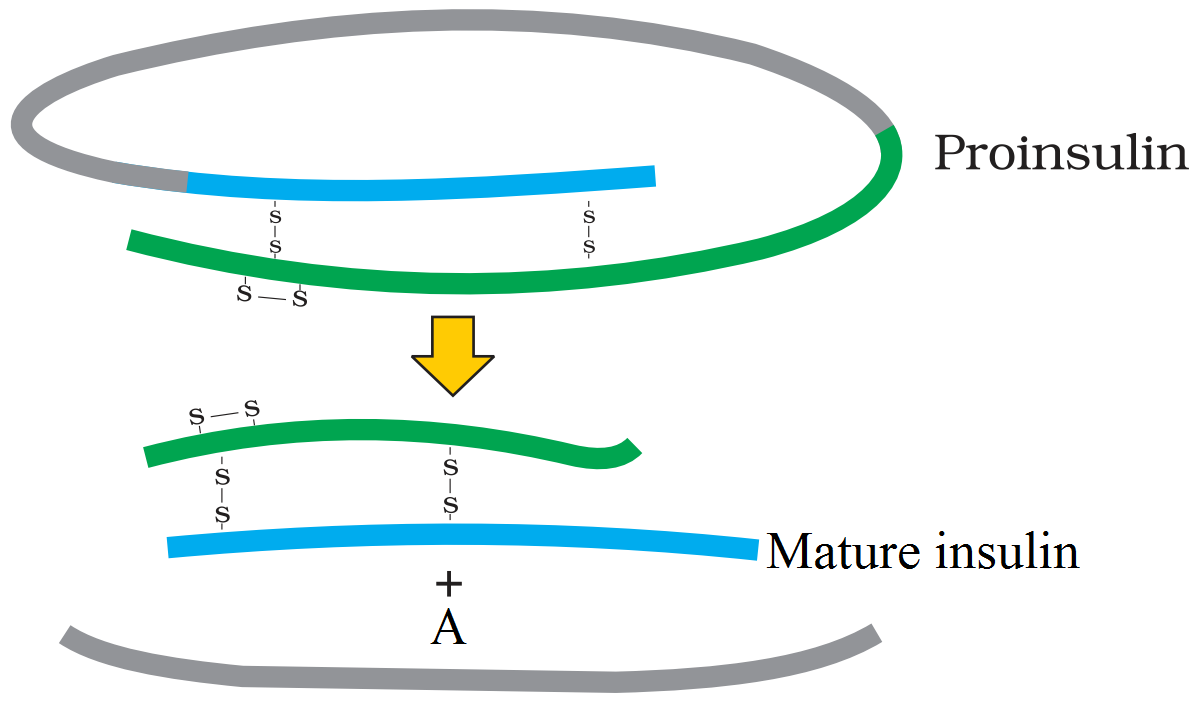
Insulin used to cure diabetes was earlier extracted from pancreas of slaughtered cattle and pigs. Insulin extracted from an animal source, though caused some patients to develop allergy or other types of reactions to the foreign protein. Human insulin consists of two short polypeptide chains : chain A and chain B, that are linked together by disulphide bridges. In mammals including humans, insulin is synthesised as a pro-hormone which contains an extra stretch called the C-peptide. This C peptide is not present in mature insulin and is removed during maturation into insulin.

  1. Identify A in the given figure.

  1. Polypeptide chain A.
  2. Polypeptide chain B.
  3. Polypeptide chain C.
  4. None of these.
  1. The following is a list of some stages involved in producing human insulin from genetically engineered bacteria.
  1. The bacteria are cultured in a fermenter for large scale production.
  2. Recombinant insulin is extracted from the bacterial cells that expresses insulin gene.
  3. The same restriction enzyme is used again to cut the bacterial plasmid for insertion of the human insulin gene.
  4. Bacteria take up the plasmid carrying the insulin gene.
  5. A restriction enzyme is used to cut human DNA to extract the insulin gene.

Select the correct order of these stages.
  1.  1, 5, 3, 4, 2
  2. 2, 4, 3, 5, 1
  3. 4, 5, 3, 2, 1
  4. 5, 3, 4, 1, 2
  1. To insert the insulin gene into bacterial DNA, both the bacterial plasmid and the human chromosome containing the insulin gene are treated with the same restriction enzyme. Using the same restriction enzyme ensures that
  1. DNA ligase is able to join the segments of human and bacterial DNA.
  2. The exact length of nucleotides matching the insulin gene is removed from the plasmid.
  3. Both the bacterial and human DNA will contain sticky ends.
  4. Sticky ends in the cut plasmid and insulin gene are complementary.
  1. Why is the fermentor important for the production of human insulin by transgenic bacteria?
  1. It provides optimal conditions for the transgenic to multiply rapidly.
  2. It facilitates the extraction and purification of insulin from the transgenic bacteria.
  3. It maximise the rate of fermentation of the transgenic bacteria.
  4. It provides the low-oxygen conditions that are important for insulin production.
  1. A bacteriologist carries out his first attempt at engineering E.coli with the gene for human insulin. During the process, he realises that his stock of DNA ligase has depleted but decides to continue anyway. What is a likely consequence of his decision?
  1. Bacteria with the rDNA will not be able to form colonies in a fermenter.
  2. The resulting plasmids are not able to enter the E.coli bacteria even after applying heat shock.
  3. The resulting E.coli bacteria do not contain the human insulin gene.
  4. The bacterial plasmids do not have sticky ends and are unable to accommodate the human gene.
Who revealed biochemical nature of the transforming principle? How was it done?
  1. How is mature insulin different from proinsulin secreted by pancreas in humans?
  2. Explain how was human functional insulin produced using rDNA technology.
  3. Why is the functional insulin thus produced considered better than the ones used earlier by diabetic patients?
How did geographical evolution helpful in explaining evolution? Justify your answer with suitable example?
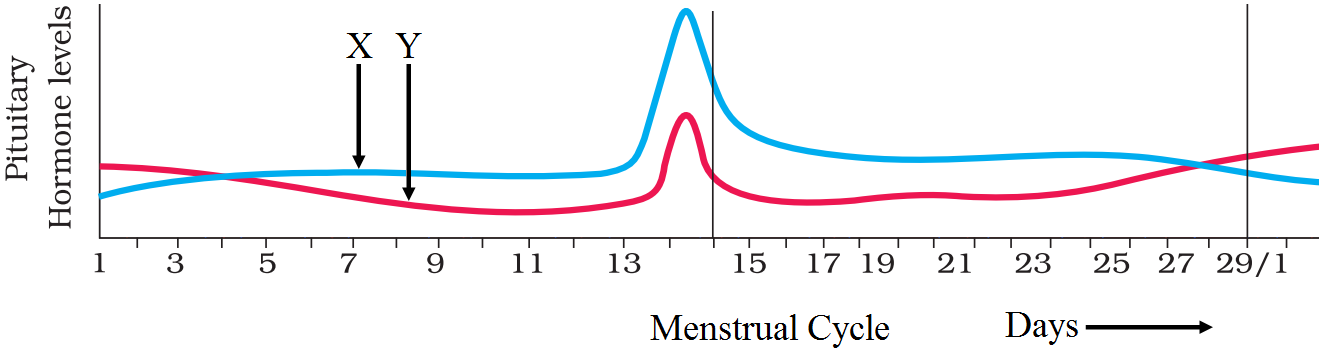
Study the graph given below and answer the questions that follow:

Identify the ovarian phases during a menstrual cycle:

  1. 5th day to 12th day of the cycle.
  2. 14th day of the cycle.
  3. 16th day to 25th day of the cycle.
Explain the post pollination events up to double fertilisation, that occur in an angiosperm.
Which statement among the following are true and which are false :