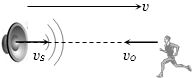
With what velocity an observer should move relative to a stationary source so that he hears a sound of double the frequency of source
Easy


Download our appand get started for free
Experience the future of education. Simply download our apps or reach out to us for more information. Let's shape the future of learning together!No signup needed.*
Similar Questions
- 1The mass per unit length of a uniform wire is $0.135\, g / cm$. A transverse wave of the form $y =-0.21 \sin ( x +30 t )$ is produced in it, where $x$ is in meter and $t$ is in second. Then, the expected value of tension in the wire is $x \times 10^{-2} N$. Value of $x$ is . (Round-off to the nearest integer)View Solution
- 2View SolutionIf the temperature increases, then what happens to the frequency of the sound produced by the organ pipe
- 3The intensity of sound during the festival season increased by $100$ times. This could imply a decibel $(dB)$ level rise fromView Solution
- 4At which temperature the speed of sound in hydrogen will be same as that of speed of sound in oxygen at $100\,^oC$ ..... $^oC$View Solution
- 5For a particular resonance tube, following are four of the six harmonics below $1000 Hz$; $300,600,750$ and $900 \,Hz$. The two missing harmonics areView Solution
- 6A policeman on duty detects a drop of $10\%$ in the pitch of the horn of a moving car as it crosses him. If the velocity of sound is $330 \,m/s,$ the speed of the car will be ..... $m/s$View Solution
- 7What should be the velocity of a sound source moving towards a stationary observer so that apparent frequency is double the actual frequency (Velocity of sound is $v$)View Solution
- 8A closed organ pipe has a frequency $'n'$. If its length is doubled and radius is halved, its frequency nearly becomes-View Solution
- 9Two tuning forks when sounded together produced $4$ beats/sec. The frequency of one fork is $256.$ The number of beats heard increases when the fork of frequency $256$ is loaded with wax. The frequency of the other fork isView Solution
- 10Stationary waves of frequency $300\, Hz$ are formed in a medium in which the velocity of sound is $1200$ metre/sec. The distance between a node and the neighbouring antinode is ... $m$View Solution