MCQ
Work done in raising a box depends on
  • A
    How fast it is raised
  • B
    The strength of the man
  • The height by which it is raised
  • D
    None of the above

Answer

Correct option: C.
The height by which it is raised
c
(c)Work in raising a box
= (weight of the box) $×$  (height by which it is raised)

Need a full question paper?

Generate a complete, print-ready paper with questions like this in minutes — across 16+ boards, with answer keys.
Start Generating Free

Similar questions

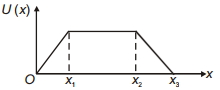
The variation of potential energy $U$ of a system is shown in figure. The force acting on the system is best represented by
Out of the given four waves $(1), (2), (3)$ and $(4)$

$y = a\sin (kx + \omega t)$   ......$(1)$

$y = a\sin (\omega t - kx)$   ......$(2)$

$y = a\cos (kx + \omega t)$   ......$(3)$

$y = a\cos (\omega t - kx)$   ......$(4)$

emitted by four different sources ${S_1},\,{S_2},\,{S_3}$ and ${S_4}$ respectively, interference phenomena would be observed in space under appropriate conditions when
A water tank of height $10\,m$, completely filled with water is placed on a level ground. It has two holes one at $3\, m$ and the other at $7\, m$ from its base. The water ejecting from
When sound travels from air to water, which parameter does not change?
A body of weight $w_1$ is suspended from the ceiling of a room through a chain of weight $w_2$. The ceiling pulls the chain by a force:
A body of mass $m$ is projected at an angle of ${45^o}$ with the horizontal. If air resistance is negligible, then total change in momentum when it strikes the ground is
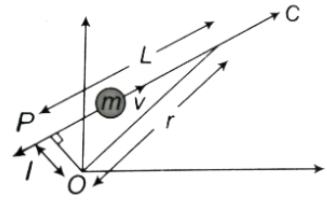
A particle of mass $m$ moves along line $PC$ with velocity $v$ as shown.  What is the angular momentum of the particle about $O$ ​
A body is moving along a rough horizontal surface with an initial velocity $6\,\,m/s.$ If the body comes to rest after travelling $9\, m$, then the coefficient of sliding friction will be
The angle between $\vec{\text{A}}=\hat{\text{i}}+\hat{\text{j}}$ and $\vec{\text{B}}=\hat{\text{i}}-\hat{\text{j}}$ is
According to $C.E.$ van der Waal, the interatomic potential varies with the average interatomic distance $(R)$ as