Question
Would you prefer a material with a high work-function or a low work-function to be used as a cathode in a diode?

Answer

We will prefer a material with low work-function to be used as a cathode in a diode, so that electron emission can occur using a small amount of energy.

Need a full question paper?

Generate a complete, print-ready paper with questions like this in minutes — across 16+ boards, with answer keys.
Start Generating Free

Similar questions

Read the passage given below and answer the following questions from (i) to (v).
Force of Friction on Connected Bodies When bodies are in contact, there are mutual contact forces satisfying the third law of motion. The component of contact force normal to the surfaces in contact is called normal reaction. The component parallel to the surfaces in contact is called friction

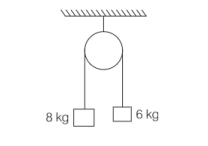
In the above figure, 8 kg and 6 kg are hanging stationary from a rough pulley and are about to move. They are stationary due to roughness of the pulley.
  1. Which force is acting between pulley and rope?
  1. Gravitational force
  2. Tension force
  3. Frictional force
  4. Buoyant force
  1. The normal reaction acting on the system is
  1. 8g
  2. 6g
  3. 2g
  4. 4g
  1. The tension is more on side having mass of:
  1. 8kg
  2. 6kg
  3. Same on both
  4. Nothing can be said
  1. The force of friction acting on the rope is:
  1. 20N
  2. 30N
  3. 40N
  4. 50N
  1. Coefficient of friction of the pulley is
  1. $\frac{1}{6}$
  2. $\frac{1}{7}$
  3. $\frac{1}{5}$
  4. $\frac{1}{4}$
When the diode shows saturated current, dynamic place resistance is:
  1. Zero.
  2. Infinity.
  3. Indeterminate.
  4. Different for different diodes.
Consider a gravity-free hall in which an experimenter of mass 50kg is resting on a 5kg pillow, 8ft above the floor of the hall. He pushes the pillow down so that it starts falling at a speed of 8ft/s. The pillow makes a perfectly elastic collision with the floor, rebounds and reaches the experimenter's head. Find the time elapsed in the process.
Read the passage given below and answer the following questions from 1 to 5.
Principle of Conservation of Energy:
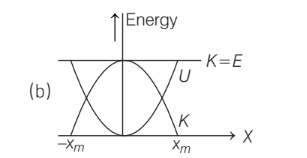
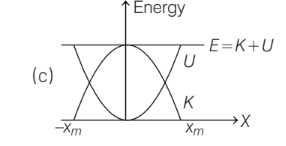
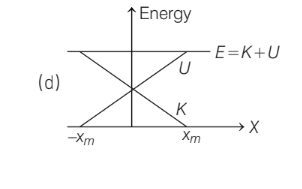
Total energy of an isolated system always remains constant. Since, the universe as a whole may be viewed as an isolated system, total energy of the universe is constant. If one part of the universe loses energy, then other part must gain an equal amount of energy. The principle of conservation of energy cannot be proved as such. However, no violation of this principle has been observed.
  1. When we rub two flint stones together, got them to heat up and to ignite a heap of dry leaves in the form of:
  1. chemical energy
  2. sound energy
  3. heat energy
  4. electrical energy
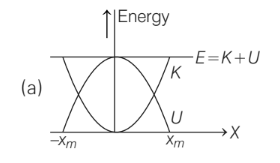
  1. Which graph represents conservation of total mechanical energy?
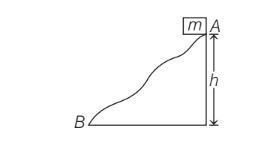
  1. In the given curved road, if particle is released from A, then:

  1. kinetic energy atB must be mgh
  2. kinetic energy atB must be zero
  3. kinetic energy atB must be less than mgh
  4. kinetic energy atB must not be equal to potential energy
  1. U is the potential energy, K is the kinetic energy and E is the mechanical energy. Which of the following is not possible for a stable system?
  1. U > E
  2. U < E
  3. E > K
  4. K > E
  1. A body of mass 5kg is thrown vertically up with a kinetic energy of 490 J. The height at which the kinetic energy of the body becomes half of the original value is
  1. 12.5m
  2. 10
  3. 2.5m
  4. 5m
Consider a gravity-free hall in which an experimenter of mass 50kg is resting on a 5kg pillow, 8ft above the floor of the hall. He pushes the pillow down so that it starts falling at a speed of 8ft/s. The pillow makes a perfectly elastic collision with the floor, rebounds and reaches the experimenter's head. Find the time elapsed in the process.
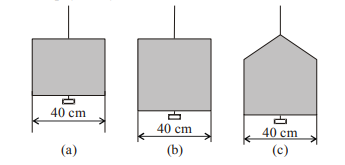
Figure (a) shows a thin liquid film supporting a small weight = 4.5 × 10²N. What is the weight supported by a film of the same liquid at the same temperature in Fig. (b) and (c)? Explain your answer physically.
Image
On a winter day when the atmospheric temperature drops to -10°C, ice forms on the surface of a lake.
  1. Calculate the rate of increase of thickness of the ice when 10cm of ice is already formed.
  2. Calculate the total time taken in forming 10cm of ice. Assume that the temperature of the entire water reaches 0°C before the ice starts forming. Density of water = 1000kgm-3, latent heat of fusion of ice $=3.36\times10^5\text{Jkg}^{-1}$ and thermal conductivity of ice $=1.7\text{Wm}^{-1}{^{\circ}}\text{C}^{-1}.$ Neglect the expansion of water on freezing.
Read the case study given below and answer any four subparts:
Potential energy is the energy stored within an object, due to the object's position, arrangement or state. Potential energy is one of the two main forms of energy, along with kinetic energy. Potential energy depends on the force acting on the two objects.

  1. A body is falling freely under the action of gravity alone in vacuum. Which of the following quantities remain constant during the fall?
    1. kinetic energy
    2. potential energy
    3. mechanical energy
    4. none of these
  2. Work done by a conservative force is positive, if
    1. potential energy decreases
    2. potential energy increases
    3. kinetic energy decreases
    4. kinetic energy increases
  3. When does the potential energy of a spring increases?
    1. only when spring is stretched
    2. only when spring is compressed 
    3. both a and b
    4. none of these
  4. Dimension of k/m is, here k is force constant
    1. T2
    2. T-2
    3. T1
    4. T-1
  5. A vehicle of mass 5000kg climbs up a hill of 10 m. The potential energy gained by it
    1. 5J
    2. 500J
    3. 5 × 104J
    4. 5 × 105J
The oxygen molecule has a mass of 5.30 × $10^{-28} kg$ and a moment of inertia of $1.94 \times 10^{-46} kg m ^2$ about an axis through its centre perpendicular to the lines joining the two atoms. Suppose the mean speed of such a molecule in a gas is $500 m / s$ and that its kinetic energy of rotation is two thirds of its kinetic energy of translation. Find the average angular velocity of the molecule.
Read the passage given below and answer the following questions from (i) to (v).
Momentum and Newton’s Second Law of Motion Momentum of a body is the quantity of motion possessed by the body. It depends on the mass of the body and the velocity with which it moves. When a bullet is fired by a gun, it can easily pierce human tissue before coming to rest resulting in casualty. The same bullet fired with moderate speed will not cause much damage. The greater the change in momentum in a given time, the greater is the force that needs to be applied. The second law of motion refers to the general situation, where there is a net external force rating on the body.
  1. A satellite in force-free space sweeps stationary interplanetary dust at a rate $\frac{\text{dM}}{\text{dt}}=\text{dv,}$ where M is the mass, v is the dt velocity of satellite and a is a constant. What is the deceleration of the satellite?
  1. $\frac{-2\text{av}^2}{\text{M}}$
  2. $\frac{-\text{av}^2}{\text{M}}$
  3. $\text{-av}^2$
  4. $\frac{\text{av}^2}{\text{M}}$
  1. A body of mass 5 kg is moving with velocity of $\text{v} = (2\hat{\text{i}} + 6\hat{\text{j}})$ ms-1 at t = 0s. After time t = 2s, velocity of body is $(10\hat{\text{i}} + 6\hat{\text{j}})$ ms-1, then change in momentum of body is:
  1. $40\hat{\text{i}}\text{ kg}-\text{ms}^{-1}$
  2. $20\hat{\text{i}}\text{ kg}-\text{ms}^{-1}$
  3. $30\hat{\text{i}} \text{kg}-\text{ms}^{-1}$
  4. $(50\hat{\text{i}}+30\hat{\text{j}})\text{ Kg - ms}^{-1}$
  1. A cricket ball of mass 0.25kg with speed 10m/ s collides with a bat and returns with same speed with in 0.01s. The force acted on bat is:
  1. 25N
  2. 50N
  3. 250N
  4. 500N
  1. A stationary bomb explodes into three pieces. One piece of 2 kg mass moves with a velocity of 8 ms” 1 at right angles to the other piece of mass 1 kg moving with a velocity of 12 ms -1 . If the mass of the third piece is 0.5 kg, then its velocity is:
  1. 10ms-1
  2. 20ms-1
  3. 30ms-1
  4. AOms-1
  1. A force of 10 N acts on a body of mass 0.5kg for 0.25s starting from rest. What is its momentum now?
  1. 0.25 N/ s
  2. 2.5 N/ s
  3. 0.5 N/ s
  4. 0.75 N/ s