Question
Write a note on acidity of alcohols.

Answer

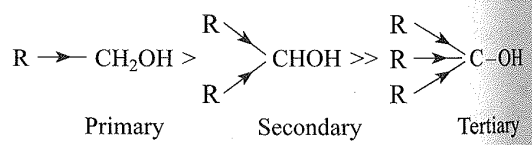
$\rightarrow$ Acidity of alcohols: The acidic character of alcohols is due to the polar nature of $O-H$ bond. An electron$-$releasing group $\ce{(-CH_3, C_2H_5) 2}$ increases electron density on oxygen tending to decrease the polarity of $O-H$ bond. This decreases the acid strength. For this reason, the acid strength of alcohols decreases in the following order :
Image
$\rightarrow $ Alcohols are, however, weaker acids than water. This can be illustrated by the reaction of water with an alkoxide.
Image
$\rightarrow$ This reaction shows that water is a better proton donor $($i.e., stronger acid$)$ than alcohol. Also, in the above reaction, we note that an alkoxide ion is a better proton acceptor than hydroxide ion, which suggests that alkoxides are stronger bases $($sodium ethoxide is a stronger base than sodium hydroxide$).$
$\rightarrow$ Alcohols can act as both bronsted bases as well as acids. It is due to the presence of unshared electron pairs on oxygen. which makes them proton acceptors.

Need a full question paper?

Generate a complete, print-ready paper with questions like this in minutes — across 16+ boards, with answer keys.

Start Generating Free

Similar questions

What is stereochemistry ? Explain plane polarised light, optical activity and optical isomers.
Vapour pressures of pure acetone and chloroform at $328\ K$ are $741.8\ mm\ Hg$ and $632.8\ mm\ Hg$ respectively. Assuming that they form ideal solution over the entire range of composition, plot $p_{total}, p_{chloroform},$ and $p_{acetone}$ as a function of $x_{acetone}.$ The experimental data observed for different compositions of mixture is:
$100 \times x_{acetone}$ $0$ $11.8$ $23.4$ $36.0$ $50.8$ $58.2$ $64.5$ $72.1$
$p_{acetone}/ mm\ Hg$ $0$ $54.9$ $110.1$ $202.4$ $322.7$ $405.9$ $454.1$ $521.1$
$p_{chloroform}/ mm\ Hg$ $632.8$ $548.1$ $469.4$ $359.7$ $257.7$ $193.6$ $161.2$ $120.7$
Plot this data also on the same graph paper. Indicate whether it has positive deviation or negative deviation from the ideal solution.
Carbonyl group is present in carboxylic acids and their derivatives, yet they do not show the properties of carboxylic group, why?
The conductivity of sodium chloride at $298 K$ has been determined at different concentrations and the results are given below:
Concentration$/M$ $0.001$ $0.010$ $0.020$ $0.050$ $0.100$
$10^2\times k/S m^{-1}$ $1.237$ $11.85$ $23.15$ $55.53$ $106.74$
Calculate $\wedge_\text{m}$ for all concentrations and draw a plot between $\wedge_\text{m}$ and $\text{C}^\frac{1}{2}.$ Find the value of $\wedge^\circ_\text{m}.$
Compare the chemistry of actinoids with that of the lanthanoids with special reference to: Chemical reactivity
What is organo metallic compound? Explain grignard reagent.
Predict the products of the following reactions$:$
Explain by giving an equation how the presence of carbonyl group and five -OH groups in the structure of glucose is determined ### Write the equation reactions of glucose with NH, OH, HCN, and acetic anhydride and state what information is obtained about the structure of glucose through it.
State the preparation, properties and uses of methanol.
Write one chemical equation for each, to illustrate the following reactions:
  1. Rosenmund reduction.
  2. Cannizzaro reaction.
  3. Fischer esterification.