Question
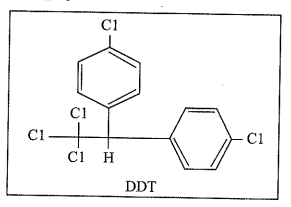
Write a note on DDT.

Answer

→ DDT, the first chlorinated organic insecticides, was originally prepared in 1873, but it was not until 1939 that Paul Muller of Geigy Pharmaceuticals in Switzerland discovered the effectiveness of DDT as an insecticide.
→ Paul Muller was awarded the Nobel Prize in Medicine and Physiology in 1948 for this discovery.
→ The use of DDT increased enormously on a worldwide basis after world war II, primarily because of its effectiveness against the mosquito that spreads malaria and lice that carry typhus.
→ However, problems related to extensive use of DDT began to appear in the late 1940s.
Image
→ Many species of insects developed resistance to DDT, and it was also discovered to have a high toxicity towards fish.
→ The chemical stability of DDT and its fat solubility compounded the problem.
→ DDT is not metabolised very rapidly by animals; instead, it is deposited and stored in the fatty tissues.
→ If ingestion continues at a steady rate, DDT builds up within the animal over time.
→The use of DDT was banned in the United States in 1973, although it is still in use in some other parts of the world.

Need a full question paper?

Generate a complete, print-ready paper with questions like this in minutes — across 16+ boards, with answer keys.

Start Generating Free

Similar questions

Answer the following questions:
An optically active compound having molecular formula $\ce{C_7H_{15}Br}$ reacts with aqueous $\text{KOH}$ to give a racemic mixture of products. Write the mechanism involved in this reaction.
$^{238}_{92}\text{U}$ Change to $^{206}_{92}\text{Pb}$ by successive radioactive decay. A sample of urenium ore was anlaysed and found to contain $1.0 g$ of $^{238}\text{U}$ and $0.1 g$ of $^{206}\text{Pb}$ had accumulated due to decay of $^{238}\text{U}$, find out the age of ore. $($Half$-$ life of $^{238}\text{U}$$= 4.5\times10^9$ years$).$
Explain the effect of hydrogen bond on boiling point of alcohol and phenol.
What is the significance of Henry's Law constant $K_H?$
Explain the nomenclature of phenols by giving examples.
How do you convert:
  1. Chlorobenzene to biphenyl.
  2. Propene to I-iodopropane.
  3. 2-bromobutane to but-2-ene.
  1. The cell in which the following reaction occurs$:$
  1. $\ce{2 Fe^{3+} (aq) + 2 I^- (aq) \longrightarrow 2 Fe^{2+}(aq) + I_2(s)}$
    has $\text{E}^0_{\text{cell}} = 0·236 V$ at $298 K.$ Calculate the standard Gibbs energy of the cell reaction. $($Given $: 1 F = 96,500 \ce{C mol^{-1})}$
  2. How many electrons flow through a metallic wire if a current of $0.5 A$ is passed for $2$ hours? $($Given $: 1 F = 96,500 \ce{C mol^{-1})}$
For a first order reaction, show that time required for 99% completion is twice the time required for the completion of 90% of reaction.
What are Carbohydrates? How are they classified?
earrange the compounds of each of the following sets in order of reactivity towards $S_N2$ displacement:
  1. $2-$Bromo$-2-$methylbutane, $1-$Bromopentane, $2-$Bromopentane.
  2. $1-$Bromo$-3-$methylbutane, $2-$Bromo$-2-$methylbutane, $3-$Bromo$-2-$methylbutane.
  3. $1-$Bromobutane, $1-$Bromo$-2, 2-$dimethylpropane, $1-$Bromo$-2-$methylbutane.