Question
Write a short-note on p-type semiconductors.

Answer


Image
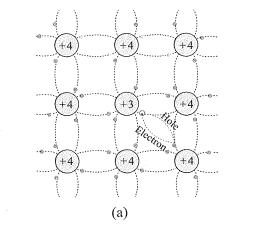
As shown in Fig., to prepare this type of semiconductors, in pure $S i$ or $G e$, trivalent impurity like $A /, B , I n$ etc. are added. (In the outer most orbit, there are 3 electrons in such atoms, so they are called tri-valent.)
Image
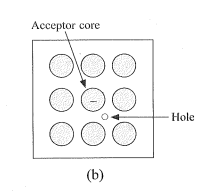
The dopant has one valence electron less than the $S i$ and $G e$ atoms, and therefore, this atom can form covalent bonds with neighbouring three $S i$ atoms but does not have any electron to offer to the fourth $S i$ atom.
So, a vacancy (empty space) or hole is created in the bond between the fourth neighbour and the trivalent atom, as shown in the Fig.
Since the neighbouring Si atom in the lattice wants an electron in place of a hole, an electron in the outer orbit of an atom in the neighbourhood may jump to fill this vacancy, leaving a vacancy or hole at its own site.
Thus the hole is available for conduction. Hole has the tendency to attract/accept an electron. Hence, such impurities are called acceptor impurities.
Apart from this, at room temperature, some covalent bonds break and pair of electron and a hole is created.
Thus, for such a material, the holes are majority carriers and electrons are minority carriers.
Since, the holes behave as a positive charge due to deficiency of negatively charged electrons, from the first letter of the word positive, such extrinsic semiconductors doped with trivalent impurity are called $p$-type semiconductors.
For $p$-type semiconductors. $n_h \gg n_e$.

Need a full question paper?

Generate a complete, print-ready paper with questions like this in minutes — across 16+ boards, with answer keys.
Start Generating Free

Similar questions

What is amplitude modulation ? Draw the simple block diagram of a modulator to get amplitude modulated wave.
How much is the minimum energy of electron of excited hydrogen atom so that three spectral lines of hydrogen spectrum could be obtained?
A molecule. of hydrogen contains two protons and two electrons. The nuclear force between these two protons is always neglected while discussing the behaviour of a hydrogen molecule. Why?
Suppose the frequency of the source in the previous example can be varied. (a) What is the frequency of the source at which resonance occurs? (b) Calculate the impedance, the current, and the power dissipated at the resonant condition.
A series $\text{LCR}$ circuit is connected across an $a.c.$ source of variable angular frequency $' \omega'$. Plot a graph showing variation of current $‘i\ ’$ as a function of $' \omega'$ for two resistances $R_1$ and $R2 \ (R_1 > R_2).$
Answer the following questions using this graph:
  1. In which case is the resonance sharper and why?
  2. In which case is the power dissipation more and why?
Rate of change of electric field in the region between the plates of capacitor is $1.5 \times 10^{12} Vm ^{-1} s^{ 1 }$. If circular plate of capacitor has a radius of 55 mm , then find the magnitude of displacement current.
The voltage and current in a series AC circuit are given by, $\text{V}=\text{V}_0\cos\omega\text{t}$ and $\text{i}=\text{i}_0\sin\omega\text{t}.$ What is the power dissipated in the circuit?
Find the angle of minimum deviation for an equilateral prism made of a material of refractive index 1.732. What is the angle of incidence for this deviation?
A charge of $+2.0 \times 10^{-8}C$ is placed on the positive plate and a charge of $-1.0 \times 10^{-8}C$ on the negative plate of a parallel$-$plate capacitor of capacitance $1.2\times10^{-3}\mu\text{F}.$ Calculate the potential difference developed between the plates.
Obtain essential expression for balanced position of Wheatstone Bridge.###Explain the principle of Wheatstone Bridge. How can we find the resistance of any resistor using this principle?