Question
Write a short note on pollination by wind.
Answer

Image
→ Pollination by wind is more common amongst abiotic pollinations.
→ Wind pollination also requires that the pollen grains are light and non-sticky so that they can be transported in wind currents.
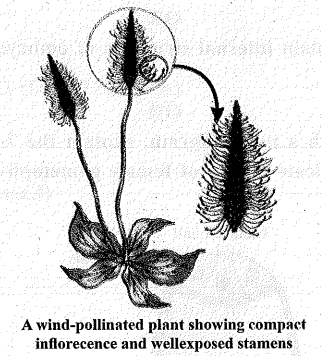
→ They often possess well-exposed stamens so that the pollens are easily dispersed into wind currents, and large often-feathery stigma to easily trap air-borne pollen grains.
→ Wind pollinated flowers often have a single ovule in each ovary and numerous flowers packed into an inflorescence.
→ A familiar example is the corn cob the - tassels you see are nothing but the stigma and style which wave in the wind to trap pollen grains.
→ Wind-pollination is quite common in grasses.

Need a full question paper?

Generate a complete, print-ready paper with questions like this in minutes — across 16+ boards, with answer keys.

Start Generating Free

Similar questions

Explain the inheritance of one gene by Punnett Square ?
Read the following and answer any four questions from (i) to (v) given below:
In today's world, more than 25% of human population is suffering from hunger and malnutrition. Scientists have developed techniques where microbes are grown on industrial scale as a source of good protein which can be grown from waste water, animal manure and even sewage. Single cell proteins are such products. TI1e biomass or protein is extracted from pure or mixed cultures of algae, yeasts, fungi or bacteria. These are a very good source of food for human consumption.
  1. Why the name single cell protein is applied?
  1. It contains only one type of protein.
  2. It is obtained from unicellular edible microbes.
  3. It contains only one type of microorganism.
  4. All of these.
  1. Which of the following is considered under single cell protein?
  1. Algae.
  2. Fungi.
  3. Cyanobacteria.
  4. All of these.
  1. Microorganisms can be a useful food resource for increasing human population because:
  1. These are easy to harvest.
  2. These can grow in water system.
  3. They have a high rate of multiplication thus producing huge biomass.
  4. They have high level of nucleic acid.
  1. Single cell protein can be grown from:
  1. Waste water.
  2. Animal manure.
  3. Sewage.
  4. All of these.
  1. Assertion: Production of single cell protein reduces pollution.
Reason: Single cell protein can be grown from waste water and even sewage.
  1. Both assertion and reason are true and reason is the correct explanation of assertion.
  2. Both assertion and reason are true but reason is not the correct explanation of assertion.
  3. Assertion is true but reason is false.
  4. Both assertion and reason are false.
Read the following and answer any four questions from (i) to (v) given below:
The pollen grains or microspores are the male reproductive bodies of a flower and are contained in the pollen sac or microsporangia. Each pollen grain consists of a single microscopic cell, possessing two coats: the exine and the in tine. The exine of a pollen grain is made of chemically stable material. Because of this, pollen grains are often very well preserved for thousands of years in soil and sediments.
  1. One of the most resistant biological material present in the exine of pollen grain is:
  1. Pectocellulose.
  2. Sporopollenin.
  3. Suberin.
  4. Cellulose.
  1. The exine possesses one or more thin places known as:
  1. Raphe.
  2. Germ pores.
  3. Hilum.
  4. Endothecium.
  1. What is the function of germ pore?
  1. Emergence of radicle.
  2. Absorption of water for seed germination.
  3. Initiation of pollen tube.
  4. All of these.
  1. What is the key advantage to the plant for having such strong pollen grain walls?
  1. It protects the vital genetic material in the pollen grain.
  2. It allows pollen to serve as a valuable fossil record for the study of ancient plants.
  3. It prevents the pollen tube from growing out before the pollen grain reaches the stigma of a compatible species.
  4. It gives weight to the pollen grain, allowing it to cling better to the body surfaces of insect pollinators.
  1. The number of germ pores in dicots and monocots respectively are:
  1. One and three.
  2. Three and two.
  3. Two and three.
  4. Three and one.
​​​​Read the following and answer any four questions from (i) to (v) given below: Edward Wilson described diversity at all levels of biological organisation ranging from macromolecules inside the cells to biomes. It is of three inter-related hierarchial levels-genetic diversity, species diversity and conununity ecosystem diversity. Species diversity is the variety in the number and richness of the species of a region. For example, the Western ghats have a greater amphibian species diversity than the Eastern ghats.
  1. The number of species per unit area is called.
  1. Species evenness.
  2. Species richness.
  3. Species equitability.
  4. Both (a) and (c).
  1. The table below gives the population (in thousands) of ten species (A - J) in four areas (I - IV) consisting of the number of habitats given within brackets against each. Study the table and answer the question which follows:
Area and number of habitats
Species and their population (in thousands) in the area
A
B
C
D
E
F
G
H
I
J
I(11)
23
12
0.52
6.0
-
3.1
1.1
9.0
-
10.3
II(11)
10.2
-
0.62
-
1.5
3.0
-
8.2
1.1
11.2
III(13)
11.3
0.9
0.48
2.4
1.4
4.2
0.8
8.4
2.2
4.1
IV(12)
3.2
10.2
1.1
4.8
0.4
3.3
0.8
7.3
1.3
2.1
Which are out of I to IV shows maximum species diversity?
  1. II
  2. III
  3. IV
  4. I
  1. Study the given populations and choose the correct answer in relation to species diversity.
Population
Species
Species
Individuals
Population A
I
Mammals
3
II
Birds
2
III
Amphibians
2
Population B
I
Mammals
2
II
Mammals
2
III
Amphibians
1
Population C
I
Mammals
3
II
Mammals
2
III
Mammals
4
 
Maximum diversity
Minimum diversity
(a)
Population B
Population C
(b)
Population A
Population C
(c)
Population A
Population B
(d)
Population B
Population A
  1. The concept of species diversity has two components : evenness and richness. Evenness is based on the relative abundance of species. Richness is based on the total number of species present. Diversity indices combine a measure of richness and evenness. The Simpson index (D) is calculated from the following equations:
$\text{D}=\displaystyle\sum_{\text{i}=1}(\text{n}_\text{i}/\text{N})^2$
where, n = total number of organisms of particular species
N = total number of organisms of all species
Below are data collected in two terrestrial plant conununities that represent part of a successional chronosequence. ln this case the values were measured as percent cover.
Early Successional Community
Late Successional Community
Species
Percent Cover
Species
Percent Cover
A
83
F
24
B
5
G
20
C
9
H
18
D
2
I
23
E
1
J
15
The data indicate that, relative to the early successional community, the late successional community has which of the following characteristics?
 
Species Richness
Evenness
(a)
Higher
Higher
(b)
Higher
Lower
(c)
Same
Lower
(d)
Same
Higher
  1. Select the incorrect statement regarding species diversity.
  1. It results in polymorph formation and is useful in adaptation to changes in environmental conditions.
  2. Number of individuals of different species represent species evenness.
  3. It influences biotic interactions and stability of the community.
  4. It is a trait of the community.
Read the following text carefully and answer the questions that follow:
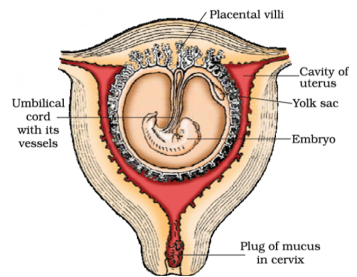
After implantation, finger-like projections appear on the trophoblast called chorionic villi which are surrounded by the uterine tissue and maternal blood. The chorionic villi and uterine tissue become interdigitated with each other and jointly form a structural and functional unit between the developing embryo (foetus) and the maternal body.
Image
i. Name the hormone crucial in parturition. Does the parturition signal originate from the mother or the fetus?(1)
ii. When and where do chorionic villi appear in humans? (1)
iii. Woman has conceived and implantation has occurred. Discuss the impact of progesterone and estrogen. (2)
OR
Fetal ejection reflex leads to parturition. Justify (2)
Suggest some methods to assist infertile couples to have children.
Explain 'rivet popper hypothesis with example.
Read the following text carefully and answer the questions that follow:
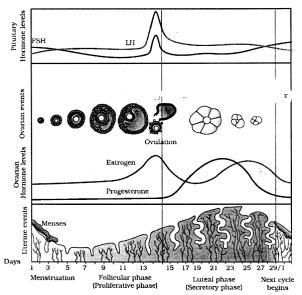
The reproductive cycle in female primates (e.g. monkeys, apes and human beings) is called the menstrual cycle. In human females, menstruation is repeated at an average interval of about 28/29 days, and the cycle of events starting from one menstruation till the next one is called the menstrual cycle Anita has show Diagrammatic presentation of various events during a menstrual cycle.
Image
i. What role do pituitary gonadotropins play during the follicular and ovulatory phases of the menstrual cycle? (1)
ii. The first half of the menstrual cycle is called the proliferative phase as well as the follicular phase. Give reason.(2)
iii. Why does corpus luteum stay active throughout pregnancy and in the absence of fertilization, is active only for 10-12 days?
OR
What happens to corpus luteum in human female if the ovum is (2)
a. fertilised,
b. not fertilised?
Read the following and answer any four questions from (i) to (v) given below:
The endosperm makes the main source of food for the embryo. Generally the endosperm nucleus divides after the division of the oospore, but in several cases the endosperm is formed to a great extent even before the first division of the oospore. There are three general types of endosperm formation: (a) nuclear type, (b) cellular type and (c) helobial type. The endosperm is usually triploid, but haploid endosperm is also found. Endosperm may either be completely consumed by the developing embryo before seed maturation, or it may persist in the mature seed.
  1. Haploid endosperm is found in:
  1. Pin us.
  2. Cauliflower.
  3. Sunflower.
  4. Pea.
  1. Persistent endosperm is found in:
P. Pea Q. Castor R. Bean S. Coconut T. Groundnut.
  1. Q and S.
  2. P and T.
  3. R, S and T.
  4. P, S and T.
  1. Milk of tender coconut represents (A) and the surrounding white coconut meal represents (B).
S. No
A
B
(a)
Cellular endosperm
Free- nuclear endosperm
(b)
Free-nuclear endosperm
Cellular endosperm
(c)
Helobial endosperm
Cellular endosperm
(d)
Free-nuclear endosperm
Helobial endosperm
  1. If an endosperm cell of a gymnosperm contains 12 chromosomes, the number of chromosomes in each cell of the root will be:
  1. 4
  2. 24
  3. 16
  4. 6
  1. In angiosperms, normally after fertilization:
  1. The zygote divides earlier than the primary endosperm nucleus.
  2. The primary endosperm nucleus divides earlier than the zygote.
  3. Both the zygote and primary endosperm nucleus divide simultaneously.
  4. Both the zygote and primary endosperm nucleus undergo a resting period.
Describe tissue culture.