Question
Explain the inheritance of one gene by Punnett Square ?

Answer

$\rightarrow$ Punnett Squre:
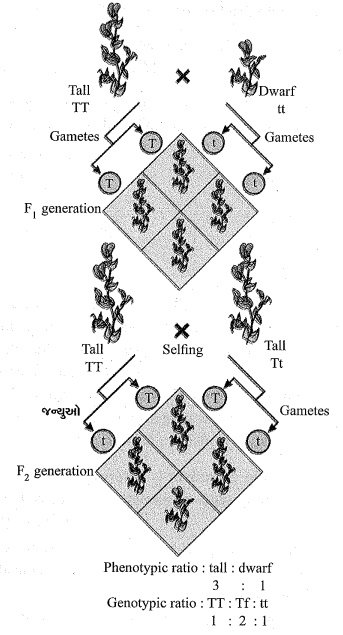
$\rightarrow$ The production of gametes by the parents, the formation of the zygotes, the $F,$ and $F_2$ plants can be understood from a diagram called Punnett Square $($By Reginald $C.$ Punnett).
$\rightarrow$ It is a graphical representation to calculate the probability of all possible genotypes of offspring in a genetic cross.
$\rightarrow$ The Punnett Square shows,
$TT$ $\rightarrow$ Tall $($Male$)$ $(♂)$
$tt$ $\rightarrow$ Dwarf $($Female$)$ $(♀)$
Produced Gametes $(T, t)$
$Tt\rightarrow$ $F$ Progeny $($self$-$pollinated$)$
$\rightarrow$ The $F_1$ plant of the genotype $Tt$ when self$-$ pollinated, produces gametes of the genotype $T$ and $t$ in equal proportion.
$\rightarrow$ When fertilisation takes place, the pollen grains of genotype $T$ have a $50$ per cent chance to pollinate eggs of the genotype $T,$ as well as of genotype $t.$
$\rightarrow$ Also pollen grains of genotype $t$ have a $50$ per cent chance of pollinating eggs of genotype $T,$ as well as of genotype $t.$ As a result of random fertilisation, the resultant zygotes can be of the genotypes $TT, Tt$ or $ tt.$
$\rightarrow$ From the Punnett square it is easily seen that $1/4^{th}$ of the random fertilisations lead to $TT, 1/2$ lead to $Tt $ and $1/4^{th}$ to $tt.$
$\rightarrow$ Though the $F_1$ have a genotype of $Tt,$ but the phenotypic character seen is 'tail'.
$\rightarrow$ At $F_2$, $3/4$ of the plants are tall, where some of them are $TT$ while others are $Tt.$
$\rightarrow$ Externally it is not possible to distinguish between the plants with the genotypes $TT$ and $Tt.$ Hence, within the genotypic pair $Tt$ only
one character $' \ T\ '$ tall is expressed.
$\rightarrow$ Hence the character $T$ or 'tall' is said to dominate over the other allele or 'dwarf character.
$\rightarrow$ It is thus due to this dominance of one character over the other that all the $F_1$ are tall $($though the genotype is $Tt)$ and in the $F_2$ $3/4$ of the plants are tall $($though genotypically $1/2$ are $Tt$ and only $1/4th$ are $TT).$
Genotypic ratio $3 : 1 ($Tall: Dwarf$)$
Phenotypic ratio $1:2:1 \ (TT: Tt: tt)$
$\rightarrow$ The $ 1/4 1/2 1/4$ ratio of $TT \ Tt: tt$ is mathematically condensable to the form of the binomial expression $(ax + by)^2,$ that has the gametes bearing genes $T$ or $t$ in equal frequency of $1/2.$ The expression is expanded as given below:
$\rightarrow$ $(1/2T + 1/2t)^2= (1/2T + 1/2t) \times (1/2T + 1/2t)$
$= 1/4 \ TT + 1/2 \ Tt + 1/4 \ tt$
$\rightarrow$ Mendel self$-$pollinated the $F_2$ plants and found that dwarf $F_2$ plants continued to generate dwarf plants in $F_3$ and $F_4$ generations. He concluded that the genotype of the dwarfs was homozygous $- tt.$ Image

Need a full question paper?

Generate a complete, print-ready paper with questions like this in minutes — across 16+ boards, with answer keys.

Start Generating Free

Similar questions

Loss of habitat and fragmentation leads to loss in biodiversity. Explain with example.
Read the following and answer any four questions from (i) to (v) given below:
Age sex structure of a population can be depicted in the form of a pyramid by plotting the percentage of population of each sex in each age class. Two age sex pyramids are as follows.
  1. Which of the following is correct regarding pyramid B?
  1. It represents stable population.
  2. It represents expanding population.
  3. It represents declining population.
  4. Both (a) and (b).
  1. Total number of individuals of a species per unit area per unit time is called.
  1. Population size.
  2. Population density.
  3. Demography.
  4. Population dynamics.
  1. Which of the following is correct regarding age sex pyramid A and B?
  1. A represents the age sex pyramid of developed country.
  2. B represents the age sex pyramid of developing country.
  3. A represents rapidly growing population.
  4. Both (a) and (b).
  1. A population with a large proportion of older individuals than younger ones will likely to:
  1. Grow larger first and then decline.
  2. Continue to grow indefinitely.
  3. Decline.
  4. None of these.
  1. Assertion: Bell shaped age pyramid represents a stable population.
Reason: ln a stable population, proportion of individuals in reproductive age group is higher than the individuals in pre reproductive age group.
  1. Both assertion and reason are true and reason is the correct explanation of assertion.
  2. Both assertion and reason are true but reason is not the correct explanation of assertion.
  3. Assertion is true but reason is false.
  4. Both assertion and reason are false.
Read the following and answer any four questions from (i) to (v) given below:
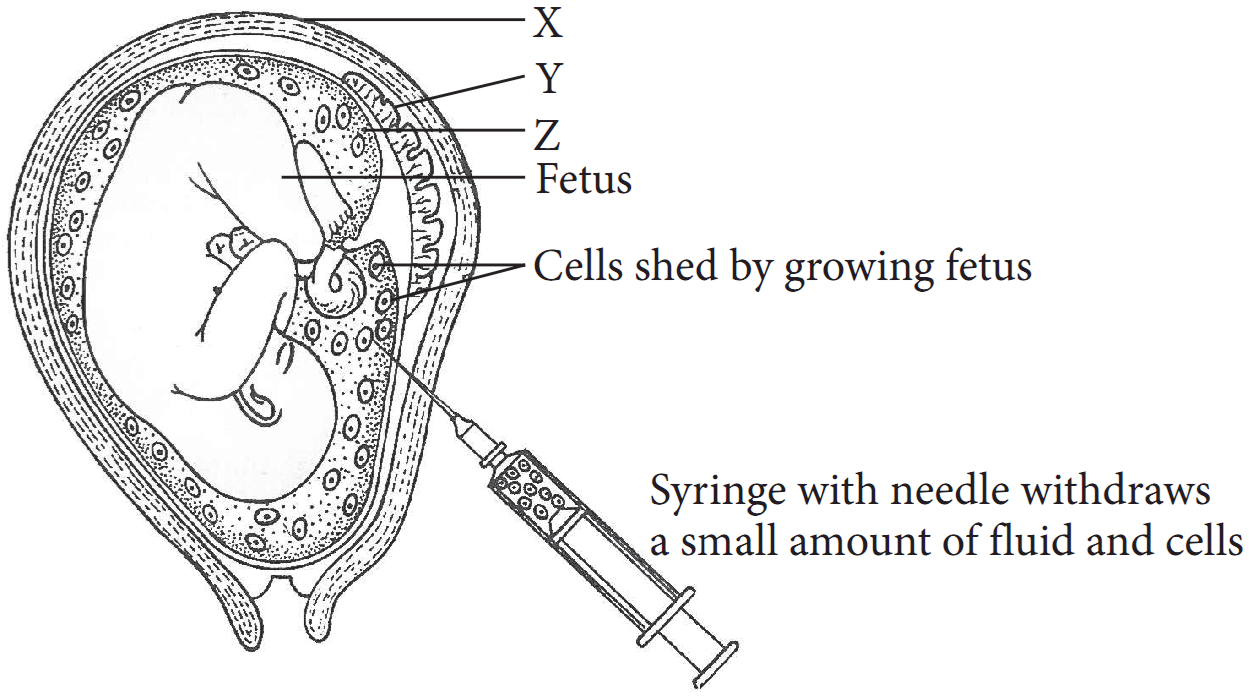
A technique known as amniocentesis is used to determine fetal abnormalities. This test chromosomal pattern in amniotic fluid. However, this technique is legally banned now.
  1. Identify X and Y in the above given figure.
S. No
X
Y
(a)
Amnion
Chorion
(b)
Uterine wall
Placenta
(c)
Placenta
Uterine wall
(d)
Uterine wall
Amnion
  1. What is the function of Z?
  1. Z is an amniotic fluid which prevents dessication of an embryo.
  2. Z is yolk sac which functions as site of early blood cell formation.
  3. Z is amnion, which takes part in placenta formation.
  4. None of these
  1. Which of the following diseases can not be diagnosed by amniocentesis?
  1. Down's syndrome.
  2. Sickle cell disease.
  3. Jaundice.
  4. Cystic fibrosis.
  1. Assertion: Amniocentesis is legally banned for sex determination.
Reason: Amniocentesis was being misused for aborting normal female fetus.
  1. Both assertion and reason are true, and reason is the correct explanation of assertion.
  2. Both assertion and reason are true, but reason is not the correct explanation of assertion.
  3. Assertion is true, but reason is false.
  4. Both assertion and reason are false.
  1. Which of these is a non-invasive technique of detecting fetal disorder?
  1. Fetoscopy.
  2. Chorionic villi sampling.
  3. Amniocentesis.
  4. Ultrasound imaging.
Define decomposition and describe the processes and products of decomposition.###Describe factor affecting decomposition.
Explain population attributes.
Write a short note on pollination by wind.
Read the following text carefully and answer the questions that follow:
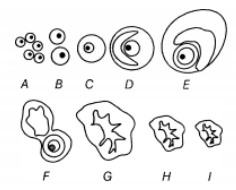
The following is the illustration of the sequence of ovarian events (A-I) in a humans female.
Image
i. Identify the figure that illustrates ovulation and mention the stage of oogenesis it represents. (1)
ii. Name the ovarian hormone and the pituitary hormone that have caused the above mentioned event. (1)
iii. Explain the changes that occur in the uterus simultaneously in anticipation. (2)
OR
Write the differences between C and H. (2)
Describe pregnancy and embryonic development.
Read the following and answer any four questions from (i) to (v) given below:
X and Y are communicable diseases, whereas Wand Z are non-communicable diseases.X is transmitted through vectors whereas Y is transmitted through droplet infection. Wis caused due to a hormone deficiency, whereas Z is a degenerative disease. Based on the above information, answer the following questions.
  1. Identify W, X, Y and Z.
 
W
X
Y
Z
(a)
Coronary artery disease
Cholera
Chikungunya
Chikungunya
(b)
Diabetes
Malaria
Rhinitis
Alzheimer's disease
(c)
Alzheimer's disease
AIDS
Shigella
Plague
(d)
Gonorrhea
Diphtheria
Pertussis
Anthrax
  1. Select the correct statement.
  1. If X is sleeping sickness then its vector is Leishrnania.
  2. If Y is diphtheria then it is caused by Bacillus anthracis.
  3. If W is hypothyroidism then it is caused by deficiency of thyroxine hormone.
  4. If Z is myocardial infarction then patient develops acute rheumatic fever, joint pain and throat infection.
  1. If X and Y both are usual diseases then which of the following holds true?
  1. X could be dengue caused by flavivirus and Y could be AIDS caused by HIV.
  2. X could be chikungunya whereas Y could be rhinitis.
  3. X could be hepatitis whereas Y could be rabies.
  4. X could be chicken pox caused by Va rice/la zoster virus whereas Y could be yellow fever caused by flavivirus
  1. If X and Y both are bacterial diseases then select the correct match from the following.
  1. X- Bubonic plague-Yersinia pestis
  2. Y-Leprosy- Mycobacteriurn leprae
  3. X-Whooping cough-Bordetella pertussis
  4. Y-Botulism-Clostridiurn botulinum
  1. Assertion: Communicable diseases could be contagious or non-contagious.
Reason: Diseases that spread through vectors are non-contagious disease.
  1. Both assertion and reason are true, and reason is the correct explanation of assertion.
  2. Both assertion and reason are true, but reason is not the correct explanation of assertion.
  3. Assertion is true, but reason is false.
  4. Both assertion and reason are false.
Explain Methodology of HGP