Kekule structure of benzene:
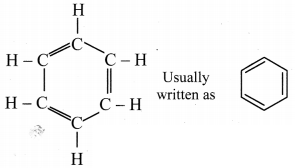
i. August Kekule in 1865 suggested the structure for benzene having a cyclic planar ring of six carbon atoms with alternate single and double bonds and hydrogen atom attached to each carbon atom..
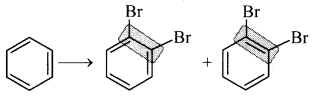
ii. The Kekule structure indicates the possibility of two isomeric 1,2-dibromobenzenes. In one of the isomers, the bromine atoms would be attached to the doubly bonded carbon atoms whereas in the other, they would be attached to single bonded carbons.
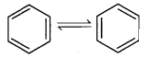
iii. However, benzene was found to form only one ortho-disubstituted benzene. This problem was overcome by Kekule by suggesting the concept of oscillating nature of double bonds in benzene as given below.
iv. Even with this modification, Kekule structure of benzene failed to explain unusual stability and preference to substitution reactions rather than addition reactions, which was later explained by resonance.