Question
Write a short note on transcription unit.### Explain : Transcription unit
Answer

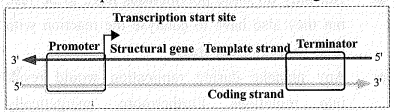
→ A transcription unit in DNA is defined primarily by the three regions in the DNA :
(i) The Structural gene
(ii) A Promoter
(iii) A Terminator
(i) A structural gene:
→ There is a convention in defining the two strands of the DNA in the structural gene of a transcription unit.
→ Since the two strands have opposite polarity and the DNA-dependent RNA polymerase also catalyse the polymerisation in only one direction, that is, 5' → 3',
→ Template strand:
→ The strand that has the polarity 3' → 5' acts as a template, and is also referred to as template strand.
Coding strand :
→ The other strand which has the polarity (5'→ 3') and the sequence same as RNA (except thymine at the place of uracil), is displaced during transcription. Strangely, this strand (which does not code for anything) is referred to as coding strand.
→ All the reference point while defining a transcription unit is made with coding strand.
Image
Schematic structure of a transcription unit
(ii) A promoter:
→ The promoter and terminator flank the structural gene in a transcription unit.
→ The promoter is said to be located towards 5'-end (upstream) of the structural gene (the reference is made with respect to the polarity of coding strand).
→ It is a DNA sequence that provides binding site for RNA polymerase and it is the presence of a promoter in a transcription unit that also defines the template and coding strands.
(iii) A Terminator:
→ By switching its position with terminator, the definition of coding and template strands could be reversed.
→ The terminator is located towards 3'-end (downstream) of the coding strand and it usually defines the end of the process of transcription.
→ There are additional regulatory sequences that may be present further upstream or downstream to the promoter.

Need a full question paper?

Generate a complete, print-ready paper with questions like this in minutes — across 16+ boards, with answer keys.

Start Generating Free

Similar questions

Write a note on Mechanism of DNA replication
Read the following and answer any four questions from (i) to (v) given below:

Rajesh, Ravi, and Rohit are roommates. 'They are doing their graduation. Few months back Ravi fell ill. it took him around 3 weeks to recover. Both his friends were absolutely healthy at that time. After sometime, Rajesh also fell ill from some other disease. This time Ravi and Rohit both contracted the same illness. Based on the above information, answer the following questions.

  1. Which of the following holds true for Ravi's illness?
  1. Ravi was suffering from a communicable disease that is transmitted through vector.
  2. Ravi was suffering from a communicable disease that is transmitted through faecal oral route.
  3. Ravi was suffering from a non-communicable disease like anaemia.
  4. Ravi was suffering from a non-communicable disease like Down's syndrome.
  1. Select the correct statement.
  1. Ravi contracted a disease caused by air borne microbes.
  2. Ravi could have suffered a nutritional disorder.
  3. Ravi suffered a non-contagious disease.
  4. Both (b) and (c)
  1. Which could be correctly said for Rajesh's illness?
  1. Rajesh's illness was due to a microbial infection.
  2. Rajesh's illness could be contagious or non-contagious.
  3. Rajesh's illness could be cured by antibiotics.
  4. All of these
  1. Which of the following may depicts Ravi's and Rajesh's illness?
S.no
Ravi
Rajesh
(a)
Which of the following may depicts Ravi's and Rajesh's illness?
Myocardial infection
(b)
Whooping cough
Tetanus
(c)
Gastritis
Rhinitis
(d)
Hypertensio
Thyroid
  1. Assertion: Diabetes mellitus is a non-communicable disease which can be completely cured.

Reason: Diabetes mellitus is caused by deficiency of aldosterone hormone.
  1. Both assertion and reason are true, and reason is the correct explanation of assertion.
  2. Both assertion and reason are true, but reason is not the correct explanation of assertion.
  3. Assertion is true, but reason is false.
  4. Both assertion and reason are false.
Explain 'rivet popper hypothesis with example.
Describe different outbreeding devices in detail.###Describe different devices to discourage self pollination.###Describe different devices to encourage cross pollination.
Read the following and answer any four questions from (i) to (v) given below:

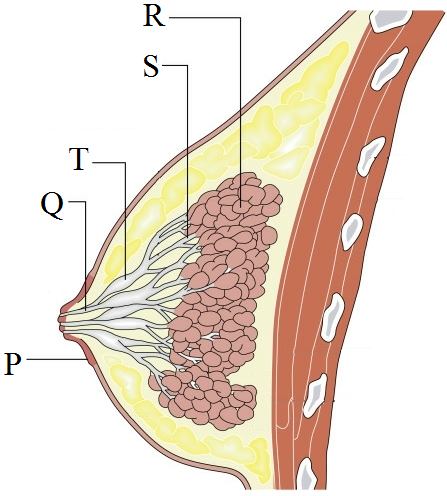
A functional mammary gland is characteristic of all female mammals. Mammary glands are paired structures that contain glandular tissue and variable amount of fat. Refer to the given figure of a mammary gland and answer the following questions.

  1. Mammary glands are modified:
  1. Sweat glands.
  2. Sebaceous glands.
  3. Sudoriferous glands.
  4. Lacrimal glands.
  1. Identify the incorrectly matched pair.
  1. P - Areola.
  2. Q - Lactiferous duct.
  3. S - Mammary duct.
  4. T - Mammary alveoli.
  1. Mammary ducts expand to form:
  1. Mammary alveoli.
  2. Mammary ampullae.
  3. Lactiferous ducts.
  4. Mammary tubules.
  1. What is areola?
  1. Grape-like clusters of milk secreting structures.
  2. Fatty tissue between the mammary lobes.
  3. Circular pigmented area of skin around nipple.
  4. Connective tissue that supports the alveoli and ducts.
  1. Assertion: The size of breast depends on the amount of adipose tissue.

Reason: The adipose tissue supports the alveoli and the ducts.

  1. Both assertion and reason are true, and reason is the correct explanation of assertion.
  2. Both assertion and reason are true, but reason is not the correct explanation of assertion.
  3. Assertion is true, but reason is false.
  4. Both assertion and reason are false.
Explain the amplification of gene of interest using PCR (Diagram is must)
Read the following and answer any four questions from (i) to (v) given below:
Disposal of untreated sewage into the river or freshwater pond causes huge water pollution. Four water samples from different sources (A, B, C, D) are collected and tested for BOD value in a lab to assess their quality. The BOD values are presented in the given table. Water samples are collected from primary effluent, secondary effluent, untreated sewage and river water. Study the given table and answer the following.
Sample BOD
A 20mg/ L
B 5mg/ L
C 300mg/ L
D 400mg/ L
  1. The source of sample 'C' is:
  1. River water.
  2. Primary effluent.
  3. Secondary effluent.
  4. Untreated sewage water.
  1. If sewage in untreated condition is disposed off in a freshwater body then.
  1. BOD and dissolved oxygen both will increase.
  2. BOD will increase and dissolved oxygen will decreas.
  3. BOD will decrease and dissolved oxygen will increase.
  4. BOD and dissolved oxygen both will decrease.
  1. A large number of pathogenic microbes can be present in water sample of:
  1. C
  2. A
  3. D
  4. Both (a) and (c).
  1. High value of BOD in sample O is due to:
  1. High amount of organic wastes and aerobic microbes.
  2. High amount of inorganic wastes and anaerobic microbes.
  3. High amount of organic wastes and anaerobic microbes.
  4. High amount of inorganic wastes and aerobic microbes.
  1. River water is represented by the sample.
  1. A
  2. B
  3. C
  4. D
Read the following and answer any four questions from (i) to (v) given below:

DNA replication is a complex multistep process that requires enzymes, protein factors and metal ions. DNA replication in eukaryotes occurs in the nucleus during the S-phase of the cell cycle. It is semidiscontinuous in eukaryotes. in prokaryotes, replication takes place in the cytoplasm. DNA replication in bacteria occurs prior to fission. Nucleoid or viral chromosome is a single molecule of nucleic acid, it may be linear of circular. Nucleic acid in a virus is either DNA or RNA but never both.

  1. In viral DNA, how many origin of replication are present?
  1. Single
  2. Twice
  3. Multiple
  4. None
  1. Select the main enzyme involved in DNA replication.
  1. DNA ligase
  2. DNA dependent DNA polymerase
  3. Topoisomerase
  4. Helicase
  1. Read the given statement and select the option that correctly fill in the blanks. Enzyme (i) acts over the Ori site and unwinds the two strands of DNA by destroying (ii) bonds.
  1. (i)-Helicase (ii) Glycosidic
  2. (i)-Helicase (ii)-Hydrogen
  3. (i)-Unwindase (ii)-Phosphodiester
  4. (i)-Unwindase (ii)-Glycosidic
  1. DNA strand, built up of Okazaki fragments, is called.
  1. Lagging strand.
  2. Leading strand.
  3. Complementary strand.
  4. Parental strand.
  1. Select the incorrect statement about DNA polymerase in eukaryotes.
  1. Polymerase $\alpha$ is required for initiation of replication.
  2. When the RNA primer gets removed the gap is filled by DNA polymerase $\beta$ in eukaryotes.
  3. Polymerase $\in$ helps in elongation of lagging strand.
  4. Polymerase $\delta$ is largest and main enzyme for DNA replication in eukaryotes.
Read the following and answer any four questions from (i) to (v) given below:

Growth of a population with time shows specific and predictable patterns. Two types of growth pattern of population are exponential and logistic growth. When resources in the habitat are unlimited each species has the ability to realise fully its innate potential to grow in number. Then the population grows in exponential fashion. When the resources are limited growth curve shows an initial slow rate and then it accelerates and finally slows giving the growth curve which is sigmoid.

  1. Which of the following statement is incorrect?
  1. Exponential growth occurs in organism such as lemmings.
  2. Logistic growth is more realistic.
  3. Exponential growth has two phases lag and log.
  4. ln logistic growth, population passes well beyond the carrying capacity of ecosystem.
  1. Which of the following equations correctly represents the exponential population growth curve?
  1. $\text{dN}/\text{dt}=\text{rN}$

  2. $\text{dN}/\text{dt}=\text{rN}\Big(\frac{\text{K-N}}{\text{K}}\Big)$

  3. $\text{N}_\text{t}=\text{N}_\text{o}\text{e}^\text{rt}$

  4. Both (a) and (c).
  1. Which of the following equations correctly represents Verhulst-Pearl logistic growth?
  1. $\text{dN}/\text{dt}=\text{rN}\Big(\frac{\text{K-N}}{\text{K}}\Big)$

  2. $\text{dN}/\text{dt}=\frac{\text{rN}}{\text{K}}$

  3. $\text{dN}/\text{dt}=\frac{\text{N}(\text{K}-\text{N})}{\text{K}}$

  4. $\text{dN}/\text{dt}=\frac{\text{r}(\text{K}-\text{N})}{\text{K}}$

  1. The population growth is generally described by the following equation:

$\frac{\text{dN}}{\text{dt}}=\text{rN}\Big(\frac{\text{K}-\text{N}}{\text{K}}\Big)$

What does 'r' represent in the given equation?
  1. Population density at time 't'.
  2. Intrinsic rate of natural increase.
  3. Carrying capacity.
  4. The base of natural logarithm.
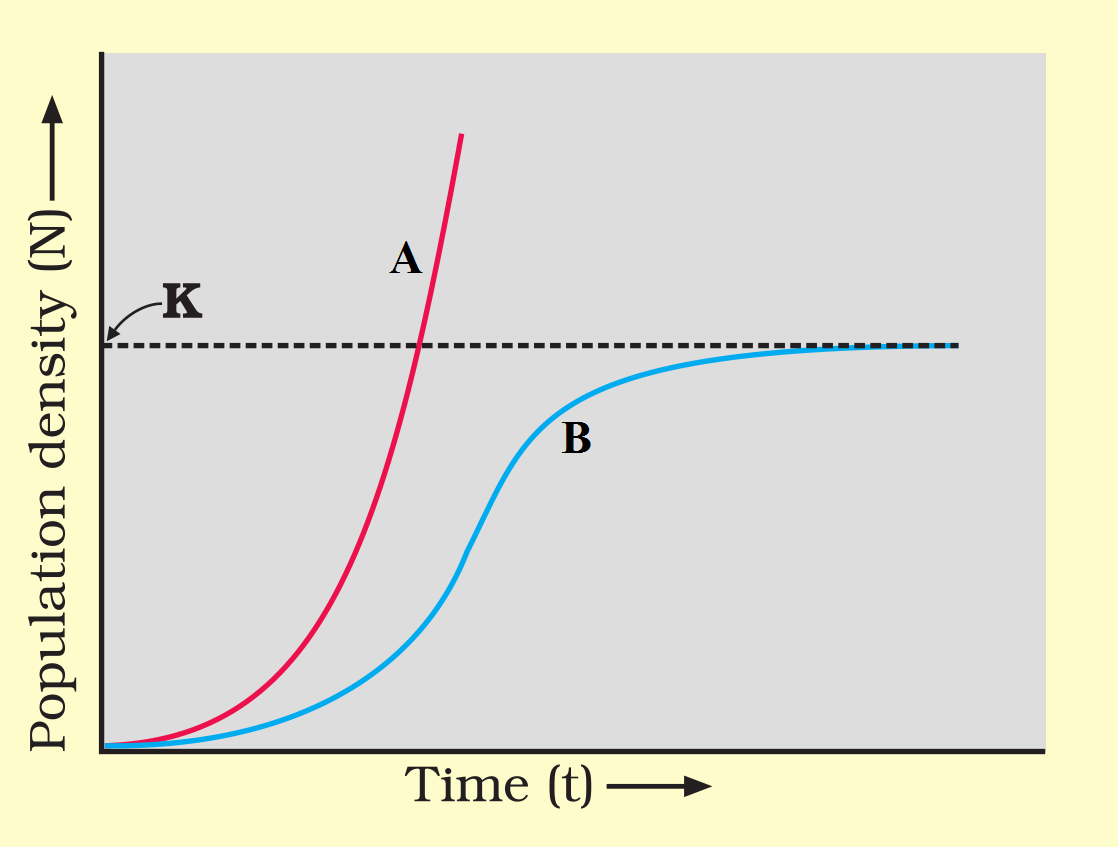
  1. Study the population growth curves (A and B) in the given graph and select the incorrect option.

  1. Curve 'A: shows exponential growth, represented by equation $\frac{\text{dN}}{\text{dt}}=\text{rN}$.

  2. Curve 'B' shows logistic growth, represented by equation $\frac{\text{dN}}{\text{dt}}=\text{rN}\Big(\frac{\text{K}-\text{N}}{\text{K}}\Big)$

  3. Exponential growth curve is considered as more realistic than the logistic growth curve.
  4. Curve 'A' can also be represented by equation $\text{N}_\text{t}=\text{N}_\text{o}\text{e}^\text{rt}$.

Microorganisms include bacteria, viruses, fungi and protozoa. In our mind, we presume, most of the time, that microbes are always harmful. Microbes are, of course, the causal agents of many infections diseases of plants and animals including humans but they also have lots of beneficial role. Lactic acid bacteria (LAB) are one of this kind of useful group. These are Gram positive, non-sporulating, either rod-shaped or spherical bacteria. They produce lactic acid in milk products as major metabolic end product of carbohydrate fermentation. LAB are considered as natural fermentors. Lactobacillus is a common LAB which converts lactose sugar of milk into lactic acid, that causes coagulation and partial digestion of milk protein casein. Milk is then changed into curd, yoghurt and cheese. Lactobacillus is also used in probiotics which have potentially beneficial effect on gut ecosystem of humans. Some other probiotic strain used belong to the Genus Bifidobacterium.

  1. Which of the following is not considered as microorganisms?
  1. Bacteriophage.
  2. Streptococcus.
  3. Porphyra.
  4. Staphylococcus.
  1. Select the incorrect option regarding the characteristics of lactic acid bacteria.
  1. They are rod-shaped or spherical.
  2. They are Gram positive.
  3. They take part in carbohydrate fermentation.
  4. They are acid intolerant.
  1. Which of the following is not a lactic acid producing bacteria?
  1. Streptococcus.
  2. Lactococcus.
  3. Saccharomyces.
  4. Enterococcus.
  1. Probiotics are:
  1. Gut friendly live bacteria.
  2. Acid balancing alternated bacteria.
  3. Beneficial amount of dead bacteria.
  4. Gram negative attenuated bacteria.
  1. Assertion: Lactobacillus bacteria do not retain crystal violet stain while staining.

Reason: Lactobacillus have a very thin layer of peptidoglycan layer in their cell wall.

  1. Both assertion and reason are true and reason is the correct explanation of assertion.
  2. Both assertion and reason are true but reason is not the correct explanation of assertion.
  3. Assertion is true but reason is false.
  4. Both assertion and reason are false.