Question
Why does a phonograph-record attract dust particles just after it is cleaned?

Answer

When a phonograph record is cleaned, it develops a charge on its surface due to rubbing. This charge attracts the neutral dust particles due to induction. 

Need a full question paper?

Generate a complete, print-ready paper with questions like this in minutes — across 16+ boards, with answer keys.
Start Generating Free

Similar questions

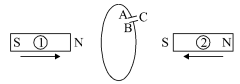
Two bar magnets are moving rapidly towards a metallic loop joined across a capacitor C as shown in the figure. What is the polarity of the capacitor?
Image
What is the meaning of stopping potential in the context of photoelectric effect?
The radii of curvature of the faces of a double convex lens are 10 cm and 15 cm. If focal length of the lens is 12 cm, find the refractive index of the material of the lens.
Write the mathematical relation between mobility and drift velocity of charge carriers in a conductor. Name the mobile charge carriers responsible for conduction of electric current in (i) an electrolyte (ii) an ionised gas.
Light of frequency $7.21 \times 10^{14} Hz$ is incident on a metal surface. Electrons with a maximum speed of $6.0 \times 10^5 m / s$ are ejected from the surface. What is the threshold frequency for photoemission of electrons?
\[\begin{array}{l}\left(h=6.625 \times 10^{-34} Js,\right. \\e=1.6 \times 10^{-19} C \\\left.m=9.1 \times 10^{-31} kg\right)\end{array}\]
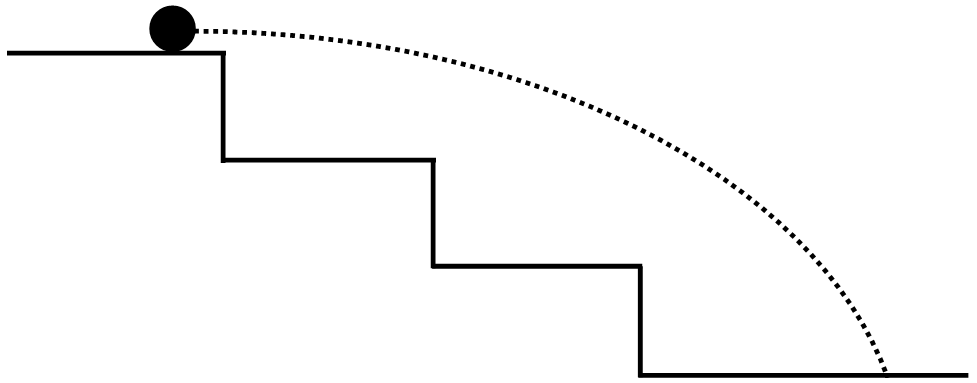
A staircase contains three steps each 10cm high and 20cm wide (figure). What should be the minimum horizontal velocity of a ball rolling off the uppermost plane so as to hit directly the lowest plane?

A simple microscope using a single lens often shows coloured image of a white source. Why?
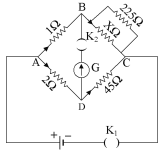
In the given figure, if the Wheatstone Bridge is balanced, then find the magnitude of unknown resistance $X$. Image
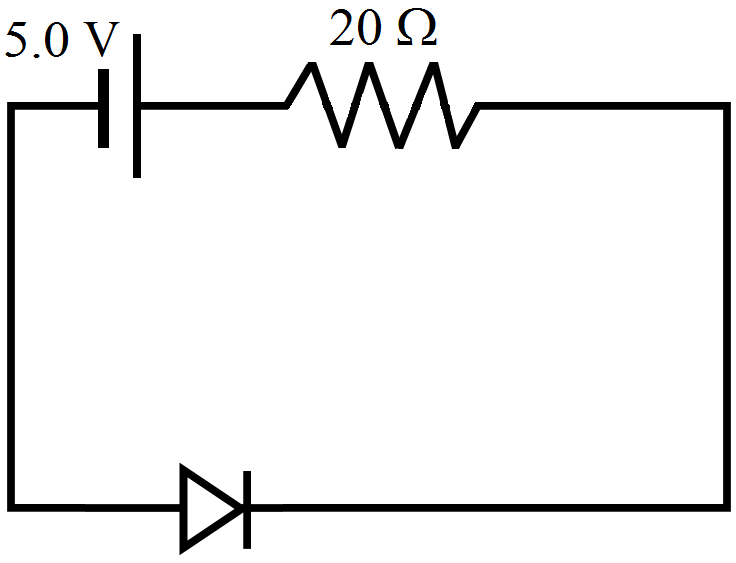
Calculate the current through the circuit and the potential difference across the diode shown in figure. The drift current for the diode is $20\mu\text{A}.$

In a double-slit experiment the angular width of a fringe is found to be 0.2° on a screen placed 1 m away. The wavelength of light used is 600 nm. What will be the angular width of the fringe if the entire experimental apparatus is immersed in water? Take refractive index of water to be 4/3.