Gujarat BoardEnglish MediumSTD 12 SciencePhysicsMOVING CHARGES AND MAGNETISM2 Marks
Question
Write and explain Ampere's circuital law.
✓
Answer
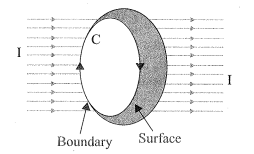
→As shown in the figure, Ampere's circuital law considers an open (free) surface with a boundary line. →An electric current is passing through this open surface. →Consider the surface boundary divided into small elements of length dl . At this element, the tangential component of the magnetic field is $B _t$ $(= B \cos \theta)$ →The integral of the product of the length element (dl) and the tangential component of the magnetic field is equal to $\mu_0$ times the total current passing through the surface. $\begin{aligned} & \oint B _t d l=\mu_0 I \\ \therefore \quad & \oint( B \cos \theta) d l=\mu_0 I \\ \therefore \quad & \oint \overrightarrow{ B } \cdot d \vec{l}=\mu_0 I \end{aligned}$ →Here, the integral is taken over the closed loop coinciding with the boundary C of the surface. →Here, the right hand thumb rule is used for sign - convention of electric currents enclosed by a closed loop. →Fingers of the right hand be curled in the sense the boundary is traversed in the loop then the direction of the thumb gives the sense in which the current is considered as positive and current in the opposite direction is considered negative. → To simplify Ampere's circuital law, the loop is assumed, which is called an amperian loop. →The loop is chosen in such a way that for each point of it, either (i) $\vec{B}$ is tangential to the loop and B is a nonzero constant. (ii) $\vec{B}$ is perpendicular (or normal) to the loop (iii) $\overrightarrow{ B }$ is eliminated (or vanishes) →Now, suppose $L$ is the length of the loop for which $\vec{B}$ is tangential and the current enclosed by the loop is $I _e$ then equation (1) becomes. $BL =\mu_0 I _e$ →This equation is a special representation of Ampere's circuital law.
Need a full question paper?
Generate a complete, print-ready paper with questions like this in minutes — across 16+ boards, with answer keys.