Question
Write and explain Kirchhoff's junction rule.

Answer

$\rightarrow$ Kirchhoff's junction rule : "At any junction, the sum of the currents entering the junction is equal to the sum of currents leaving the junction."
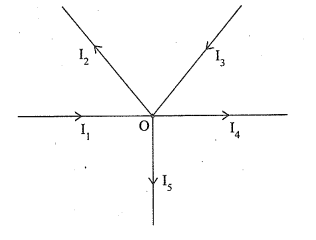
$\rightarrow$ Consider junction $O$ of a network as shown in the figure.

Image
$\rightarrow$The currents meeting at the junction point $O$ are $I _1, I _2, I _3, I _4$ and $I _5$ respectively. Their directions are represented by arrows in the figure.
$\rightarrow$ Let $Q_1, Q_2, Q_3, Q_4$, and $Q_5$ be charges flowing through the cross- sectional area of conductors at time $t$ respectively.
$\rightarrow$ Thus,
$I _1=\frac{ Q _1}{t} \therefore Q _1= I _1 t$
$I _2=\frac{ Q _2}{t} \therefore Q _2= I _2 t \ldots$
$I _3=\frac{ Q _3}{t} \therefore Q _3= I _3 t$
$I _4=\frac{ Q _4}{t} \therefore Q _4= I _4 t$
$I _5=\frac{ Q _5}{t} \therefore Q _5= I _5 t$
$\rightarrow$ From the figure, the total electric charge entering the junction is $Q_1+Q_3$ while $Q_2+Q_4+Q_5$ amount of electric charge is leaving the junction in time $t$.
$\rightarrow$ According to the law of conservation of charge,
$Q _1+ Q _3= Q _2+ Q _4+ Q _5$
$\therefore I _1 t+ I _3 t= I _2 t+ I _4 t+ I _5 t$
$\therefore I _1+ I _3= I _2+ I _4+ I _5$
$\rightarrow$​​​​​​​ Thus at the junction the sum of the currents entering the junction is equal to the sum of currents leaving the junction.

Need a full question paper?

Generate a complete, print-ready paper with questions like this in minutes — across 16+ boards, with answer keys.
Start Generating Free

Similar questions

  1. Distinguish between ‘Analog’ and ‘Digital’ forms of communication.
  2. Explain briefly two commonly used applications of the ‘Internet’.
Figure. shows a cylindrical tube of cross-sectional area A fitted with two frictionless pistons. The pistons are connected to each other by a metallic wire. Initially, the temperature of the gas is $T_0$ and its pressure is P, which equals the atmospheric pressure. (a) What is the tension in the wire? (b) What will be the tension if the temperature is increased to $2T_0?$​​​​​​​
Two dielectric blocks (whose dielectric constants are $K_1$ and $K_2$, respectively) are filled between the plates of a parallel plate capacitor as shown in the figure. What will be the capacitance of the capacitor?
Image
A free neutron beta-decays to a proton with a half-life of 14 minutes.
  1. What is the decay constant?
  2. Find the energy liberated in the process.
The charge on a parallel plate capacitor varies as $\text{q}=\text{q}_0\cos2\pi\text{vt}$. The plates are very large and close together (area = A, separation = d). Neglecting the edge effects, find the displacement current through the capacitor?
How can a bundle of optical fibers be used? Explain.
A simple microscope is rated 5 for a normal relaxed eye. What will be its magnifying power for a relaxed farsighted eye whose near point is 40cm?
A transparent paper (refractive index = 1.45) of thickness 0.02mm is pasted on one of the slits of a Young's double slit experiment which uses monochromatic light of wavelength 620nm. How many fringes will cross through the centre if the paper is removed?
Define lens and write its formula.
The force on a north pole,$\overrightarrow{\text{F}}=\text{m}\overrightarrow{\text{B}},$ is parallel to the field $\overrightarrow{\text{B}}.$ Does it contradict our earlier knowledge that a magnetic field can exert forces only perpendicular to itself?