Question
Write any four general properties of electric field lines.

Answer

(i) Electric field lines are imaginary curves drawn in such a way that the tangent to it of each point shows the direction of electric field at that point.
(ii) Field lines start from positive charges and end at negative charges. If there is a single charge, they may start or end at infinity.
(iii) In a charge-free region, electric field lines can be taken to be continuous curves without any breaks.
(iv) Two field lines never cross each other.
(v) Electrostatic field lines do not form any closed loops.
(vi) Distribution of electric field lines gives an idea of electric field intensity in that region.
(vii) Field lines of a uniform electric field are mutually parallel and equidistant.

Need a full question paper?

Generate a complete, print-ready paper with questions like this in minutes — across 16+ boards, with answer keys.
Start Generating Free

Similar questions

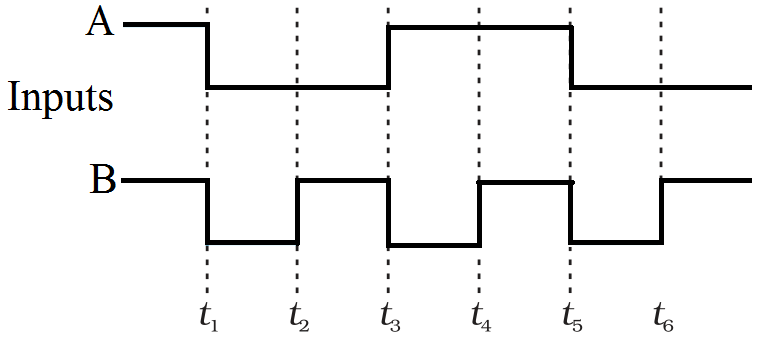
The given inputs A and B are fed to 2-inputs NAND gate. Draw the output waveform of the gate.

Define activity of a sample of a radioactive substance. The value of the disintegration constant of a radioactive substance is 0.0693h-1. Find the time after which the activity of a sample of this substance reduces to one-half that of its present value.
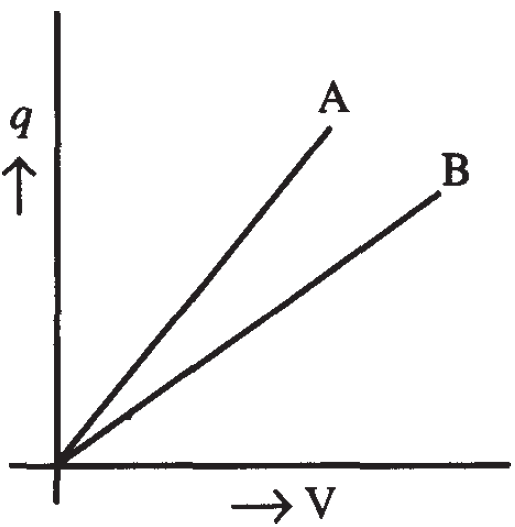
The given graph shows the variation of charge q versus potential difference V for two capacitors C1 and C2. The two capacitors have same plate separation, but the plate area of C2 is double than that of C1. Which of the lines in the graph correspond to C1 and C2 and why?

Write two points of difference between intrinsic and extrinsic semiconductors.
The susceptibility of magnesium at 300K is 1.2 × 10-5. At what temperature will the susceptibility increase to 1.8 × 10-5?
The value of the Brewster angle for a transparent medium is different for lights of different colours.
At room temperature (27.0°C) the resistance of a heating element is $100\ \Omega.$ What is the temperature of the element if the resistance is found to be $117\ \Omega,$ given that the temperature coefficient of the material of the resistor is $1.70\times10^{-4}\ ^\circ\text{C}^{-1}.$
A hydrogen atom contains one proton and one electron. It may be assumed that the electron revolves in a circle of radius 0.53 angstrom (1 angstrom = 10-10m and is abbreviated as A) with the proton at the centre. The hydrogen atom is said to be in the ground state in this case. Find the magnitude of the electric force between the proton and the electron of a hydrogen atom in its ground state.
Explain that the nature of electron motion in a solid is very different from that in an isolated atom.
On changing a current carrying coil of N turns and R radius into a straight wire, how many times the magnetic field at distance R will be than at the magnitude at the center of the coil?