Question
Write Bohr's postulates of hydrogen atom.

Answer

Bohr's Postulates : (i) An atom consists of a very tiny positively charged nucleus. Nearly the entire mass of the atom is concentrated in the nucleus.
(ii) The electrons in an atom revolve around the nucleus in certain permitted circular orbits. The electrostatic force of attraction between the electron and the nucleus provides the necessary centripetal force.
(iii) An electron can revolve only in those orbits for which its orbital angular momentum is an integral multiple of $\frac{h}{2 \pi}$. Here, h is a universal constant known as Planck's constant $=6.63 \times 10^{-34} Js$
If $r$ is the radius of a permitted orbit, $m$ is the mass of the electron and $v$ is the velocity of the electron in that orbit, then
$m v r=n\left(\frac{h}{2 \pi}\right)$
where $n$ is an integer known as principle quantum number and has integral values 1, 2, 3, ...This relation is regarded as a quantisation condition for the angu-lar momentum of the electron
(iv) An electron revolving in a permitted orbit does not radiate energy though it is accelerating. So, the total energy of the electron remains constant. The permitted orbits are called stationary or non-radiating orbits. By introducing the concept of stationery orbit, Bohr could explain the stability of the atomic structure.
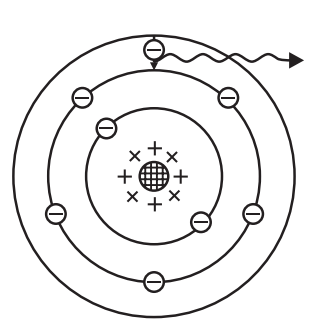
(v) When an electron jumps from higher orbit to lower orbit, electromagnetic radiation is emitted.
Image
On the other hand, there is absorption of energy when an electron jumps from lower orbit to higher orbit. Consider two orbits of principle quantum numbers n1 and n2 Let En1 and En2 be the energies associated with respective orbits. The frequency of the emitted radiation is given by
$h \nu= E _{n_2}- E _{n_1}$
$\Rightarrow \quad v=\left(\frac{E_{n_2}-E_{n_1}}{h}\right)$
It is obvious that emission of energy from a atom takes place only when an electron jumps from higher energy level to any lower level. Hence in the energy emitted by an atom has only some definite frequency waves. If the spectrum of this energy it taken it is obtained as a line spectrum, in which there are many sharp lines.

Need a full question paper?

Generate a complete, print-ready paper with questions like this in minutes — across 16+ boards, with answer keys.
Start Generating Free

Similar questions

What is a transformer? It is of how many types? Explain the principle, construction and working of any transformer.
A double convex lens has focal length $25\ cm$. The radius of curvature of one of the surfaces is double of the other. Find the radii, if the refractive index of the material of the lens is $1.5$.
Write the expression for the force, $\vec{\text{F}}$ acting on a charged particle of charge ‘q’, moving with a velocity $\vec{\text{v}}$ in the presence of both electric field $\vec{\text{E}}$ and magnetic field $\vec{\text{B}}$. Obtain the condition under which the particle moves undeflected through the fields.
A block slides down an inclined surface of inclination 30° with the horizontal. Starting from rest it covers 8m in the first two seconds. Find the coefficient of kinetic friction between the two.
A faulty barometer contains certain amount of air and saturated water vapour. It reads 74.0cm when the atmospheric pressure is 76.0cm of mercury and reads 72.10cm when the atmospheric pressure is 74.0cm of mercury. Saturation vapour pressure at the air temperature = 1.0cm of mercury. Find the length of the barometer tube above the mercury level in the reservoir
Write the definition of electric flux.Obtain the expression for the electric field intensity at any point due to a uniformly charged straight wire of infinite extension using Gauss'law. Draw the necessary diagram.
Determine the current in each branch of the network shown in Fig. $3.17$.
Image
A person travels by a car at a speed of 180km/h. It takes exactly 10 hours by his wristwatch to go from the station A to the station B:
  1. What is the rest distance between the two stations?
  2. How much time is taken in the road frame by the car to go from the station A to the station B?
Consider the situation shown in figure. Suppose a small electric field E exists in the space in the vertically upward direction and the upper block carries a positive charge Q on its top surface. The friction coefficient between the two blocks is g but the floor is smooth. What maximum horizontal force F can be applied without disturbing the equilibrium?
[Hint: The force on a charge Q by the electric field E is F = QE in the direction of E.]
A circular coil of 200 turns has a radius of 10cm and carries a current of 2.0A.
  1. Find the magnitude of the magnetic field. B at the centre of the coil.
  2. At what distance from the centre along the axis of the coil will the field B drop to half its value at the centre? $\big(\sqrt[3]{4}=1.5874\ ...\big)$