Question
Write characteristics of different components of electromagnetic waves and describe them.
Answer

SELF

Need a full question paper?

Generate a complete, print-ready paper with questions like this in minutes — across 16+ boards, with answer keys.

Start Generating Free

Similar questions

An electron makes 3 × 10⁵ revolutions per second in a circle of radius 0.5 angstrom. Find the magnetic field B at the centre of the circle.
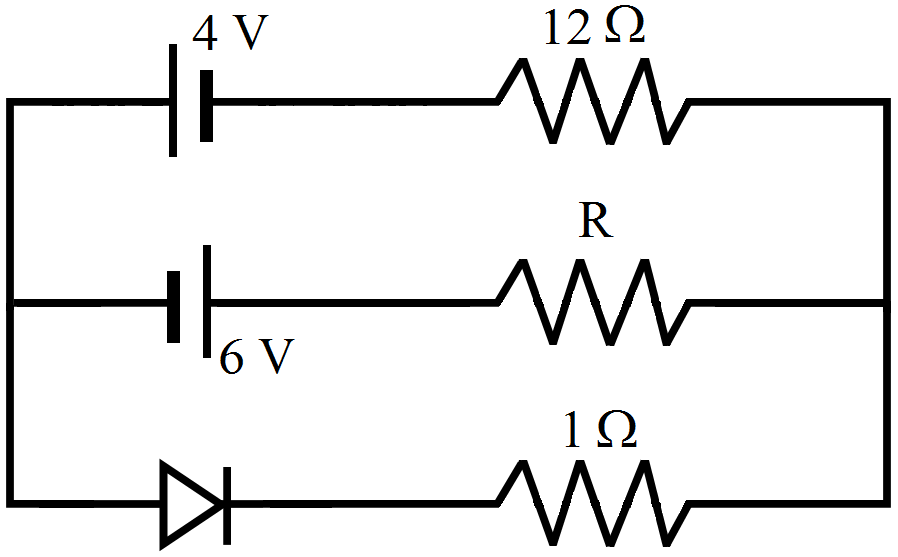
Find the current through the resistance R in figure. if.

  1. $\text{R}=12\Omega$
  2. $\text{R}=48\Omega$
A room has AC run for 5 hours a day at a voltage of 220V. The wiring of the room consists of Cu of 1mm radius and a length of 10m. Power consumption per day is 10 commercial units. What fraction of it goes in the joule heating in wires? What would happen if the wiring is made of aluminium of the same dimensions?
cu = 1.7 × 10⁻⁸Ωm , ρAl = 2.7 × 10-8 Ωm]
To ensure almost 100 per cent transmittivity, photographic lenses are often coated with a thin layer of dielectric material. The refractive index of this material is intermediated between that of air and glass (which makes the optical element of the lens). A typically used dielectric film is MgF2 (n = 1.38). What should the thickness of the film be so that at the center of the visible speetrum $(5000\mathring{\text{A}})$ there is maximum transmission.
Are the nucleons fundamental particles, or do they consist of still smaller parts? One way to find out is to probe a nucleon just as Rutherford probed an atom. What should be the kinetic energy of an electron for it to be able to probe a nucleon? Assume the diameter of a nucleon to be approximately 10-15m.
A long straight cable of length l is placed symmetrically along z-axis and has radius a(< < l). The cable consists of a thin wire and a co-axial conducting tube. An alternating current $\text{I}(\text{t})=\text{I}_0\sin(2\pi\text{vt})$ flows down the central thin wire and returns along the co-axial conducting tube. The induced electric field at a distance s from the wire inside the cable is $\text{E}(\text{s},\text{t})=\mu_0\text{I}_0\text{v}\cos(2\pi\text{vt})\text{In}\Big(\frac{\text{s}}{\text{a}}\Big)\hat{\text{k}}$.
  1. Calculate the displacement current density inside the cable.
  2. Integrate the displacement current density across the crosssection of the cable to find the total displacement current Id.
  3. Compare the conduction current I0 with the dispalcement current $\text{I}_0^\text{d}$.
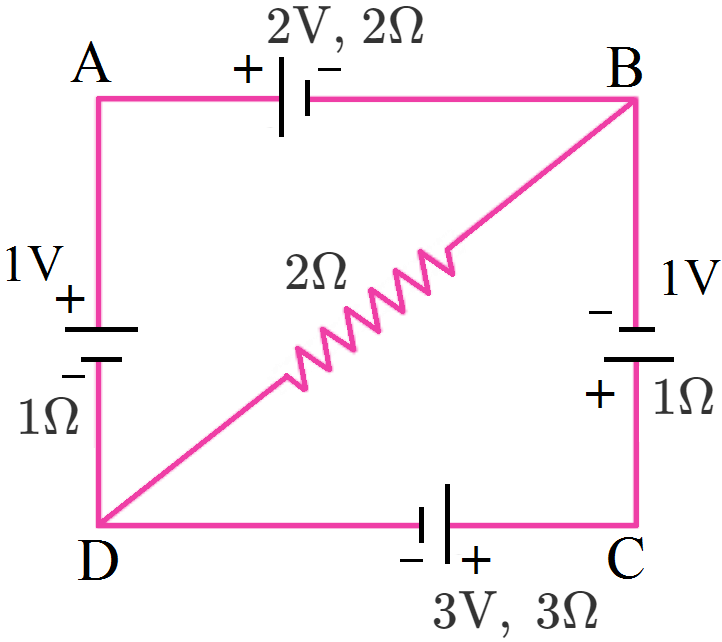
For the circuit shown here, calculate the potential difference between points B and D.

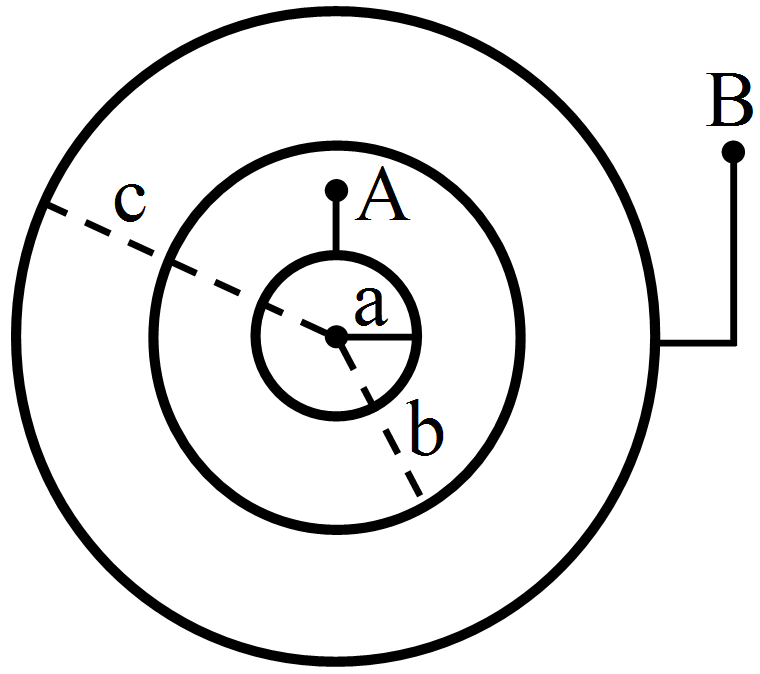
Consider an assembly of three conducting concentric spherical shells of radii a, b and c as shown in figure. Find the capecitance of the assembly between the poima A and B

An adiabatic cylindrical tube of cross-sectional area 1cm2 is closed at one end and fitted with a piston at the other end. The tube contains 0.03g of an ideal gas. At 1atm pressure and at the temperature of the surrounding, the length of the gas column is 40cm. The piston is suddenly pulled out to double the length of the column. The pressure of the gas falls to 0.355atm. Find the speed of sound in the gas at atmospheric temperature.
When a p-n junction is reverse-biased, the current becomes almost constant at $25\mu\text{A}.$ When it is forwardbiased at 200mV, a current of $75\mu\text{A}$ is obtained. Find the magnitude of diffusion current when the diode is,
  1. Unbiased.
  2. Reverse-biased at 200mV.
  3. Forward-biased at 200mV.