Question
Write difference between nuclear fission and radioactivity i.e. radioactive decay.

Answer

Difference between Nuclear fission and Radioactive decay : Although these two processes are nuclear phenomenon, yet they are quite different from each other in following respects :
(i) Radioactive decay is a spontaneous phenomenon whereas fission is not. In fission, heavy nuclei are bombarded by neutrons.
(ii) In radioactive decay, $\alpha$ - and $\beta$ - particles are emitted from the nucleus and energy is obtained in the form of $\gamma$ - rays which is not very large. In nuclear fission, a heavy nucleus is broken into two nearly equal lighter nuclei and very huge energy is liberated.
(iii) In radioactive decay, the atomic number can change by 1 or 2 and the mass number can change by 0 or 1. In nuclear fission, both atomic number and mass number are almost equally distributed.
(iv) The rate of radioactive decay cannot by controlled in any way, but the rate of nuclear fission can be controlled.

Need a full question paper?

Generate a complete, print-ready paper with questions like this in minutes — across 16+ boards, with answer keys.
Start Generating Free

Similar questions

A bar magnet whose area of cross-section is $0.25 cm^2$ is kept in a magnetising field of intensity of $5000 A / m$. If magnitude of magnetic flux passing through the bar is $2.5 \times 10^{-5}$ weber, then calculate :(a) Magnetic induction (b) Magnetic susceptibility (c) Intensity of magnetisation.
Show that the magnetic field at a point due to a magnetic dipole is perpendicular to the magnetic axis if the line joining the point with the centre of the dipole makes an angle of $\tan^{-1}(\sqrt{2})$ with the magnetic axis.
A bar magnet has a length of $8\ cm$. The magnetic field at a point at a distance $3\ cm$ from the centre in the broadside$-$on position is found to be $4 \times 10^{-6} T$. Find the pole strength of the magnet.
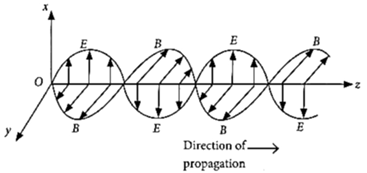
A stationary charge produces only an electrostatic field while a charge in uniform motion produces a magnetic field, that does not change with time. An oscillating charge is an example of accelerating charge. It produces an oscillating magnetic field, which in turn produces an oscillating electric fields and so on. The oscillating electric and magnetic fields regenerate each other as a wave which propagates through space.
Image
$(i).$ Magnetic field in a plane electromagnetic wave is given by $\vec{B}= B _0 \sin ( kx +\omega t ) \hat{j} T$Expression for corresponding electric field will be (Where c is speed of light.)
$(a) \ \vec{E}= B _0 c \sin ( kx +\omega t ) \hat{k} V / m$
$(b) \ \vec{E}=- B _0 c \sin ( kx -\omega t ) \hat{k} V / m$
$(c) \ \vec{E}=- B _0 c \sin ( kx +\omega t ) \hat{k} V / m$
$(d) \ \vec{E}=\frac{B_0}{c} \sin ( kx +\omega t ) \hat{k} V / m$
$(ii)$ The electric field component of a monochromatic radiation is given by $\vec{E}=2 E _0 \hat{i} \cos kz \cos \omega t$. Its magnetic field $\vec{B}$ is then given by
$(a) \ -\frac{2 E_0}{c} \hat{j} \sin kz \sin \omega t$
$(b) \ \frac{2 E_0}{c} \hat{j} \sin kz \sin \omega t$
$(c) \ \frac{2 E_0}{c} \hat{j} \sin kz \cos \omega t$
$(d) \ \frac{2 E_0}{c} \hat{j} \cos kz \cos \omega t$
$(iii)$ A plane em wave of frequency $25 MHz$ travels in a free space along $x -$direction. At a particular point in space and time, $E =(6.3 \hat{j}) V / m$. What is magnetic field at that time?
$(a) \ 0.089 \mu T$
$(b) \ 0.124 \mu T$
$(c) \ 0.021 \mu T$
$(d) \ 0.095 \mu T$
OR
A plane electromagnetic wave travels in free space along $x-$axis. At a particular point in space, the electric field along $y-$axis is $9.3 V m ^{-1}$. The magnetic induction $(B)$ along $z -$axis is
$(a) \ 3.1 \times 10^{-8} T$
$(b) \ 3 \times 10^{-5} T$
$(c) \ 3 \times 10^{-6} T$
$(d) \ 9.3 \times 10^{-6} T$
$(iv)$ A plane electromagnetic wave travelling along the $x-$direction has a wavelength of $3 \ mm$ . The variation in the electric field occurs in the $y-$direction with an amptitude $66 V m ^{-1}$. The equations for the electric and magnetic fields as a function of $x$ and $t$ are respectively
$ \text { a) } E_y =11 \cos 2 \pi \times 10^{11}\left(t-\frac{x}{c}\right), \text { b) } E_y =66 \cos 2 \pi \times 10^{11}\left(t-\frac{x}{c}\right),$
$B_y =11 \times 10^{-7} \cos 2 \pi \times 10^{11}\left(t-\frac{x}{c}\right) B_z =2.2 \times 10^{-7} \cos 2 \pi \times 10^{11}\left(t-\frac{x}{c}\right)$
$\text { c) } E_x =33 \cos \pi \times 10^{11}\left(t-\frac{x}{c}\right), \text { d) } E_y =33 \cos \pi \times 10^{11}\left(t-\frac{x}{c}\right),$
$B_x =11 \times 10^{-7} \cos \pi \times 10^{11}\left(t-\frac{x}{c}\right) B_z =1.1 \times 10^{-7} \cos \pi \times 10^{11}\left(t-\frac{x}{c}\right)$
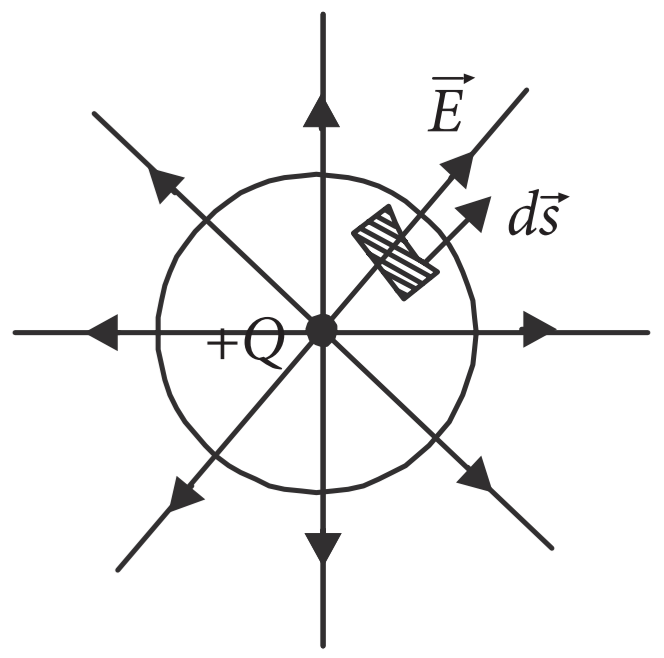
Gauss's law and Coulomb's law, although expressed in different forms, are equivalent ways of describing the relation between charge and electric field in static conditions. Gauss's law is $\epsilon_0\phi=\text{q}_{\text{end},}$ when $\text{q}_{\text{encl}}$ is the net charge inside an imaginary closed surface called Gaussian surface. $\phi=\oint\vec{\text{E}}\cdot\text{d}\vec{\text{A}}$ gives the electric flux through the Gaussian surface. The two equations hold only when the net charge is in vacuum or air.
  1. If there is only one type of charge in the universe, then $(\vec{\text{E}}\rightarrow$ Electric field, $\text{d}\vec{\text{s}}\rightarrow$ Area vector$)$.
  1. $\oint\vec{\text{E}}\cdot\text{d}\vec{\text{s}}\not=0$ on any surface.
  2. $\oint\vec{\text{E}}\cdot\text{d}\vec{\text{s}}$ could not be defined.
  3. $\oint\vec{\text{E}}\cdot\text{d}\vec{\text{s}}=\infty$ if charge is inside.
  4. $\oint\vec{\text{E}}\cdot\text{d}\vec{\text{s}}=0$ if charge is outside, $\oint\vec{\text{E}}\cdot\text{d}\vec{\text{s}}=\frac{\text{q}}{\epsilon_0}$ if charge is inside.
  1. What is the nature of Gaussian surface involved in Gauss law of electrostatic?
  1. Magnetic.
  2. Scalar.
  3. Vector.
  4. Electrical.
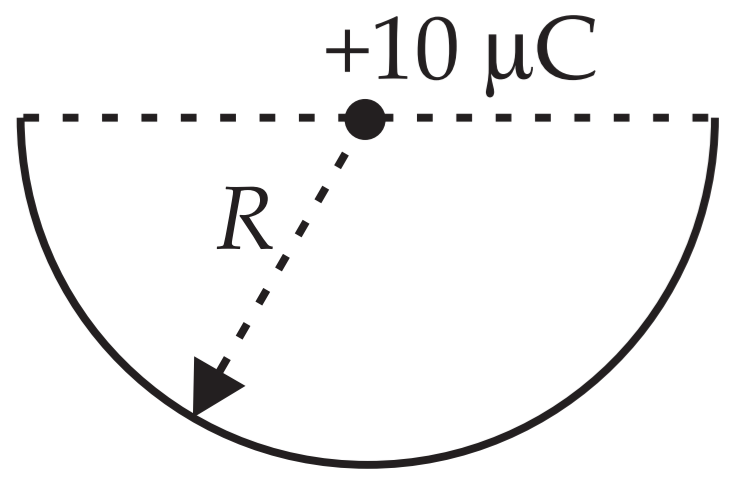
  1. A charge $10\mu\text{C}$ is placed at the centre of a hemisphere of radius $R = 10\ cm$ as shown. The electric flux through the hemisphere $($in $\text{MKS}$ units$)$ is:
  1. $20 \times 10^5$
  2. $10 \times 10^5$
  3. $6 \times 10^5$
  4. $2 \times 10^5$
  1. The electric flux through a closed surface area $S$ enclosing charge $Q$ is $\phi$. If the surface area is doubled, then the flux is:
  1. $2\phi$
  2. $\frac{\phi}{2}$
  3. $\frac{\phi}{4}$
  4. $\phi$
  1. A Gaussian surface encloses a dipole. The electric flux through this surface is:
  1. $\frac{\text{q}}{\epsilon_0}$
  2. $\frac{\text{2q}}{\epsilon_0}$
  3. $\frac{\text{q}}{2\epsilon_0}$
  4. Zero
Electrons oscillating in a circuit give rise to radiowaves. A transmitting antenna radiates most effectively the radiowaves of wavelength equal to the size of the antenna. The infrared waves incident on a substance set into oscillation all its electrons, atoms and molecules. This increases the internal energy and hence the temperature of the substance.

(i) If $v_g, v_X$ and $v_m$ are the speeds of gamma rays, $X$-rays and microwaves respectively in vacuum, then
(a) $v_g>v_X>v_m$
(b) $v_g<v_X<v_m$
(c) $v_g>v_X>v_m$
(d) $v_g=v_X=v_m$

(ii) Which of the following will deflect in electric field?
(a) ultraviolet rays
(b) $\gamma$-rays
(c) X-rays
(d) cathode rays

(iii) $\gamma$-rays are detected by
(a) point contact diodes
(c) thermopiles
(b) ionization chamber
(d) photocells

OR

We consider the radiation emitted by the human body. Which one of the following statements is true?
i. The radiation emitted is in the infrared region
ii. The radiation is emitted only during the day.
iii. The radiation is emitted during the summers and absorbed during the winters.
iv. The radiation emitted lies in the ultraviolet region and hence it is not visible
(a) Option(iv) (iii) (b) Option (ii) (c) Option (d) Option (i)

(iv) The frequency of electromagnetic wave, which best suited to observe a particle of radius $3 \times 10^{-4} cm$ is the order of
(a) $10^{14} Hz$
(b) $10^{12} Hz$
(c) $10^{13} Hz$
(d) $10^{15} Hz$
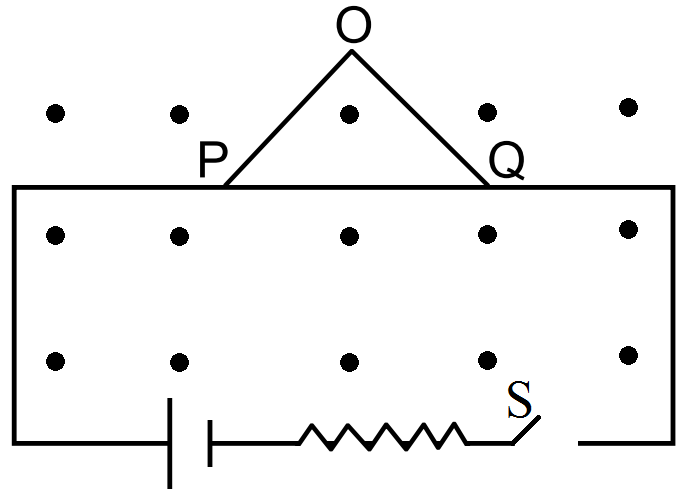
Shows a rod PQ of length 20.0cm and mass 200g suspended through a fixed point O by two threads of lengths 20.0cm each. A magnetic field of strength 0.500T exists in the vicinity of the wire PQ, as shown in the figure. The wires connecting PQ with the battery are loose and exert no force on PQ.
  1. Find the tension in the threads when the switch S is open.
  2. A current of 2.0A is established when the switch S is closed. Find the tension in the threads now.
Photoelectric effect
It is the phenomenon of emission of electrons from a metallic surface when light of a suitable frequency is incident on it. The emitted electrons are called photoelectrons.
Nearly all metals exhibit this effect with ultraviolet light but alkali metals like lithium, sodium, potassium, cesium etc. show this effect even with visible light. It is an instantaneous process i.e. photoelectrons are emitted as soon as the light is incident on the metal surface. The number of photoelectrons emitted per second is directly proportional to the intensity of the incident radiation.
The maximum kinetic energy of the photoelectrons emitted from a given metal surface is independent of the intensity of the incident light and depends only on the frequency of the incident light. For a given metal surface there is a certain minimum value of the frequency of the incident light below which emission of photoelectrons does not occur. 
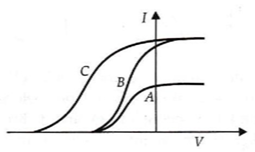
(I) In a photoelectric experiment plate current is plotted against anode potential.


Image

(A) A and B will have same intensities while B and C will have different frequencies.
(B) B and C will have different intensities while A and B will have different frequencies.
(C) A and B will have different intensities while B and C will have equal frequencies.
(D) B and C will have equal intensities while A and B will have same frequencies

(II) Photoelectrons are emitted when a zinc plate is
(A) Heated (B) hammered (C) Irradiated by ultraviolet light (D) subjected to a high pressure

(III) The threshold frequency for photoelectric effect on sodium corresponds to a wavelength of 500 nm. Its work function is about
(A) $4 \times 10^{-19} J$ (B) $2 \times 10^{-19} J$ (D) $3 \times 10^{-19} J$

(IV) The maximum kinetic energy of photoelectrons emitted from a surface when photons of energy 6 eV fall on it is 4 eV. The stopping potential is
(A) 2 V (B) 4 V (C) 6 V (D) 10 V

OR

The minimum energy required to remove an electron from a substance is called its
(A) work function (B) kinetic energy (C) stopping potential (D) potential energy
When a ferromagnetic material goes through a hysteresis loop, its thermal energy is increased. Where does this energy come from?
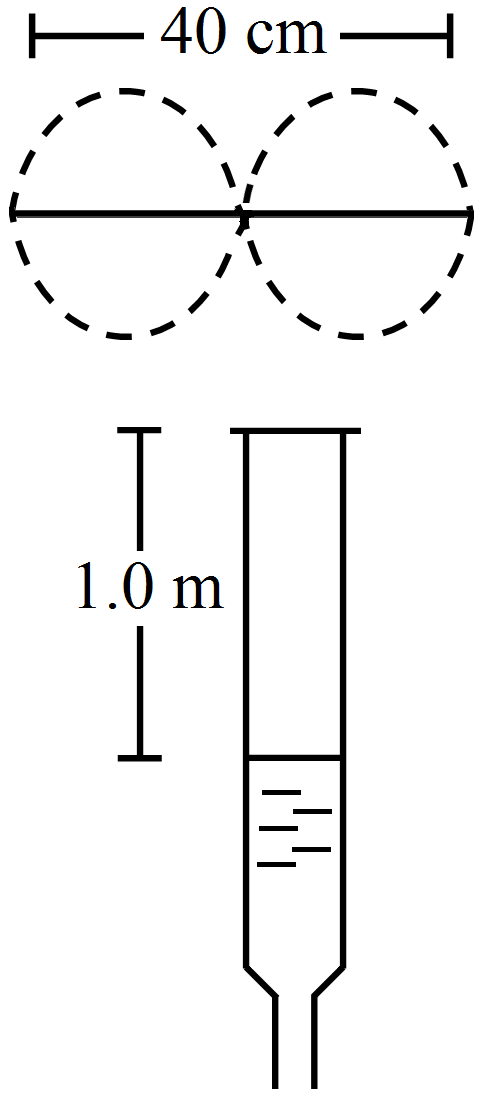
Consider the situation shown in figure. The wire which has a mass of $4.00g$ oscillates in its second harmonic and sets the air column in the tube into vibrations in its fundamental mode. Assuming that the speed of sound in air is $340m/s$, find the tension in the wire.