Question
Write doen four general characters of Porifera. Give two examples.

Answer

  1. Sessile, sedentary, and marine except one group that lives in fresh water. These are non-motile animals attached to some solid support.
  2. Simplest multicellular, diploblastic animals.
  3. The body design involves minimal differentiation and division into tissues.
  4. Asymmetrical or radically symmetrical.
Example: Sponges and Sycon.

Need a full question paper?

Generate a complete, print-ready paper with questions like this in minutes — across 16+ boards, with answer keys.

Start Generating Free

Similar questions

i. Suppose the mass of the earth somehow increases by $10 \%$ without any change in its size. What would happen to your weight?
ii. Suppose the radius of the earth becomes twice of its present radius without any change in its mass. What will happen to your weight?
State the main points of difference between homogeneous and heterogeneous mixtures.
How does sound from a sound producing body travel through air to reach our ears? Illustrate your answer with the help of a labelled diagram.
Give four general characters of phylum Mollusca. Write down two examples.
Draw a labelled diagram of the fractional distillation apparatus used for separating a mixture of alcohol and water.
Distinguish between longitudinal and transverse waves.
Pragya tested the solubility of three different substances at different temperatures and collected the data as given below (results are given in the following table, as grams of substance dissolved in $100$ grams of water to form a saturated solution).
Substance Dissolved Temperature in K
283 293 313 333 353
Solubility
Potassium nitrate $21$ $32$ $62$ $106$ $167$
Sodium chloride $36$ $36$ $36$ $37$ $37$
Potassium chloride $35$ $35$ $40$ $46$ $54$
Ammonium chloride $24$ $37$ $41$ $55$
$66$
  1. What mass of potassium nitrate would be needed to produce a saturated solution of potassium nitrate in $50$ grams of water at $313\ K$?
  2. Pragya makes a saturated solution of potassium chloride in water at $353K$ and leaves the solution to cool at room temperature. What would she observe as the solution cools? Explain.
  3. Find the solubility of each salt at $293\ K$. Which salt has the highest solubility at this temperature?
  4. What is the effect of change of temperature on the solubility of a salt?
Pressure and temperature determine the state of a substance. Explain this in detail.
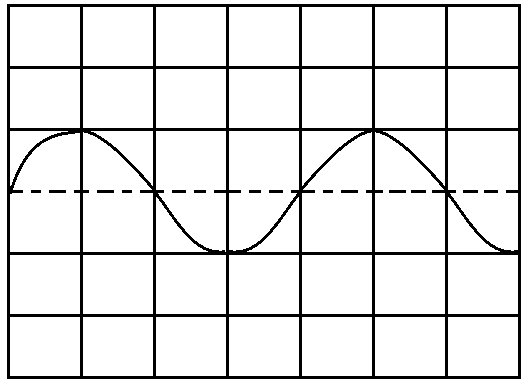
Figure $X$ showa a trace of a sound wave produced by a particular tuning fork:


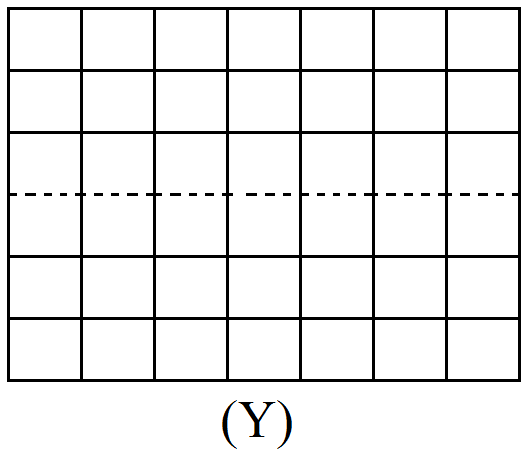
  1. On the graph paper given in Figure $Y,$ draw a trace of the sound wave which has higher frequency than that shown in Figure $X.$
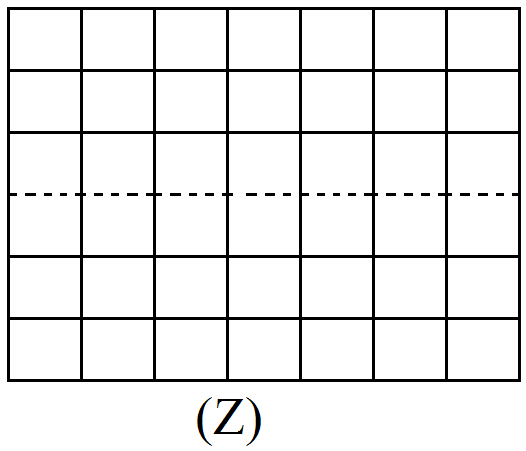
  2. On the graph paper shoen in Figure $Z,$ draw a trace of the sound wave which has a larger amplitude than that shown in Figure $X.$
If one gram of sulphur contains $x$ atoms, calculate the number of atoms in one gram of oxygen element. (Atomic masses: $S = 32u; O = 16u)$