Question
Write down the Coulomb's law and get the vector form of it.

Answer

→ The electric force (Coulomb force) between two point stationary charges is proportional to the product of the values of the charges and inversely proportional to the square of the distance between them. The direction of this force is in the direction of the line joining the two charges.
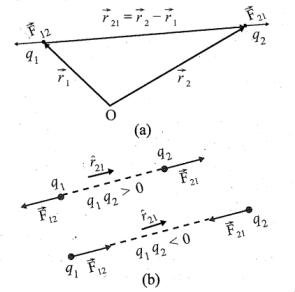
→ Let the position vectors of charges $q_1$ and $q_2$ be $\vec{r}_1$ and $\vec{r}_2$ respectively [see Fig. (a)].

Image


→ We denote force on $q_1$ due to $q_2$ by $\vec{F}_{12}$ and force on $q_2$ due to $q_1$ by $\overrightarrow{ F }_{21}$. The two point charges $q_1$ and $q_2$ have been numbered 1 and 2 for convenience and the vector leading from 1 to 2 is denoted by $\vec{r}_{21}$ :
$\vec{r}_{21}=\vec{r}_2-\vec{r}_1$

→ In the same way, the vector leading from 2 to 1 is denoted by $\vec{r}_{12}$ :
$\vec{r}_{12}=\vec{r}_1-\vec{r}_2=-\vec{r}_{21}$

→ The magnitude of the vectors $\vec{r}_{21}$ and $\vec{r}_{12}$ is denoted by $r_{21}$ and $r_{12}$, respectively $\left(r_{12}=r_{21}\right)$.
→ The direction of a vector is specified by a unit vector along the vector. To denote the direction from 1 to 2 (or from 2 to 1 ), we define the unit vectors:
$\hat{r}_{21}=\frac{\overrightarrow{r_{21}}}{r_{21}}, \hat{r}_{12}=\frac{\overrightarrow{r_{12}}}{r_{12}}, \hat{r}_{21}=-\hat{r}_{12}$

→ Coulomb's force law between two point charges

$q_1$ and $q_2$ located at $\vec{r}_1$ and $\vec{r}_2$, respectively is then expressed as
$\overrightarrow{ F }_{21}=\frac{1}{4 \pi \varepsilon_0} \frac{q_1 q_2}{r_{21}^2} \cdot \hat{r}_{21}$

→ Equation is valid for any sign of $q_1$ and $q_2$ whether positive or negative.
→ If $q_1$ and $q_2$ are of the same sign (either both positive or both negative), $F _{21}$ is along $\hat{r}_{21}$, which denotes repulsion, as it should be for like charges. If $q_1$ and $q_2$ are of opposite signs, $F_{21}$ is along $-\hat{r}_{21}=\hat{r}_{12}$, which denotes attraction, as expected for unlike charges.
→The force $\overrightarrow{ F }_{12}$ on charge $q_1$ due to charge $q_2$ is obtained from Eq. by simply interchanging 1 and 2 , i.e.,
$\overrightarrow{ F }_{12}=\frac{1}{4 \pi \varepsilon_0} \frac{q_1 q_2}{r_{12}^2} \hat{r}_{12}=-\overrightarrow{ F }_{21}$

→Thus, Coulomb's law agrees with Newton's third law.

Need a full question paper?

Generate a complete, print-ready paper with questions like this in minutes — across 16+ boards, with answer keys.
Start Generating Free

Similar questions

A small conducting sphere (radius r ) is placed concentrically inside a larger conducting hollow sphere of radius $R$. The big and small spheres are charged with $Q$ and $q(Q>q)$ respectively and kept separate from each other. Calculate the potential difference between the spheres.
Consider the situation of the previous problem. A particle having charge q and mass m is projected from the point Q in a direction going into the plane of the diagram. It is found to describe a circle of radius r between the two plates. Find the speed of the charged particle.
You have learnt that plane and convex mirrors produce virtual images of objects. Can they produce real images under some circumstances? Explain.
Explain that Kirchhoff's second law is law of conservation of energy.
  1. What characteristic property of nuclear force explains the constancy of binding energy per nucleon (BE/A) in the range of mass number 'A' lying 30
    • Show that the density of nucleus over a wide range of nuclei is constantindependent of mass numberA.
Draw the typical input and output characteristics of an $\text{n - p - n}$ transistor in $CE$ configuration. Show how these characteristics can be used to determine
$(a)$ the input resistance $(r_i),$ and
$(b)$ current amplification factor $(\beta).$
A charge of 1.0C is placed at the top of your college building and another equal charge at the top of your house. Take the separation between the two charges to be 2.0km. Find the force exerted by the charges on each other. How many times of your weight is this force?
Identify the following electromagnetic radiations as per the frequencies given below$:$
  1. $10^{20}\ Hz$
  2. $10^9\ Hz$
  3. $10^{11}\ Hz$
Write one application of each.
If three helium nuclei combine to form a carbon nucleus, energy is liberated. Why can't helium nuclei combine on their own and minimise the energy?
A positive ion having just one electron ejects it if a photon of wavelength $288\mathring{\text{A}}$ or less is absorbed by it. Identify the ion.