Question
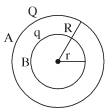
A small conducting sphere (radius r ) is placed concentrically inside a larger conducting hollow sphere of radius $R$. The big and small spheres are charged with $Q$ and $q(Q>q)$ respectively and kept separate from each other. Calculate the potential difference between the spheres.
Answer

Potential on the surface of A due to Q $ V=\frac{1}{4 \pi \epsilon_0} \times \frac{Q}{R} $
Potential on the surface of A due to $q$
Image
$ V=\frac{1}{4 \pi \epsilon_0} \times \frac{q}{R} $
Potential on the surface of $B$ due to $Q=\frac{1}{4 \pi \epsilon_0} \times \frac{Q}{R}$
Potential on the surface of B due to $q=\frac{1}{4 \pi \epsilon_0} \times \frac{q}{r}$
$\therefore$ Potential at $A , B _{s l}=\frac{1}{4 \pi \epsilon_0}\left(\frac{ Q }{ R }+\frac{q}{ R }\right)$
Potential at $B , V _{ B }=\frac{1}{4 \pi \epsilon_0}\left(\frac{ Q }{ R }+\frac{q}{r}\right)$
$\therefore \quad V _{ B }- V _{ A }=\frac{1}{4 \pi \epsilon_0}\left(\frac{q}{r}-\frac{q}{ R }\right)$

Need a full question paper?

Generate a complete, print-ready paper with questions like this in minutes — across 16+ boards, with answer keys.

Start Generating Free

Similar questions

If the separation between the slits in a Young's double slit experiment is increased, what happens to the fringe-width? If the separation is increased too much, will the fringe pattern remain detectable?
Find the range of frequency of light that is visible to an average human being $(400\ \text{nm}<\lambda<700\ \text{nm}).$
A small pin fixed on a table top is viewed from above a distance of 50 cm. By what distance would the pin appear to be raised if it is viewed from the same point through a 15 cm thick glass slab held parallel to the table? Refractive index of glass = 1.5. Does the answer depend on the location of the slab?
A magnifying glass is a converging lens placed close to the eye. A farsighted person uses spectacles having converging lenses. Compare the functions of a converging lens used as a magnifying glass and as spectacles.
  1. How are electromagnetic waves produced? Explain.
  2. A plane electromagnetic wave is travelling through a medium along the +ve z-direction. Depict the electromagnetic wave showing the directions of the oscillating electric and magnetic fields.
Use Bohr’s postulates hydrogen atom to deduce the expression for the kinetic energy $(K.E.)$ of the electron revolving in the $n^{th}$ orbit and show that, $K.E. \frac{\text{e}^{2}}{8\pi\varepsilon_{0}\text{ e}_{n}} , $ where $r_n$ is the radius of the $n^{th}$ orbit. How is the orbit. How is the potential energy in the orbit related to the orbital radius orbit related to the orbital radius $r_n?$
$i.$ State two important features of Einstein's photoelectric equation.
$ii.$ Radiation of frequency $10^{15} Hz$ is incident on two photosensitive surface $P$ and $Q.$ There is no photoemission from surface $P.$ Photoemission occurs from surface $Q$ but photoelectrons have zero kinetic energy. Explain these observations and find the value of work function for surface $Q.$
Derive the equation for the torque acting on a current carrying loop placed at an angle $\theta$ with uniform magnetic field $(\vec{B})$.
When a photon is emitted by a hydrogen atom, the photon carries a momentum with it.
$(a)$ Calculate the momentum carries by the photon when a hydrogen atom emits light of wavelength $656.3\ nm.$
$(b)$ With what speed does the atom recoil during this transition? Take the mass of the hydrogen atom $= 1.67 \times 10^{-27}kg.$
$(c)$ Find the kinetic energy of recoil of the atom.
Answer the following questions.
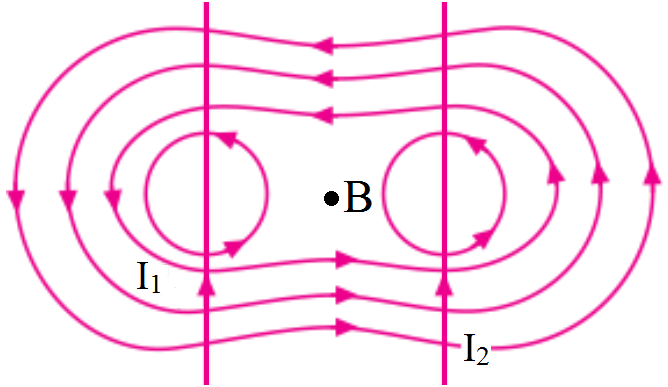
  1. Draw the magnetic field lines due to two straight, long, parallel conductors carrying currents $I_1$ and $I_2$ in the same direction. Write an expression for the force acting per unit length on one conductor due to other. Is this force attractive or repulsive?
  1. Figure shows a rectangular current$-$carrying loop placed $2\ cm$ away from a long, straight, current$-$carrying conductor. What is the direction and magnitude of the net force acting on the loop?