Question
Write down the equation of electric potential for a point $-$ outside the spherical shell $-$ on the surface of a spherical shell and $-$ inside the spherical shell.
Answer

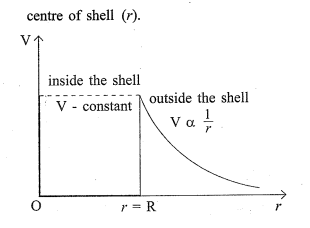
$\rightarrow $ Generally, for a spherical shell, the electric field for a point outside the surface of shell is such that the entire charge of shell can be considered as concentrated at its centre.
$\rightarrow $ The value of electric potential that we get for a point outside the surface of shell is also got $($derived$)$ in a similar way.
$V =\frac{1}{4 \pi \varepsilon_0} \cdot \frac{q}{r}(r \geq R )$
Where, $q -$ total electric charge on the shell
$R -$ radius of the shell
$r -$ the distance of the point from the centre of the shell.
$\rightarrow $ The electric field inside the shell is zero, therefore potential inside remains constant.
$\rightarrow $ Because as there is no electric field inside, the work done in taking the charge from one point to the other is zero.
$\therefore \text { In } W =q \Delta V ,$
$\text { because } W =0$
$\therefore \Delta V =0$
$\therefore V =\text { constant }$
and that value of potential is same as the value on the surface of shell.
$\therefore V =\frac{1}{4 \pi \varepsilon_0} \cdot \frac{q}{ R } \quad(\because r \leq R )$
$\rightarrow $ Below figure $($graph$)$ shows the variation of electric potential $( V )$ versus distance from the
Image

Need a full question paper?

Generate a complete, print-ready paper with questions like this in minutes — across 16+ boards, with answer keys.
Start Generating Free

Similar questions

Consider a 10cm long portion of a straight wire carrying a current of 10A placed in a magnetic field of 0.1T making an angle of 53° with the wire. What magnetic force does the wire experience?
The battery discussed in the previous question is suddenly disconnected. Is a current induced in the other loop? If yes, when does it start and when does it end? Do the loops attract each other or repel?
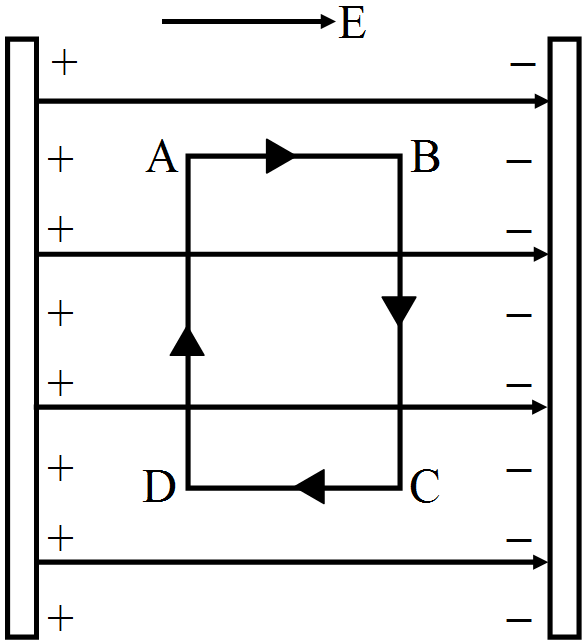
A uniform electric field exists between two charged plates as shown in the fig. What should be the work done in moving a charge $q$ along the closed rectangular path $\text{ABCD}$?
If light of wavelength 412.5 nm is incident on each of the metals given below, which ones will show photoelectric emission and why?
MetalWork Function (eV)
Na1.92
K2.15
Ca3.20
Mo4.17
A wire, carrying a current i, is kept in the x−y plane along the curve $\text{y}=\text{A}\sin\Big(\frac{2\pi}{\lambda}\text{x}\Big).$ A magnetic field B exists in the z direction. Find the magnitude of the magnetic force on the portion of the wire between $\text{x}=0$ and $\text{x}=\lambda.$
Two electric charges $+Q$ and $-Q(x-y)$ are placed at the points $\left(-x_2, 0\right)$ and $\left(x_1, 0\right)$ respectively in the plane. Find the magnitude and direction of the resultant electric field at the origin $(0,0)$.
What is Rectifier?
Suppose the amplitude of a simple pendulum having a bob of mass m is $\theta_0.$ Find the tension in the string when the bob is at its extreme position.
Why do stable nuclei never have more protons than neutrons?
A galvanometer has a resistance of 30Ω. It gives full scale deflection with a current of 2 mA. Calculate the value of the resistance needed to convert it into an ammeter of range 0-0.3 A.