Question
Write first and second postulates of Bohr's Atomic Model. Obtain the expression for radius and velocity of stable orbit of electron.###Explain Bohr's two postulates for hydrogen atom.

Answer

Bohr's postulates : Bohr proposed three postulates which are following :
(1) Bohr's first postulates : Any electron can revolve in the definite stable states of atom without radiating the emission energy. It is opposite to the electromagnetic principle. According to this postulate, each atom has same definite stable states in which it existed and existed total energy is definite in all possible states. All these possible states are called stable states of atom.
(2) Bohr's second postulate : Second postulate defines to these stable orbit. According to this postulate, electron revolves around the nucleus only in those orbits for which angular momentum is multiple integer of $\frac{h}{2 \pi}$. Where, $h$ Planck's constant $\left(=6.6 \times 10^{-34} Js \right)$. Therefore, L is quantised angular momentum of revolving electron. That is,
$L=\frac{n h}{2 \pi}$ $\ldots (1)$
(3) Bohr's third postulate : According to this postulate, transition of electron can be done from specially given unradiated orbits to second low energy orbits. When it does so a photon is emitted, whose energy is equal to the difference of energy of initial and final states. Frequency of emitted photon is given by following expression :
$h v=E_i-E_f$ $\ldots (2)$
Where, $E _i$ and $E _f$ are the energies of initial and final states, $E _i> E _f$
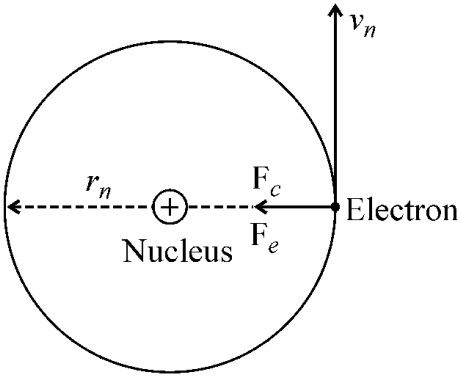
Bohr's Radius or radius of stable orbits : Let $r_n$ is the radius of $n^{\text {th }}$ orbit of any atom and in which an electron is moving with velocity $v_n$. If mass of electron is $m$ then from the Bohr's second postulate,
$m v_n r_n=n \cdot \frac{h}{2 \pi}$ $\ldots (1)$
Image
From Bohr's first postulate,
$F _e = F _c$
$\therefore \frac{1}{4 \pi \in_0} \cdot \frac{Z e^2}{r_n^2}=\frac{m v^2 n}{r_n}$ $\ldots (2)$
From eqn. (1) $v_n=\frac{n h}{2 \pi m r_n}$
Put value of $v_n$ in eqn. (2)
$\frac{1}{4 \pi \in_0} \cdot \frac{ Z e^2}{r_n^2}=\frac{m}{r_n} \times \frac{n^2 h^2}{4 \pi^2 m^2 r_n^2}$
or $\quad \frac{Z e^2}{\in_o}=\frac{n^2 h^2}{r_n \cdot \pi m}$ $\quad$ $\therefore r_n=\frac{\in_0 n^2 h^2}{\pi m Z e^2}$
or $\quad \underline {r_n=\frac{\in_0 h^2}{\pi m Z e^2} \cdot n^2}$ $\ldots (3)$
Speed of electron in stable orbit
$\because \quad v_n=\frac{n h}{2 \pi m r_n}$
Put the value of $r_n$ from eqn. (3)
$v_n=\frac{n h}{2 \pi m\left[\frac{\in_0 h^2 n^2}{\pi m e^2 Z}\right]} \Rightarrow \underline {v_n=\frac{Z e^2}{2 \in_0 h n}}$

Need a full question paper?

Generate a complete, print-ready paper with questions like this in minutes — across 16+ boards, with answer keys.
Start Generating Free

Similar questions

The temperature and humidity of air are 27°C and 50% on a particular day. Calculate the amount of vapour that should be added to 1 cubic metre of air to saturate it. The saturation vapour pressure at 27°C = 3600Pa.
A pendulum bob of mass 80mg and carrying a charge of 2 × 10-8C is at rest in a uniform, horizontal electric field of 20kVm-1. Find the tension in the thread.
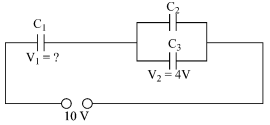
Define capacitor. Obtain the relation of equivalence in series combination of capacitors by making a circuit diagram. Write the value of voltage $V_1$ in the given circuit.
Image
A smooth sphere of radius R is made to translate in a straight line with a constant acceleration a. A particle kept on the top of the sphere is released from there at zero velocity with respect to the sphere. Find the speed of the particle with respect to the sphere as a function of the angle $\theta$ it slides.
When a proton is released from rest in a room, it starts with an initial acceleration a0 towards west. When it is projected towards north with a speed v0, it moves with an initial acceleration 3a0 towards west. Find the electric field and the maximum possible magnetic field in the room.
First a set of n equal resistors of R each are connected in series to a battery of emf E and internal resistance R. A current I is observed to flow. Then the n resistors are connected in parallel to the same battery. It is observed that the current is increased 10 times. What is 'n'?
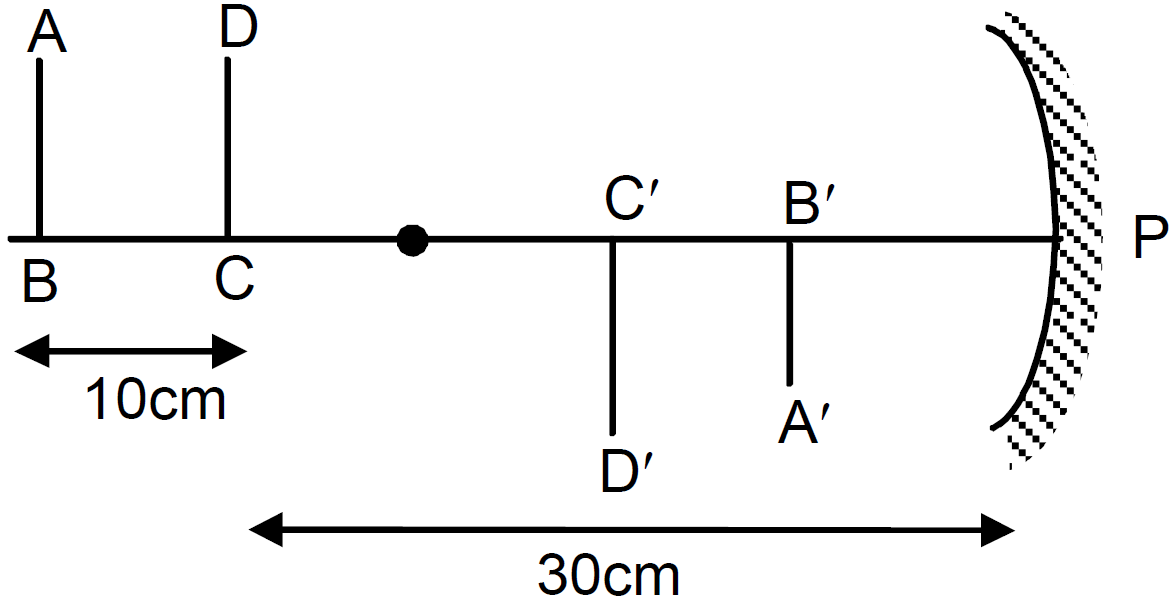
A U-shaped wire is placed before a concave mirror having radius of curvature 20cm. Find the total length of the image.

The energy from the sun reaches just outside the earth's atmosphere at a rate of 1400W/m2. The distance between the sun and the earth is 1.5 × 10¹¹m.
  1. Calculate the rate at which the sun is losing its mass.
  2. How long will the sun last assuming a constant decay at this rate? The present mass of the sun is 2 × 1080kg.
The magnetic field existing in a region is given by $\overrightarrow{\text{B}}=\text{B}_0\Big(1+\frac{\text{x}}{\text{l}}\Big)\overrightarrow{\text{k}}.$ A square loop of edge land carrying a current i, is placed with its edges parallel to the x - y axes. Find the magnitude of the net magnetic force experienced by the loop.
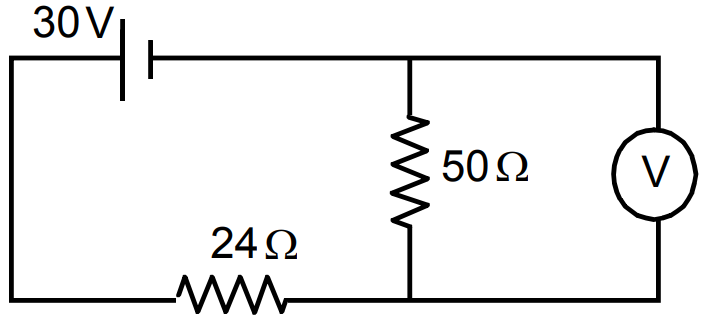
The voltmeter shown in the figure. reads 18V across the $50\Omega$ resistor. Find the resistance of the voltmeter.