On the basis of Bohr's postulates, derive the expression for orbital speed of electron for $n ^{\text {th }}$ stable orbit in hydrogen atom. Energy in ground state of hydrogen atom is $(-) XeV$. What will be the kinetic energy in this state?
Answer
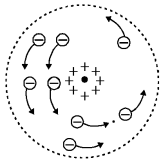
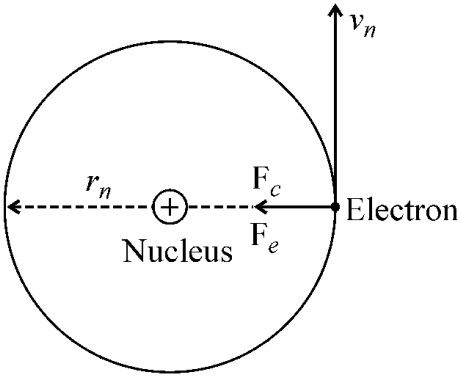
Bohr's first postulate : The electrons revolves around the nucleus in different stable circular orbits of the atom. The required contripetal force to more the electron in circular orbit provided by the Coloumb's force, works between the electron and charge of the nucleus. Therefore, from the Bohr's first postulate, $\begin{aligned} \frac{m v^2}{r} & =\frac{KZ e^2}{r^2} \\ \frac{m v^2}{r} & =\frac{1}{4 \pi \in_0} \frac{Z e^2}{r^2} \Rightarrow m v^2 r=\frac{Z e^2}{4 \pi \in_0} \ldots(1) \end{aligned}$ Bohr's second postulate : Electron revolves only there orbits in which angular momentum ( $L =m v r$ ) is multiple integer of $\frac{h}{2 \pi}$. According to Bohr's this postulate: $L=\frac{n h}{2 \pi} \text { or } m v r=n\left(\frac{h}{2 \pi}\right) \ldots(2) $ Where $h=$ Planck's constant and $n=1,2,3, \ldots$ are the principal quantum numbers. From (1) $m v^2 r=\frac{Z e^2}{4 \pi \in_0}$ or $\quad m v r . v=\frac{Z e^2}{4 \pi \in_0} \ldots(3) $ Put the value of $m v r$ from eqn. (2) $n\left(\frac{h}{2 \pi}\right) v=\frac{Z e^2}{4 \pi \in_0}$ or $v=\frac{Z e^2}{4 \pi \in_0} \times\left(\frac{2 \pi}{n h}\right) \text { or } v=\left(\frac{Z e^2}{2 \in_0 h}\right) \frac{1}{n} \ldots (4) $ (where, $n=1,2,3, \ldots$. ) Equation (4) is the general formula of velocity of electron in stable orbits. In this formula, $e, \in_0$ and $h$ are the universal constants. Z is constant specifically for atom therefore $v \propto \frac{1}{n}$ That is, "The velocity of electron in stable orbits is inversely proportional to the orbit number i.e. principal quantum." Value of kinetic energy of electron : $\begin{array}{l} K=-(-) XeV \\ K=XeV \quad Ans. \end{array}$
Write first and second postulates of Bohr's Atomic Model. Obtain the expression for radius and velocity of stable orbit of electron.###Explain Bohr's two postulates for hydrogen atom.