Question
Write four properties of $\gamma$-rays. What will be the difference between velocity of $\gamma$-ray of wavelength 0.01 Å and X-ray of wave-length 3 Å.

Answer

Properties of $\gamma$-rays:
(1) $\gamma$-rays are not deflected by electric field and magnetic field which indicates that these are electrically neutral i.e. have no electric charge.
These rays are electromagnetic waves (or photons) like X-rays. The energy of $\gamma$-photons is much higher (in the order of million electron volt). Therefore, their wavelength is very short. For example, the wavelength of $\gamma$-photon of 1 MeV (= 106 eV) energy is :
$\lambda=\frac{12375}{10^6} Å \approx 0.01 Å$
which is $\left(\frac{1}{100}\right)$ of the wavelength of X-rays.
(2) Their velocity is equal to that of light i.e., $3 \times 10^8$ m/sec.
(3) They produce ionisation through gases but their ionisation power is very small in comparison to that of $\alpha-$ and $\beta$-particles.
(4) They produce fluorescence in barium platinocyanide etc.
(5) They are most penetrating. They can pass through 30 cm thickness of iron sheet.
(6) They are diffracted by crystals in the same way as X-rays.
(7) They affect photographic plate more than $\alpha$ - and $\beta$-particles.
(8) Though there is much similarlity between X-rays and $\gamma$-rays , yet their sources of origin are different. X-rays are produced by the transition of electrons in an atom from one energy level to another energy level, that is, it is an atomic property; whereas $\gamma$-rays are produced from the nucleus, and are emitted only after the nucleus ejects either an $\alpha$ - or $\beta$-particles , that is, it is a nuclear property.
(9) $\gamma$-rays exhibit the phenomenon of pair production in which $\gamma$-rays photon striking the nucleus of some atom is completely absorbed by the nucleus and its energy is converted into one electron and one positron. This phenomenon is represented by the following reaction :
$\underset{\text { (Photon) }}{\gamma} \longrightarrow \underset{\text { (Electron) }}{e^{-}}+\quad \underset{\text { (Positron) }}{e^{+}}$
(10) $\gamma$-rays destroy living tissues. This property is used in the treatment of cancer where $\gamma$-rays emitted only from radium are used.
Since $\gamma$-rays and X-rays both are electromagnetic waves having velocity 3 × 10⁸ m/s. Hence there is no difference between velocities of these radiations.

Need a full question paper?

Generate a complete, print-ready paper with questions like this in minutes — across 16+ boards, with answer keys.
Start Generating Free

Similar questions

A uniform field of 2.0NC-1 exists in space in x-direction.
  1. Taking the potential at the origin to be zero, write an expression for the potential at a general point (x, y, z).
  2. At which points, the potential is 25V?
  3. If the potential at the origin is taken to be 100V, what will be the expression for the potential at a general point?
  4. What will be the potential at the origin if the potential at infinity is taken to be zero? Is it practical to choose the potential at infinity to be zero?
Define capacitance of a capacitor. Derive expression for stored energy between plates of parallel plate capacitor. Show that energy-density between plates of parallel capacitor can be expressed as $\frac{1}{2}\in_{0}E^{2}$ , when E = Electric Field between plates.
How many time constants will elapse before the energy stored in the capacitor reaches half of its equilibrium value in a charging RC circuit?
Calculate the work done in moving a test charge q0 from point A to point B against the repulsive force acting on it due to the other charge Q > 0 located at the origin.
(II) (a) With the help of a diagram, explain the principle of a device which changes a low ac voltage into a high voltage . Deduce the expression for the ratio of secondary voltage to the primary voltage in terms of the ratio of the number of turns of primary and secondary winding. For an ideal transformer, obtain the ratio of primary and secondary currents in terms of the ratio of the voltages in the secondary and primary coils.
(b) Write any two sources of the energy losses which occur in actual transformers.
(c) A step-up transformer converts a low input voltage into a high output voltage. Does it violate law of conservation of energy? Explain.
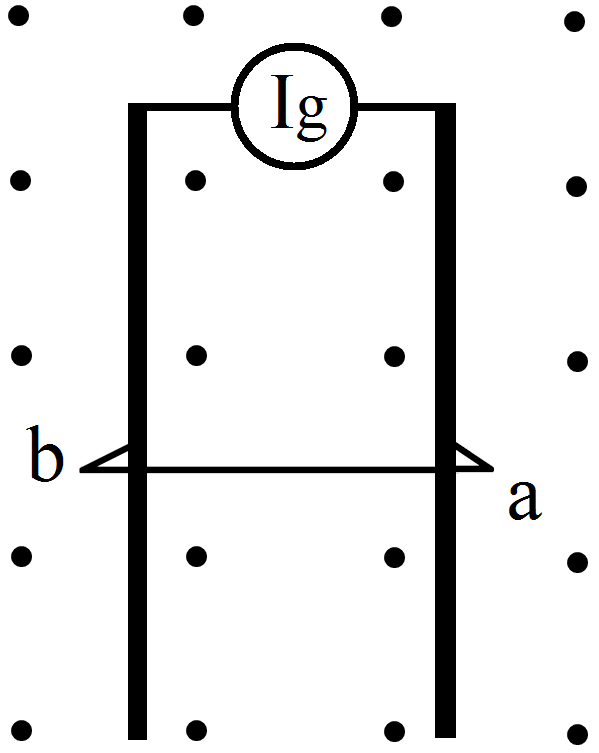
The system containing the rails and the wire of the previous problem is kept vertically in a uniform horizontal magnetic field B that is perpendicular to the plane of the rails (figure). It is found that the wire stays in equilibrium. If the wire ab is replaced by another wire of double its mass, how long will it take in falling through a distance equal to its length?

Consider a 20W bulb emitting light of wavelength $5000\mathring{\text{A}}$ and shining on a metal surface kept at a distance 2m. Assume that the metal surface has work function of 2eV and that each atom on the metal surface can be treated as a circular disk of radius $1.5\mathring{\text{A}}$.
  1. Estimate no. of photons emitted by the bulb per second. [Assume no other losses]
  2. Will there be photoelectric emission?
  3. How much time would be required by the atomc disk to receive energy equal to work function (2eV)?
  4. How many photons would atomic disk receive within time duration calculated in (iii) above?
  5. Can you explain how photoelectric effect was observed instantaneously?
Hint: Time calculated in part (iii) is from classical consideration and you may further take the target of surface area say 1cm2 and estimate what would happen?
Suppose the ceiling in the previous problem is that of an elevator which is going up with an acceleration of 2.0m/s2. Find the elongations.
A charged particle is accelerated through a potential difference of 12kV and acquires a speed of 1.0 × 10⁶m s−1. It is then injected perpendicularly into a magnetic field of strength 0.2T. Find the radius of the circle described by it.
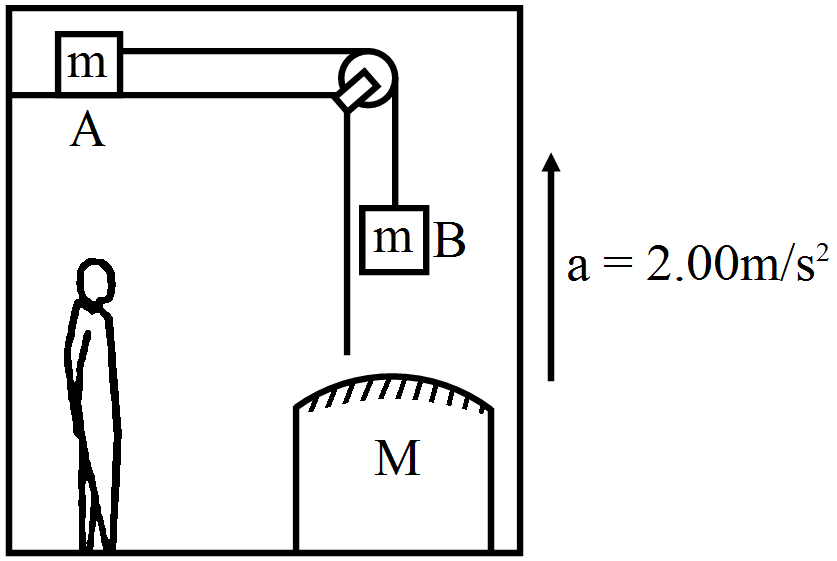
Consider the situation shown in figure. The elevator is going up with an acceleration of 2.00m/s2 and the focal length of the mirror is 12.0cm. All the surfaces are smooth and the pulley is light. The mass-pulley system is released from rest (with respect to the elevator) at t = 0 when the distance of B from the mirror is 42.0cm. Find the distance between the image of the block B and the mirror at t = 0.200s. Take g = 10m/s2.