Question
Write Gauss's law and explain.

Answer

Image

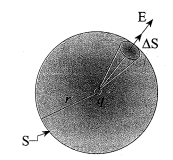
→ Let us consider the total flux through a sphere of radius $r$, which encloses a point charge $q$ at its centre. Divide the sphere into small area elements, as shown in fig.
→ The flux through an area element $\Delta S$ is
$\Delta \phi=\overrightarrow{ E } \cdot \Delta \overrightarrow{ S }=\frac{q}{4 \pi \varepsilon_0 r^2} \hat{r} \cdot \overrightarrow{\Delta S }$
→ The unit vector $\hat{r}$ is along the radius vector from the centre to the area element.
→ Now, since the normal to a sphere at every point is along the radius vector at that point, the area element $\Delta S$ and $\hat{r}$ have the same direction.
Therefore,
$\Delta \phi=\frac{q}{4 \pi \varepsilon_0 r^2} \Delta S$
→ The total flux through the sphere is obtained by adding up flux through all the different area elements:
→ Now S, the total area of the sphere, equals $4 \pi r^2$. Thus,
$\phi=\frac{q}{4 \pi \varepsilon_0 r^2} \times 4 \pi r^2=\frac{q}{\varepsilon_0}$
→ Equation (1) is a simple illustration of a general result of electrostatics called Gauss's law.
→ "The total electric flux associated with a closed surface is equal to the ratio of total enclosed charge and $\varepsilon_0$."
$\therefore \phi=\int \overrightarrow{ E } \cdot d \overrightarrow{ S }=\frac{\sum q}{\varepsilon_0}$
$\phi=\sum_{\text {avl } \Delta S } \frac{q}{4 \pi \varepsilon_0 r^2} \Delta S$
→ Since each area element of the sphere is at the same distance $r$ from the charge,
$\phi=\frac{q}{4 \pi \varepsilon_0 r^2} \sum_{\text {all } \Delta S } \Delta S =\frac{q}{4 \pi \varepsilon_0 r^2} S$

Need a full question paper?

Generate a complete, print-ready paper with questions like this in minutes — across 16+ boards, with answer keys.
Start Generating Free

Similar questions

A proton and an α-particle move perpendicular to a magnetic field. Find the ratio of radii of the circular paths described by them when both (i) have equal momenta, and (ii) were accelerated through the same potential difference.
Rate of change of electric field in the region between the plates of capacitor is $1.5 \times 10^{12} Vm ^{-1} s^{ 1 }$. If circular plate of capacitor has a radius of 55 mm , then find the magnitude of displacement current.
A ball of mass $0.50\ kg$ moving at a speed of $5.0\ m/s$ collides with another ball of mass $1.0\ kg.$ After the collision the balls stick together and remain motionless. What was the velocity of the $1.0\ kg$ block before the collision?
Find the energy liberated in the reaction :
$^{223}Ra \rightarrow ^{209}Pb + ^{14}C.$
The atomic masses needed are as follows.
$^{223}Ra$ $^{209}Pb$ $^{14}C$
$22.018u$ $208.981u$ $14.003u$
$^{228}Th$ emits an alpha particle to reduce to $^{224}Ra.$ Calculate the kinetic energy of the alpha particle emitted in the following decay:
$\text{ }^{228}\text{Th}\rightarrow\text{ }^{224}\text{Ra}^*+\alpha$
$\text{ }^{224}\text{Ra}^*\rightarrow\text{ }^{224}\text{Ra}+\gamma(217\text{kev}).$
Atomic mass of $^{228}Th$ is $228.028726u,$ that of $^{224}Ra$ is $224.020196u$ and that of $\text{ }^4_2\text{He}$ is $4.00260u.$
In the relation to the photoelectric effect, write the definition of the terms 'stopping potential' and 'threshold frequency'. How are these physical quantities determined using Einstein's equation?
Suppose a monochromatic X-ray beam of wavelength 100pm is sent through a Young's double slit and the interference pattern is observed on a photographic plate placed 40cm away from the slit. What should be the separation between the slits so that the successive maxima on the screen are separated by a distance of 0.1mm?
Find the acceleration of the moon with respect to the earth from the following data:
Distance between the earth and the moon $= 3.85 \times 10^5\ km$ and the time taken by the moon to complete one revolution around the earth $= 27.3$ days.
Get the electric field due to a uniformly charged thin spherical shell.
A bomb is dropped from a plane flying horizontally with uniform speed. Show that the bomb will explode vertically below the plane. Is the statement true if the plane flies with uniform speed but not horizontally?