Question
Write Huygen's principle and explain how a new spherical wave front is formed after a very small time interval.

Answer

• Huygen's principle :
"Every point or particle of a wavefront behaves as an independent secondary source, emits by itself secondary spherical waves. After a very small time interval the surface tangential to all such secondary spherical wavelets gives the position and shape of the new wavefront."
[Alternatively, "Each point of the wavefront is the source of a secondary disturbance and the wavelets emanating from these points spread out in all directions with the speed of the wave. These wavelets emanating from the wavefront are usually referred to as secondary wavelets and if we draw a common tangent to all these spheres, we obtain the new position of the wave front at a later time."]
Image
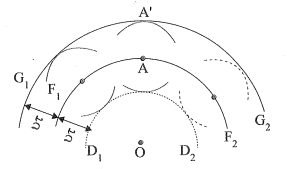
As shown in the Fig, $F _1 F_2$ represents the spherical wave front (with O as Centre) at $t=0$.
As per Huygen's principle each point on the wavefront behaves as a secondary source and the waves emanating from these point spread equally in all directions at the speed of wave. If we wish to determine the shape of the wave front at $t=\tau$, we draw spheres of radius $v \tau$ from each point on the spherical wave front where $v$ represents the speed of the waves in the medium.
If we now draw a common tangent to all these spheres, we obtain the new position of the wave front at $t =\tau$.
The new wavefront is shown in the Fig. as $G _1 G _2$, which is again a spherical with point ' O ' as centre.

Need a full question paper?

Generate a complete, print-ready paper with questions like this in minutes — across 16+ boards, with answer keys.
Start Generating Free

Similar questions

Define electric current and current density. By giving an example prove that electric current is a scalar quantity but not a vector quantity. Explain electric current in any conductor.
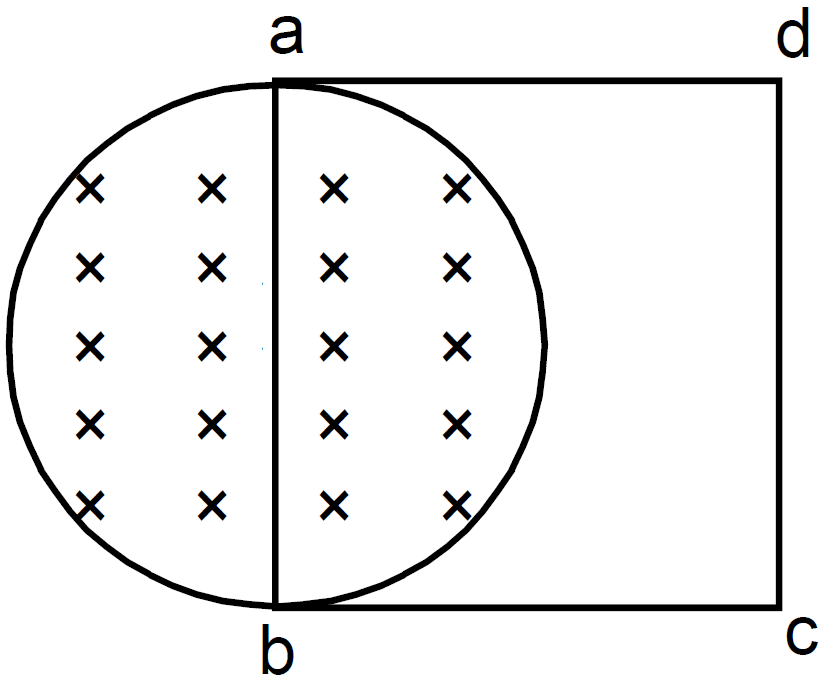
A uniform magnetic field B exists in a cylindrical region of radius 10cm as shown in figure. A uniform wire of length 80cm and resistance $4.0\Omega$ is bent into a square frame and is placed with one side along a diameter of the cylindrical region. If the magnetic field increases at a constant rate of 0.010T/s, find the current induced in the frame.

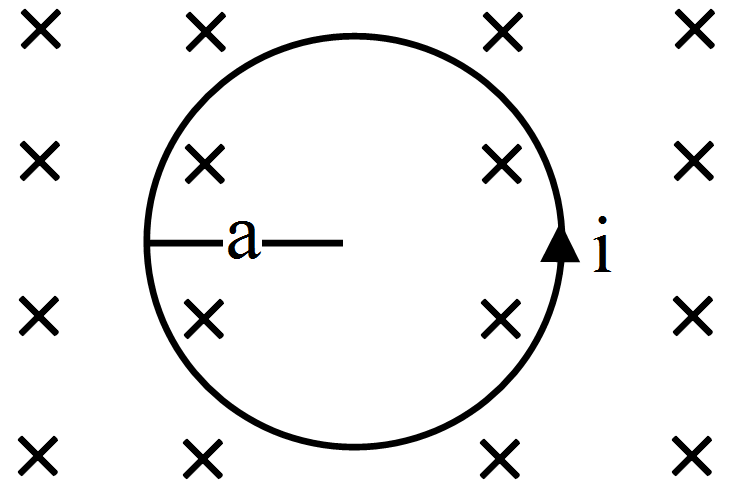
The shows a circular wire loop of radius a and carrying a current i, which is placed in a perpendicular magnetic field B.
  1. Consider a small part dl of the wire. Find the force on this part of the wire exerted by the magnetic field.
  2. Find the force of compression in the wire.

A proton has spin and magnetic moment just like an electron. Why then its effect is neglected in magnetism of materials?
Obtain the relationship between object distance (u), image distance $(v)$ and focal length (f) for a concave mirror.###Obtain $\frac{1}{f}=\frac{1}{v}+\frac{1}{u}$ formula for a concave mirror.
A potentiometer wire of length 1 m has a resistance of 10$\Omega$. It is connected to a 6 V battery in series with a resistance of 5$\Omega$. Determine the emf of the primary cell which gives a balance point at 40 cm.
Define atomic mass unit.
A capacitance C charged to a potential difference V is discharged by connecting its plates through a resistance R. Find the heat dissipated in one time constant after the connections are made. Do this by calculating $\int\text{i}^2\text{R}$ dt and also by finding the decrease in the energy stored in the capacitor.
Repeat the previous exercise if the angle between each pair of springs is 120° initially.
During a heavy rain, hailstones of average size 1.0cm in diameter fall with an average speed of 20m/s. Suppose 2000 hailstones strike every square meter of a 10m × 10m roof perpendicularly in one second and assume that the hailstones do not rebound. Calculate the average force exerted by the falling hailstones on the roof. Density of a hailstone is 900kg/m3.