Question
Write in brief about progressive changes in animal classification.

Answer

There were different methods of classification of animals.
  1. The first classification method was given by the Greek philosopher Aristotle. He took into account the criteria like body size, habits and habitats of the animals. This method was called artificial method of classification.
  2. The same artificial method was used by other scientists such as Theophrastus, Pliny, John Ray, Linnaeus, etc.
  3. Further due to advances in science the references were changed and there were some new methods of classification proposed.
  4. The system of classification called ‘Natural system of classification’ was then proposed. This system of classification was based on criteria such as body organization, types of cells, chromosomes, bio-chemical properties, etc.
  5. Later, Dobzhansky and Meyer gave the system of classification based on evolution.
  6. In 1977, Carl Woese has also proposed the three domain system of animal classification.

Need a full question paper?

Generate a complete, print-ready paper with questions like this in minutes — across 16+ boards, with answer keys.
Start Generating Free

Similar questions

Elders always instruct you to get out of the home to interact with relatives and others and play outdoor games but not to spend time continuously with television, phone and internet. Why the children of your age are instructed same in each home?
Answer the questions based on Modern Periodic table.
(i) Go through the Modern Periodic table (fig 2.1) and write the names one below the other of the elements of group 1.
(ii) Write the electronic configuration of the first four elements in this group.
(iii) What similarity do you find in their electronic configuration?
(iv) How many valence electrons are there in each of these elements?
Dispersion of light.
Explain the application of heating effect of electric current in an electric iron.
Draw the labelled diagram of an $A.C$. generator. With the help of this diagram, explain the construction and working of an $A.C.$ generator.
What does the central nervous system in humans consist of? What is the job of the central nervous system?
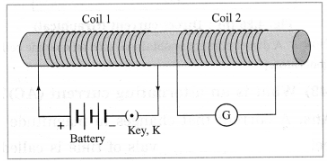
Take two coils of about 50 turns. Insert them over a nonconducting cylindrical roll as shown in Figure.
Image

(A thick paper roll can be used.) Connect coil 1 to a battery with a plug key K. Connect coil 2 to a galvanometer G. (1) Plug the key and observe the deflection in the galvanometer. (2) Unplug the key and again observe the deflection.
Note your observations. What conclusions do you draw from these observations?

An organism A which cannot move from one place to another, makes a simple food B from the substances C and D available in the environment. This food is made in the presence of a green coloured substance E present in organs F in the presence of light energy in a process called G. Some of the simple food B also gets converted into a complex food H for storage purposes. The food H gives a blue-black colour with dilute iodine solution.
  1. What is (i) organism A, (ii) food B and (iii) food H?
  2. What are C and D?
  3. Name (i) green coloured substance E, and (ii) organ F.
  4. What is the process G?
What are the three R’s to save the environment? Explain with one example of each.
A forest ecosystem having a lot of green plants has some foxes, lions and rabbits in it.
  1. Write a food chain comprising all the four organisms mentioned above.
  2. Name (i) one herbivore, and (ii) two carnivores, in this food chain.
  3. Name the link which is a predator as well as a prey.
  4. Name (i) second trophic level, and (ii) third trophic level.
  5. Which link of this food chain can feed on second trophic level as well as third trophic level, independently?
  6. If the sun provides 1000 J of energy to the plants, then how much energy will be transferred to fox through the food chain.