Question
Dispersion of light.

Answer

The process of separation of light into its component colours while passing through a medium is called dispersion of light. When white light passes through a glass prism, it spreads out into a band of different colours (components) called the spectrum of light. The colours in the spectrum of white light are violet, indigo, blue, green, yellow, orange and red.

Formation of a rainbow is an example of dispersion of light in nature. In this case, raindrops are responsible for dispersion of sunlight.

Dispersion takes place because the refractive index of a material such as glass or water, is different for different colours. It is maximum for violet colour and minimum for red colour. Hence, in the spectrum of white light (sunlight) obtained with a prism, violet light is deviated the most while red light is deviated the least. The deviation of light corresponding to other colours lies in between.

Need a full question paper?

Generate a complete, print-ready paper with questions like this in minutes — across 16+ boards, with answer keys.
Start Generating Free

Similar questions

The human males use a device X made of a very thin rubber sheet as a covering on the male organ to prevent pregnancy. This device traps the gametes Y in it. In order to prevent pregnancy, the human females use a device Z which is a circle of rubber with a metal spring around it. The device Z is put inside the vagina to cover the cervix. It stops Y from going into the uterus.
  1. What is device X?
  2. What are Y?
  3. Name the device Z.
  4. What is the general name of these methods of birth control (or preventing pregnancy)?
  5. The use of which contraceptive device, X or Z, can protect the persons from sexually transmitted diseases?
Differentiate between myopia and hypermetropia. What type of spectacles should be worn by a person having the defects of myopia as well as hypermetropia? How does it help?
A gland W is located just below the stomach in the human body. The gland W secretes a hormone X. The deficiency of hormone X in the body causes a disease Y in which the blood sugar level of a person rises too much. The person having high blood sugar is called Z.
  1. Name (i) gland W, and (ii) hormone X.
  2. What is the function of hormone X?
  3. Name (i) disease Y, and (ii) person Z.
  4. What advice would you like to give to a person who is suffering from disease Y due to faulty life - style?
What are the various advantages of water stored in ground?
Describe the structure of graphite with the help of a labelled diagram.
Explain Bayer’s process.
Generally the ionic compounds have high melting points.
 Give names of three functional groups containing three different heteroatoms. Write name and structural formula of one example each.
An organic compound A having the molecular formula $C_3H_8O$ is a liquid at room temperature. The organic liquid $A$ reacts with sodium metal to evolve a gas which burns causing a little explosion. When the organic liquid A heated with concentrated sulphuric acid at $170^\circ C,$ it forms a compound $B$ which decolourizes bromine water. The compound $B$ adds on one molecule of hydrogen in the presence of Ni as catalyst to forms compound $C$ which gives substitution reactions with chlorine.
  1. What is compound $A?$
  2. What is compound $B?$
  3. What type of reaction occurs when $A$ is converted into $B?$
  4. What is compound $C?$
  5. What type of reaction takes place when $B$ is converted into $C?$
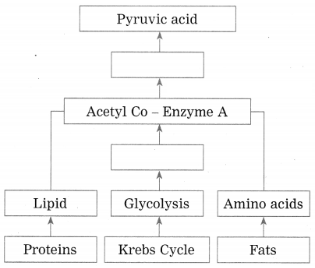
How energy is formed from oxidation of carbohydrates, fats and proteins?
Correct the dagram below.
Image