Question
Write in detail the important results related to conductive electrostatics.

Answer

SELF

Need a full question paper?

Generate a complete, print-ready paper with questions like this in minutes — across 16+ boards, with answer keys.
Start Generating Free

Similar questions

Repeat the previous problem if the particle C is displaced through a distance x along the line AB.
The force exerted by the floor of an elevator on the foot of a person standing there is more than the weight of the person if the elevator is:
  1. Going up and slowing down.
  2. Going up and speeding up.
  3. Going down and slowing down.
  4. Going down and speeding up.
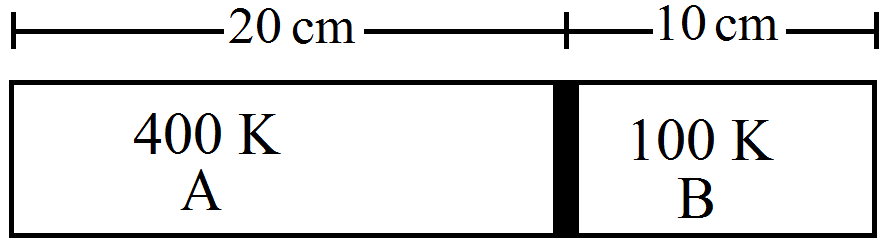
Figure. shows a cylindrical tube of length 30cm which is partitioned by a tight-fitting separator. The separator is very weakly conducting and can freely slide along the tube. Ideal gases are filled in the two parts of the vessel. In the beginning, the temperatures in the parts A and B are 400K and 100K respectively. The separator slides to a momentary equilibrium position shown in the figure. Find the final equilibrium position of the separator, reached after a long time.

Write Einstein's photoelectric equation and explain any two observations related to the photoelectric effect.
Suppose that the radius of cross-section of the wire used in the previous problem is r. Find the increase in the radius of the loop if the magnetic field is switched off. Young's modulus of the material of the wire is Y.
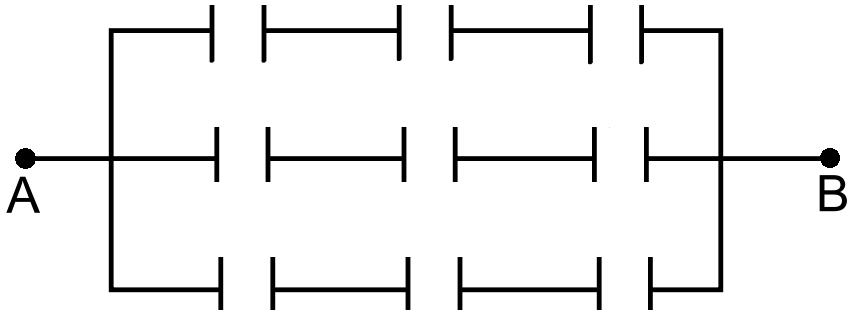
Each of the capacitors shown in figure has a capacitance of $2\mu\text{F}.$ Find the equivalent capacitance of the assembly between the points A and B. Suppose, a battery of emf 60 volts is connected between A and B. Find the potential difference appearing on the individual capacitors.

What are coherent sources of light? Why are coherent sources required to produce interference of light? Give an example of interference in everyday life.
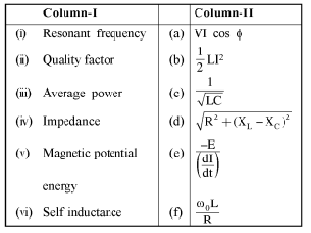
Match the following
Image
A circular coil of 200 turns has a radius of 10cm and carries a current of 2.0A.
  1. Find the magnitude of the magnetic field. B at the centre of the coil.
  2. At what distance from the centre along the axis of the coil will the field B drop to half its value at the centre? $\big(\sqrt[3]{4}=1.5874\ ...\big)$
A coil of radius 10cm and resistance $40\Omega$ has 1000 turns. It is placed with its plane vertical and its axis parallel to the magnetic meridian. The coil is connected to a galvanometer and is rotated about the vertical dimeter through an angle of 180°. Find the charge which flows through the galvanometer if the horizontal component of the earth's magnetic field is $\text{B}_{\text{H}}=3.0\times10^{-5}\text{T}.$