Question
Write IUPAC names of the following coordination compounds:
  1. $K_3[Fe(C_2O_4)_3]$
  2. $K_2[PdCl_4]$

Answer

  1. Potassium trioxalatoferrate(III).
  2. Potassium tetrachloridopalladate(II).

Need a full question paper?

Generate a complete, print-ready paper with questions like this in minutes — across 16+ boards, with answer keys.
Start Generating Free

Similar questions

Neeta was experimenting in the lab to study the chemical reactivity of alcohols. She carried out a dehydration reaction of propanol at $140^\circ C$ to $180^\circ C.$ Different products were obtained at these two temperatures.
$a.$ Identify the major product formed at $140^\circ C$ and the substitution mechanism followed in this case.
$b.$ Identify the major product formed at $180^\circ C$ and the substitution mechanism followed in this case.
How the following conversions can be carried out?
i. 2-Bromopropane to 1-bromopropane
ii. Chloroethane to butane
iii. Benzene to diphenyl
Explain the following terms giving a suitable example in each case:
  1. Ambident ligand.
  2. Denticity of a ligand.
  3. Crystal field splitting in an octahedral field.
Explain the nucleophilic substitution reaction of aldehydes and ketones with Grignard reagent (R'-Mg-X) with chemical equations ### Write only chemical reactions to obtain 1º, 2º and 3º alcohols from aldehyde andketone compounds.
Answer the following questions:
In the titration of $FeSO_4$ with $KMnO_4$ in the acidic medium, why is dil. $H_2SO_4$ used instead of dil. $HCl$?
What is stereochemistry ? Explain plane polarised light, optical activity and optical isomers.
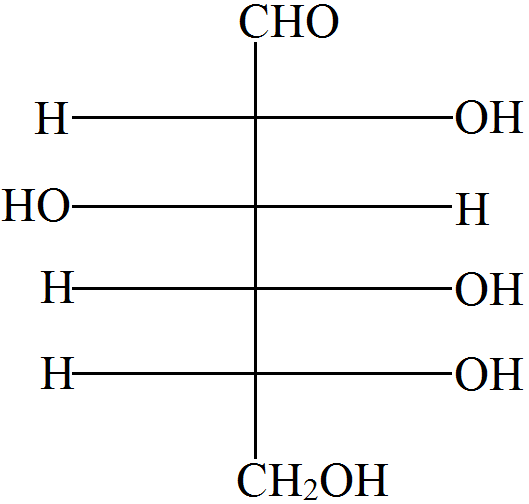
The Fischer projection of D-Glucose is given alongside.
Give the Fischer projection of L-Glucose.
Discuss chemical properties of lanthanoids.
Write chemical reactions to show that open structure of D-glucose contains the following:
  1. Straight chain.
  2. Five alcohol groups.
  3. Aldehyde as carbonyl group.
The cell in which the following reaction occurs:
$2\text{Fe}^{3+}(\text{aq})+2\text{I}^-(\text{aq})\rightarrow2\text{Fe}^{2+}(\text{aq})+\text{I}_2(\text{s})\ \text{has}\ \text{E}^\circ_{\text{cell}}$ = 0.236 V at 298 K. Calculate the standard Gibbs energy and the equilibrium constant of the cell reaction.