Question
Write Kirchhoff's rules for electric circuit.

Answer

First law (junction rule) : Algebraic sum of all the currents meeting at a junction in any closed circuit is zero. which means $\Sigma I =0$
Second law (loop rule): According to this law, the algebraic sum of the products of currents and resistances of any closed loop of any electric circuit is equal to the algebraic sum of electromotive forces working in that loop.
i.e.,$\Sigma E =\Sigma V =\Sigma IR$

Need a full question paper?

Generate a complete, print-ready paper with questions like this in minutes — across 16+ boards, with answer keys.
Start Generating Free

Similar questions

A cell of emf ‘E’ and internal resistance ‘r’ is connected across a variable resistor ‘R’. Plot a graph showing the variation of terminal potential ‘V’ with resistance R. Predict from the graph the condition under which ‘V’ becomes equal to ‘E’.
The density of water at $4^\circ C$ is supposed to be $1000\ kg m^3.$ Is it same at sea level and at high altitude?
It is proposed to move a particle in simple harmonic motion on a rough horizontal surface by applying an external force along the line of motion. Sketch the graph of the applied force against the position of the particle. Note that the applied force has two values for a given position depending on whether the particle is moving in positive or negative direction.
The radii of curvature of the faces of a double convex lens are 10 cm and 15 cm. If focal length of the lens is 12 cm, find the refractive index of the material of the lens.
The gravitational field in a region is given by $\overrightarrow{\text{E}}=(5\text{N/kg})\overrightarrow{\text{i}}+(12\text{N/kg})\overrightarrow{\text{j}}.$
  1. Find the magnitude of the gravitational force acting on a particle of mass 2kg placed at the origin.
  2. Find the potential at the points (12m, 0) and (0, 5m) if the potential at the origin is taken to be zero.
  3. Find the change in gravitational potential energy if a particle of mass 2kg is taken from the origin to the point (12m, 5m).
  4. Find the change in potential energy if the particle is taken from (12m, 0) to (0, 5m).
Answer the following question: As you have learnt in the text, the principle of linear superposition of wave displacement is basic to understanding intensity distributions in diffraction and interference patterns. What is the justification of this principle?
Provide the comparison (analogy) between Electro Statics and Magnetism.
Two satellites going in equatorial plane have almost same radii. As seen from the earth one moves from east to west and the other from west to east. Will they have the same time period as seen from the earth? If not, which one will have less time period?
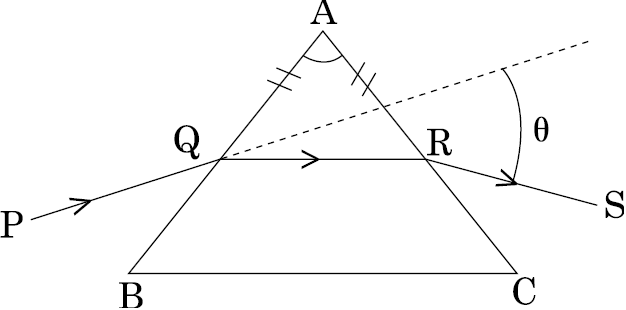
A ray $\text{PQ}$ incident on the refracting face $\text{BA}$ is refracted in the prism $\text{BAC}$ as shown in the figure and emerges from the other refracting face $\text{AC}$ as $\text{RS}$ such that $\text{AQ = AR}$. If the angle of prism $\text{A} = 60^\circ$ and refractive index of material of prism is$\sqrt{3}$, calculate angle $\theta.$
 
The eyepiece of an astronomical telescope has a focal length of $10\ cm.$ The telescope is focused for normal vision of distant objects when the tube length is $1.0m.$ Find the focal length of the objective and the magnifying power of the telescope.