Question
Write note on Hydrogen Oxygen fuel cell.

Answer

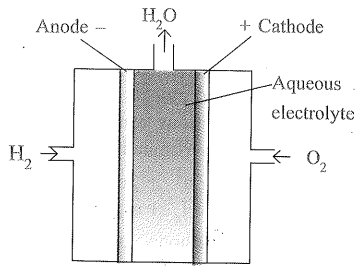
→ One of the most successful fuel cells uses the reaction of hydrogen with oxygen to form water
Image
→ In the cell, hydrogen and oxygen are bubbled through porous carbon electrodes into concentrated aqueous sodium hydroxide solution.
→ Catalysts like finely divided platinum or palladium metal are incorporated into the electrodes for increasing the rate of electrode reactions.
→ The electrode reactions are given below :
Cathode : $O _2(g)+2 H _2 O (l)+4 e ^{-} \rightarrow 4 OH ^{-}( aq )$
Anode : $2 H _2(g)+4 OH ^{-}( aq ) \rightarrow 4 H _2 O ( l )+4 e ^{-}$
Net reactions : $2 H _2(g)+ O _2(g) \rightarrow 2 H _2 O (l)$

Need a full question paper?

Generate a complete, print-ready paper with questions like this in minutes — across 16+ boards, with answer keys.

Start Generating Free

Similar questions

On what basis can you say that scandium $(Z = 21)$ is a transition element but zinc $(Z = 30)$ is not?
  1. Write the $\text{IUPAC}$ name of the complex $\ce{[Cr(NH_3)_4 Cl_2]Cl}.$
  2. What type of isomerism is exhibited by the complex $\ce{[Co(en)_3]^{3+}}$?
$($en $=$ ethane $-1,2-$ diamine$)$
  1. Why is $\ce{[NiCl_4]^{2–}}$ paramagnetic but $\ce{[Ni(CO)_4]}$ is diamagnetic?
$($At. nos.: $Cr= 24, Co=27, Ni= 28)$
When a chromite ore (A) is fused with sodium carbonate in free excess of air and the product is dissolved in water, a yellow solution of compound (B) is obtained. After treatment of this yellow solution with sulphuric acid,compound (C) can be crystallised from the solution. When compound (C) is treated with KCl, orange crystals of compound (D) crystallise out. Identify A to D and also explain the reactions.
(i) Give the structure of haloalkane having five carbon by which optical isomerism is shown.
(ii) Which type of isomerism is present in 1-chloro butane and 1-chloro-2-methyl propane.
(iii) Write the position isomers of the compound having molecular formula $C _4 H _9 Cl$, which have straight chain.
Calculate e.m.f of the following cell at $298 K:$
$2Cr(s)+3Fe^{2+}(0.1M) \rightarrow 2Cr^{3+}(0.01M)+3Fe(s)$
Given: $E^\circ (Cr^{3+}|Cr)= –0.74 V E^\circ (Fe^{2+}|Fe) = –0.44 V$
How would you account for the following? 
  1. Many of the transition elements are known to form interstitial compounds.
  2. The metallic radii of the third (5d) series of transition metals are virtually the same as those of the corresponding group members of the second (4d) series.
  3. Lanthanoids form primarily +3 ions, while the actinoids usually have higher oxidation states in their compounds, +4 or even +6 being typical.
  1. The cell in which the following reaction occurs$:$
  1. $\ce{2 Fe^{3+} (aq) + 2 I^- (aq) \longrightarrow 2 Fe^{2+}(aq) + I_2(s)}$
    has $\text{E}^0_{\text{cell}} = 0·236 V$ at $298 K.$ Calculate the standard Gibbs energy of the cell reaction. $($Given $: 1 F = 96,500 \ce{C mol^{-1})}$
  2. How many electrons flow through a metallic wire if a current of $0.5 A$ is passed for $2$ hours? $($Given $: 1 F = 96,500 \ce{C mol^{-1})}$
The Fischer projection of D-Glucose is given alongside.
What happens when L-Glucose is treated with Tollens’ reagent?
What is spectrochemical series? Explain the difference between a weak field ligand and a strong field ligand.
For the complex $\ce{[Fe(en)_2Cl_2]Cl}, ($en $=$ ethylene diamine$),$ identify.
  1. The oxidation number of iron,
  2. The hybrid orbitals and the shape of the complex,
  3. The magnetic behaviour of the complex,
  4. The number of geometrical isomers,
  5. Whether there is an optical isomer also, And
  6. Name of the complex. $($At. no. of $Fe = 26).$
​​​​​