Question
Write note on lead storage cell.

Answer

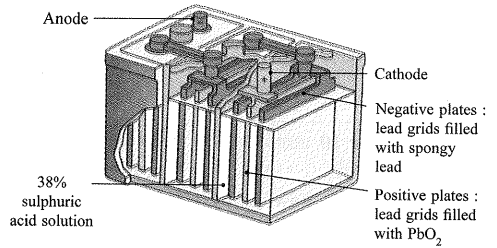
$\rightarrow $ In consists of a lead anode and a grid of lead packed with lead dioxide $\left( PbO _2\right)$ as cathode.
$\rightarrow $ A $38\%$ solution of sulphuric acid is used as an electrolyte.
Image
\rightarrow The cell reactions when the battery is in use are given below :
Anode : $Pb ( s )+ SO _4^{2-}( aq ) \rightarrow PbSO _4(s)+2 e ^{-}$
Cathode : $PbO _2(s)+ SO _4{ }^{2-}( aq )+4 H ^{+}( aq )+2 e ^{-}$
$\rightarrow PbSO _4(s)+2 H _2 O (l)$
$\rightarrow$ Overall cell reaction consisting of cathode and anode reactions is :
$Pb ( s )+ PbO _2(s)+2 H _2+ SO _4( aq ) \rightarrow 2 PbSO _4(s)$
$+2 H _2 O (l)$
$\rightarrow$ On charging the battery, the reaction is reversed and $PbSO _4(s)$ on the anode and cathode is converted into Pb and $PbO _2$, respectively.

Need a full question paper?

Generate a complete, print-ready paper with questions like this in minutes — across 16+ boards, with answer keys.
Start Generating Free

Similar questions

  1. Deficiency of which vitamin causes rickets?
  2. Give an example for each of fibrous protein and globular protein.
  3. write the product formed on reaction of D-glucose with Br, water.
How will you distinguish between the following pairs of compounds:
Benzyl chloride and chlorobenzene.
(A), (B) and (C) are three non-cyclic functional isomers of a carbonyl compound with molecular formula $C_4H_8O$. Isomers (A) and (C) give positive Tollens’ test whereas isomer (B) does not give Tollens’ test but gives positive Iodoform test. Isomers (A) and (B) on reduction with Zn(Hg)/ conc. HCl give the same product (D).
  1. Write the structures of (A), (B), (C) and (D).
  2. Out of (A), (B) and (C) isomers, which one is least reactive towards addition of HCN?
Write the reactions involved when D-glucose is treated with the following reagents:
i. $\mathrm{Br}_2$ water
ii. $\mathrm{H}_2 \mathrm{N}-\mathrm{OH}$
iii. $\left(\mathrm{CH}_3 \mathrm{CO}\right)_2 \mathrm{O}$
Write the structure of the alkene formed by dehydrohalogenation of 1-bromo-1-methylcyclohexane with alcoholic KOH.
State Kohlrausch's law of independent migration of ions. How can the degree of dissociation of acetic acid in a solution be calculated from its molar conductivity data?
Write the Nernst equation and calculate emf of the following cell at $298 K:$
$ Cr \left| Cr ^{3+}(0 \cdot 1 M ) \| Fe ^{2+}(0 \cdot 01 M )\right| Fe$
$\text { Given : } E _{ Cr ^{3+} / Cr }^{\ominus}=-0 \cdot 75 V$
$E _{ Fe ^{2+} / Fe }^{\ominus}=-0 \cdot 45 V (\log 10=1)$
Amino acids may be acidic, alkaline or neutral. How does this happen? What are essential and non-essential amino acids? Name one of each type.
Calculate emf of the following cell at $25^{\circ} \mathrm{C}$ :
$\mathrm{Fe}\left|\mathrm{Fe}^{2+}(0.001 \mathrm{M})\right|\left|\mathrm{H}^{+}(0.01 \mathrm{M})\right| \mathrm{H}_2(\mathrm{~g})(1$ bar $) \mid \mathrm{Pt}(\mathrm{s})$
$\mathrm{E}^{\circ}\left(\mathrm{Fe}^{2+} \mid \mathrm{Fe}\right)=-0.44 V \mathrm{E}^{\circ}\left(\mathrm{H}^{+} \mid \mathrm{H}_2\right)=0.00 \mathrm{~V}$
Short note on: Sucrose.